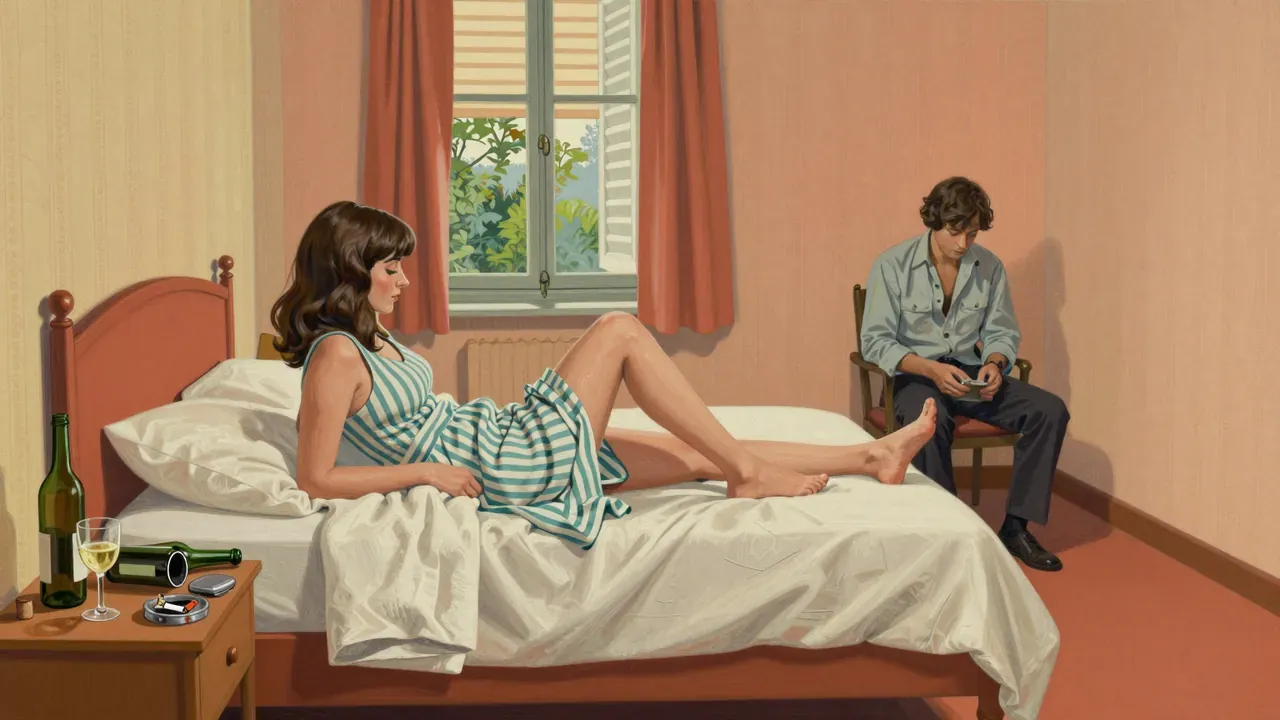
The look of it
Murmur of the Heart is a French coming-of-age film set in Dijon in 1954, written and directed by Louis Malle. It follows fourteen-year-old Laurent Chevalier as he navigates adolescence amid bourgeois family life, Catholic schooling, jazz obsession, and political awareness. The film attempts something precise: to treat taboo intimacy—not as transgression or trauma, but as an unforced, fleeting convergence of affection, vulnerability, and misrecognition between mother and son. Its ambition lies in tonal calibration: holding irony and tenderness in equilibrium, avoiding both moralism and titillation. It does not seek to explain Laurent’s behaviour through psychology or sociology, nor to frame Clara’s actions as symptomatic. Instead, it presents their relationship as one episode in a wider pattern of emotional improvisation—within a family that laughs easily, argues often, and rarely speaks plainly. The film’s semi-autobiographical framing is structural, not confessional: Malle borrows biographical texture—the heart murmur, the jazz records, the Dijon setting—but deliberately departs from his own history in its central event. Word count: 148
The shape of the story
The story unfolds with episodic lightness: Laurent’s theft of a Charlie Parker record, his initiation at a brothel, scarlet fever, the sanatorium trip, Bastille Day drinking, and the single night with Clara. Ricardo Aronovich’s cinematography favours soft focus and natural light, especially in interiors; hotel corridors and sunlit bedrooms feel lived-in rather than composed. Suzanne Baron’s editing avoids emphasis—scenes end before resolution, transitions are unmarked, and silence is left intact. Lea Massari’s Clara is warm, restless, and physically present; Benoît Ferreux’s Laurent watches more than he speaks, his face registering shifts in mood without explanation. Daniel Gélin’s Charles is all clipped efficiency, never cruel but consistently absent. The brothers Thomas and Marc operate as a unit of mischief, their energy contrasting Laurent’s inwardness. Jazz is woven into the fabric—not just as score, but as rhythm: pauses, repetitions, sudden shifts in key. There is no musical underscoring of emotion; music appears diegetically, or not at all. Word count: 152
The sound of laughter
What lands is the texture of daily life in mid-century French provincial bourgeoisie: the weight of school reports, the awkwardness of Catholic confession, the way adults speak past children while pretending to listen. The film’s humour arises from behavioural accuracy—the brothers’ mockery of authority, Laurent’s earnest anti-colonial arguments at dinner, Clara’s theatrical drunkenness—not from setup-punchline timing. The Bastille Day sequence works because it builds slowly: the heat, the cheap wine, the shared exhaustion, the lack of dialogue before the act itself. The final family laughter is earned not by catharsis but by recognition: this is how they deflect what cannot be named. Massari’s performance anchors the film’s emotional logic; her Clara is neither idealised nor punished, and her physical ease with her son feels less like seduction than like habit momentarily mistaken for choice. The film’s refusal to pathologise or romanticise the central event gives it durability—it remains unsettling not because it shocks, but because it refuses to settle into any familiar category of meaning. Word count: 156
What is left unsaid
What does not land is the film’s attempt to suggest Laurent’s political consciousness as anything more than decorative. His opposition to the First Indochina War is stated once, then dropped; it has no bearing on plot, character, or consequence. Similarly, the subplot involving Hélène and Daphne functions only as foil—neither girl is given interiority, and their rejection of Laurent reads less as agency than as narrative convenience. The brothel scene feels perfunctory, its purpose unclear beyond establishing Laurent’s loss of virginity as a clumsy, interrupted rite. Some performances falter under the film’s low-key approach: Daniel Gélin’s Charles remains opaque to the point of vacancy, and the elder brothers blur into caricature when they should feel like specific, irritating presences. The film’s lightness occasionally tips into evasiveness—moments that demand emotional consequence (Clara’s return from her lover, Laurent’s fever) are smoothed over rather than deepened. This is not indifference, but a stylistic choice that leaves certain relationships under-explored. Word count: 154
The air they breathe
The themes that matter are not incest or rebellion, but the instability of categories: adult and child, public and private, care and desire, comedy and discomfort. The film treats the body as ordinary—Laurent spies on his mother bathing, but the shot holds no voyeuristic charge; it is simply observation, neutral and uninflected. Class operates quietly: the Chevaliers’ comfort is assumed, not flaunted, and their privilege manifests in access to doctors, sanatoria, and private schools—not in wealth displays. Language matters too: Clara’s Italian accent marks her as other within the family, yet she is also its emotional centre. Time is another theme—the film takes place in 1954, but feels suspended between post-war austerity and pre-1968 restlessness, a moment when old hierarchies still hold but no longer convince. The heart murmur is literal and metaphorical: a minor physiological flaw that becomes the occasion for prolonged closeness, attention, and care. None of these ideas are argued; they accumulate through repetition, gesture, and omission. Word count: 150
Who it is for
This film is for viewers who value tonal precision over exposition, who find emotional truth in understatement, and who do not require moral framing to sit with ambiguity. It suits those familiar with French New Wave pacing and comfortable with long silences, unexplained glances, and endings that resolve nothing. It is not for viewers who need clear cause-and-effect storytelling, psychological motivation, or thematic closure—those expecting a ‘message’ about family or sexuality will leave unsatisfied. Some will object to its treatment of incest as non-traumatic, particularly viewers for whom such subject matter demands explicit ethical reckoning. Others may find its period specificity alienating: the absence of modern reference points, the quiet domesticity, the lack of digital or urban friction. A viewer who values narrative propulsion over atmosphere, or who requires characters to articulate their feelings, will likely disengage early. Word count: 152
The length of the evening
Yes, it is worth your evening—if you approach it as a study in mood and comportment rather than plot or revelation. Its 120 minutes pass without strain because its rhythms are those of real time: waiting, overhearing, half-understanding. It rewards attention to detail—the way Clara adjusts her stockings, how Laurent folds his school report before handing it to his father, the sound of rain on the hotel roof during the Bastille Day scene. Those who dislike films where little ‘happens’ may find it inert; those who expect the central event to dominate the film’s emotional architecture will be disappointed. But its endurance lies in its restraint: it does not explain, justify, or condemn. It simply shows a family breathing, stumbling, laughing—and that is enough. Word count: 150