The shape of silence
La Cérémonie is a French psychological drama adapted from Ruth Rendell’s 1977 novel A Judgment in Stone, directed and co-written by Claude Chabrol in 1995. It sets out to examine the quiet violence of class estrangement through a tightly controlled, morally unmoored narrative. Rather than dramatising revolt as spectacle or catharsis, it traces how literacy, etiquette, surveillance and silence function as instruments of exclusion — and how those instruments can be turned back on their wielders. Chabrol avoids exposition, symbolism or commentary; he presents Sophie Bonhomme’s illiteracy not as deficit but as a structural condition, and Jeanne Marchal’s alienation not as pathology but as logical consequence. The film’s ambition lies in its refusal to assign motive or meaning to the killings beyond what the characters themselves articulate — or fail to articulate. It treats the Lelièvre household not as a home but as a site of accumulated cultural debt, and the ceremony of its destruction not as rebellion but as punctuation: the final full stop in a sentence no one taught Sophie how to read. (158 words)
The rhythm of restraint
The story unfolds with procedural exactness: Sophie’s hiring, her concealment of illiteracy, the slow convergence with Jeanne, the exposure, dismissal and final incursion. Bernard Zitzermann’s cinematography holds frames at medium distance, favouring static compositions and shallow focus that flatten hierarchy — no character dominates the frame, even when holding a gun. Monique Fardoulis edits with surgical restraint: cuts land on glances, not reactions; silences are held past comfort. Isabelle Huppert and Sandrine Bonnaire perform without emphasis — their voices rarely rise, their gestures rarely expand — yet every pause and glance accrues weight. Jean-Pierre Cassel and Jacqueline Bisset play the Lelièvres with unselfconscious ease, their privilege rendered not through caricature but through unexamined habit: the way Catherine adjusts her scarf before answering the door, or Georges reaches for his shotgun without looking at it. Matthieu Chabrol’s score is sparse, mostly absent, returning only in the final minutes as low strings swell beneath the portable stereo’s playback — not scoring emotion, but marking the moment evidence becomes audible. (159 words)
The weight of what comes after
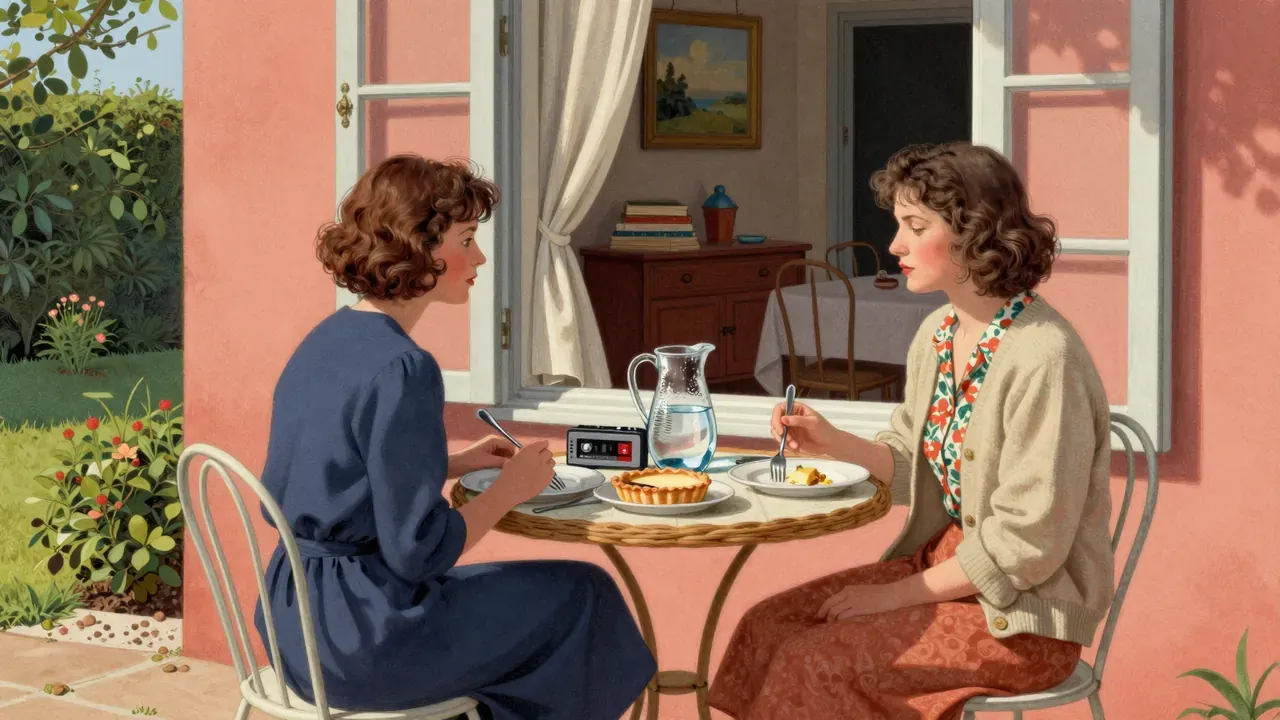
What lands is the cumulative pressure of misrecognition. Sophie’s illiteracy is never pitied or explained; it is simply the condition around which all other behaviour organises itself — Mélinda’s condescension, Catherine’s vague concern, Jeanne’s immediate, wordless solidarity. The film’s most effective sequence is not the massacre but the birthday lunch: Sophie and Jeanne eating in a sunlit garden while Don Giovanni plays faintly in the background, their conversation about fire and blame delivered with the same flat tone as a grocery list. That tonal consistency — the refusal to heighten — makes the violence feel less like rupture and more like inevitability. The postmistress’s ostracism, the priest’s casual cruelty, the Lelièvres’ assumption that Sophie’s glasses are real — none of these register as plot points but as atmospheric givens, like humidity or light quality. Even the final image — Sophie walking past flashing blue lights, unseen — works because it follows logically from every prior choice: she has spent the film moving unseen, and the film honours that invisibility to the last frame. (156 words)
The ghost in the frame
What does not land is the attempt to anchor the film’s moral ambiguity in the Papin sisters reference. The encyclopedia context notes the echo, but the film itself makes no explicit invocation — no photograph, no newsreel, no line of dialogue — and the absence leaves the allusion inert, decorative rather than structural. Similarly, the subplot involving Gilles’s sullen detachment and Jérémie’s off-screen presence adds texture but no traction; they remain placeholders, not participants. The priest’s reprimand at the church drive feels abruptly inserted, lacking the slow-burn resentment built elsewhere — his later appearance as driver of the fatal car reads as contrivance, not consequence. There is also a slight imbalance in dramatic weight: Jeanne’s acquittal over her daughter’s death is stated but never dramatised, leaving her volatility under-motivated next to Sophie’s grounded, practical rage. The film’s rigour means it refuses to explain, but here it mistakes omission for implication. Without a single scene showing Jeanne’s trial, grief or isolation beyond her mail-vandalism, her arc leans on audience familiarity with the archetype, not on what the film provides. (159 words)
The grammar of belonging
The themes that matter are literacy as gatekeeping, silence as complicity, and domestic space as archive. Chabrol treats the Lelièvre manor not as setting but as repository: every book unread by Sophie, every art catalogue Catherine flips through, every classical recording played without comment, functions as evidence of inherited access — and inherited exclusion. Illiteracy is never framed as personal failure but as systemic erasure, made visible only when Mélinda puts on Sophie’s fake glasses and sees the world as Sophie must: blurred, illegible, dependent on others’ interpretation. Class operates not through wealth display but through micro-rituals — the way Catherine corrects Sophie’s posture when serving coffee, or how Jeanne knows exactly which envelope to slit open first. The film’s Marxism is structural, not rhetorical: it shows how capital reproduces itself not just in money but in grammar, pronunciation, timing, eye contact. Even the title — La Cérémonie — refers not to celebration but to procedure: the ceremony of hiring, of dismissal, of murder, of evidence playback. Each is performed with the same detached precision, as if all are equally formal, equally inevitable. (157 words)
The terms of attention
This film is for viewers who value narrative economy over exposition, moral unease over resolution, and performance as accumulation rather than declaration. It suits those accustomed to Chabrol’s late style — films where tension lives in duration, not dialogue — and those familiar with French literary realism’s treatment of class as atmosphere. It is not for viewers needing psychological backstory, causal clarity or emotional release; the film offers none of these, and resists them as narrative indulgences. Those who expect the thriller genre to deliver suspense through pacing or the crime genre to offer procedural logic will find its stillness frustrating. Some critics have called it ‘cold’, but that misreads its method: it is not indifferent — it is attentive to a fault, refusing to interpret what it observes. A viewer who needs the film to tell them how to feel about Sophie or Jeanne will leave unsettled not by ambiguity but by the film’s refusal to supply the very framework required to generate that feeling. That refusal is deliberate, and central to its purpose. (158 words)
The cost of coherence
Yes, it is worth your evening — provided you watch it as Chabrol made it: without expectation of explanation, without demand for catharsis, and with willingness to sit inside its silences. Its 111 minutes pass with the weight of something inevitable, not urgent; its power lies in how little it insists, how much it implies. It rewards attention to gesture, to framing, to what is withheld — not what is revealed. Those who approach it as a puzzle to be solved, or a statement to be endorsed, will find it withholding. But those who accept it as a precise, unsentimental study of how inequality settles into bone and breath will find it unnervingly resonant. It is not ‘enjoyable’ in any conventional sense, but it is rigorously coherent, formally assured and morally unflinching. Its value is not in what it says about class, but in how thoroughly it enacts class — in every cut, every glance, every unspoken rule. To miss that is to miss the film entirely. (159 words)