The look of it
The Red Balloon is a 34-minute French fantasy film, made in Paris in 1956, that tells almost no story in the conventional sense. It does not aim to explain, persuade or develop character over time; instead, it sustains a single visual and emotional proposition: that a child’s relationship with a red balloon can hold the weight of wonder, vulnerability and transcendence. Albert Lamorisse — writer, director, producer — treats the balloon not as a prop but as a silent, sentient presence, moving with intention and responding to mood. The film avoids dialogue, exposition and psychological realism. Its ambition is poetic rather than narrative: to compress the feeling of childhood innocence into a sequence of observed gestures, light conditions and spatial relationships. It works within strict formal limits — one location, one central child, one object — and uses those limits not as constraints but as generative conditions. The film’s silence is not absence; it is a deliberate narrowing of channel, so attention falls on texture, colour, rhythm and the physical grammar of pursuit and release. Wordlessness here is method, not compromise.
The child in the frame
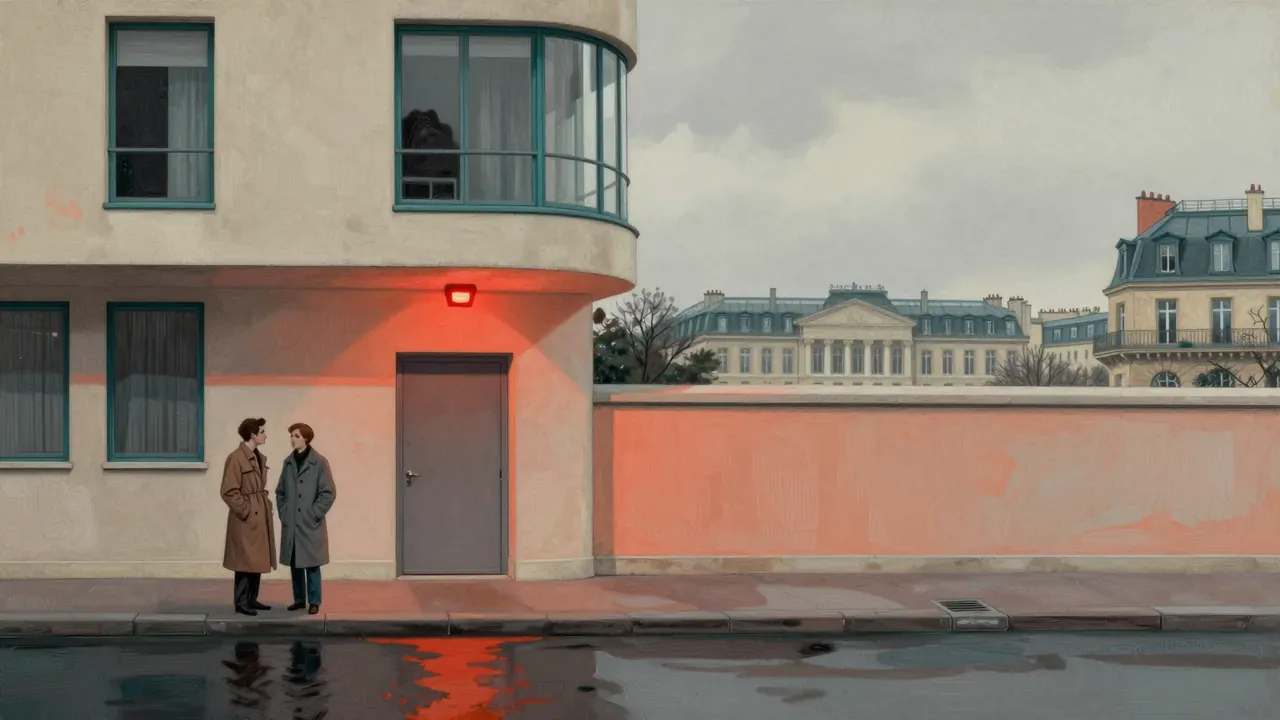
The film unfolds across Ménilmontant in late-1950s Paris, using real streets, staircases, bakeries and courtyards as its sole set. Pascal Lamorisse, aged five, plays himself — not performing but existing, reacting, pausing, looking up. His movements are unchoreographed, his expressions unmodulated: he blinks when light catches his eye, frowns when confused, runs without flourish. Edmond Séchan’s cinematography keeps the frame steady and the focus shallow, letting the balloon dominate the centre while background architecture recedes into soft grey stone and weathered plaster. Maurice Le Roux’s score is sparse, melodic and unobtrusive — strings and harp sketching mood without dictating it. Pierre Gillette’s editing avoids cuts that signal meaning; transitions follow duration or movement, not logic. There are no close-ups of faces to cue emotion, no reaction shots to confirm interpretation. The balloon’s ‘agency’ emerges from timing and placement: it lingers just out of reach, drifts ahead at the right moment, floats still when everything else moves. This is not special-effects illusion but spatial choreography — a sustained act of visual trust between camera, child and object.
The texture of place
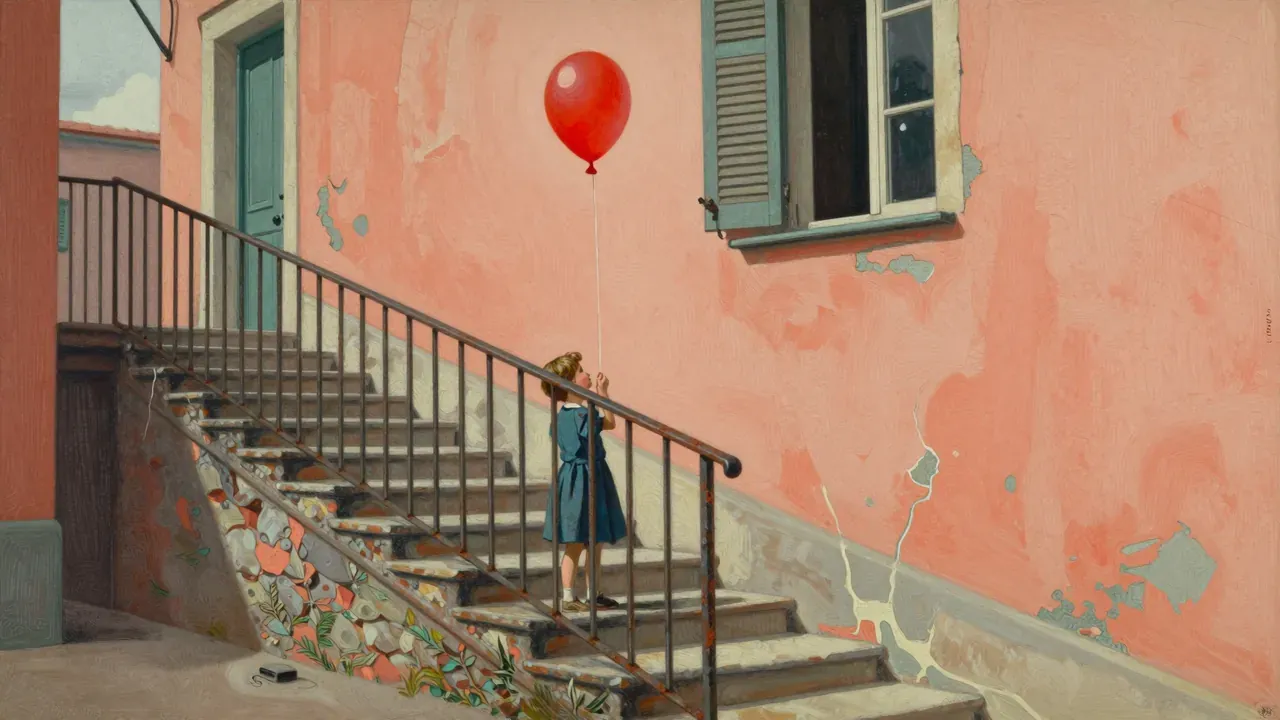
What lands most firmly is the film’s tactile fidelity to place and age. The cobblestones are uneven, the staircases steep and narrow, the walls damp and stained — none of it prettified. Pascal’s small hands grip the balloon string with the slight tremor of real exertion; his shoes scuff on stone, his coat flaps in wind that feels cold and real. The red balloon is never glossy or artificial in sheen — it catches light like rubberised silk, dimpling slightly under pressure, swaying with inertia. When children chase it through alleyways, their footsteps echo with distinct pitch and decay, varying by surface and distance. The film’s restraint makes moments of rupture land with quiet force: the balloon’s sudden descent after being struck, the slow deflation, the silence that follows. Even the cluster of balloons lifting Pascal skyward feels physically plausible — buoyant, unsteady, quiet. There is no triumphal music, no upward tilt of the camera; the ascent is level, calm, matter-of-fact. That refusal to underline emotion — to let the image carry the weight — is where the film earns its lasting resonance. It trusts the viewer to feel without instruction.
How the balloon behaves
What does not land is any attempt to read the film as social commentary or allegory without evidence in the frame. The grey palette and post-war setting do not automatically signify trauma or recovery; the film never shows rubble, rationing, soldiers or grief. Nor does it offer irony or critique of adult authority — the schoolmaster, beadle and mother are present but neutral, functional figures, not caricatures. Attempts to map Christian symbolism onto the final ascent rest on external interpretation, not cinematic construction: there is no cross-shaped framing, no liturgical gesture, no visual quotation of iconography. Similarly, claims about capitalism or class envy depend on reading motive into the boys’ actions, but the film gives them no dialogue, no facial expression beyond concentration or playfulness. Their aggression is physical, not ideological — they throw stones because the balloon floats, not because it represents capital. The film’s minimalism leaves room for projection, but it does not invite or support readings that require adding what is not shown. Where it stays literal — light, weight, movement, texture — it holds. Where it is asked to mean more than that, it recedes.
What the film measures
The themes that matter are those anchored in perception and scale: the way a child’s height alters the world’s proportions, how a single colour can dominate a monochrome field, how breath and wind become narrative agents. The film explores attention as a form of devotion — Pascal watches the balloon with the same stillness others reserve for prayer or study. It treats loneliness not as isolation but as a condition of heightened receptivity: he is often alone, but never cut off from the atmosphere, the light, the movement of air. Hope appears not as optimism but as persistence — the balloon returns, reappears, reattaches. The ending is not transcendence in the theological sense, but a shift in physical possibility: the boy rises because enough lift exists, not because he is chosen. The film’s moral universe is pre-ethical. It does not judge the boys who destroy the balloon; it records their action, then moves on. What endures is not innocence as purity, but as a mode of engagement — direct, unmediated, responsive to surfaces and forces. That sensibility is neither nostalgic nor naive. It is observational, precise, and rooted in the physics of a specific time and place.
What it refuses to do
This film is for viewers who value sustained attention over exposition, who find emotional weight in texture and duration rather than dialogue or plot turns. It suits those comfortable with silence as a medium, not a gap to be filled. It rewards patience, not expertise — no knowledge of French cinema or post-war history is required. It is not for viewers who need narrative propulsion, causal logic or psychological explanation. Those who rely on verbal cues to orient themselves emotionally may find the film withholding or opaque. Parents expecting a children’s entertainment will likely misread its pace and tone: it is not didactic, nor does it flatter childhood. Teachers using it in classrooms should know it resists summarisation — it cannot be reduced to ‘a lesson about kindness’. Anyone approaching it as allegory, parable or historical document will leave frustrated. Its power lies in its refusal to serve those functions. To watch it expecting metaphor is to miss its literal precision. To watch it expecting drama is to overlook its quiet insistence on presence.
Why thirty-four minutes is enough
Yes, it is worth your evening — not as diversion, but as recalibration. Thirty-four minutes is enough to reset the eye’s tolerance for slowness, to relearn how much meaning resides in a change of light or the angle of a shadow. It works best seen alone, in a room with controlled light, without interruption. Its value is not cumulative — it does not build to a climax — but iterative: each viewing reveals new details of brickwork, fabric, or the balloon’s subtle deformation under wind. Those who find it ‘too simple’ are mistaking economy for emptiness. Those who call it ‘timeless’ overlook how specifically it belongs to 1956 Paris — its locations, textures and silence are historical artefacts. If you require narrative resolution, thematic clarity or emotional signposting, this film will disappoint. But if you accept that a child, a balloon and a staircase can hold as much gravity as a war film or a courtroom drama, then it delivers fully. Its brevity is not limitation — it is discipline.