The look of it
The Life of Oharu is a historical drama in Japanese, released in 1952, adapted from Ihara Saikaku’s 1686 stories by Yoshikata Yoda and directed by Kenji Mizoguchi. It traces the life of a woman whose social standing collapses after a single transgression — eloping with a lower-ranking retainer — and never recovers, despite repeated efforts to re-enter respectable society. The film does not seek catharsis or redemption; it structures itself as an unbroken descent, framed by Oharu’s collapse in a temple and her final flight as a wandering nun. Its purpose is not to indict individuals but to expose how status, gender, and lineage operate as fixed, unforgiving systems: every reversal — banishment, sale, dismissal, expulsion — follows the same logic, with no appeal. Mizoguchi treats the Edo period not as backdrop but as architecture: its laws, rituals, and silences are the forces that shape, contain, and ultimately erase Oharu. The film’s ambition lies in its refusal to soften that mechanism — not as polemic, but as observation. (147 words)
The length of a fall
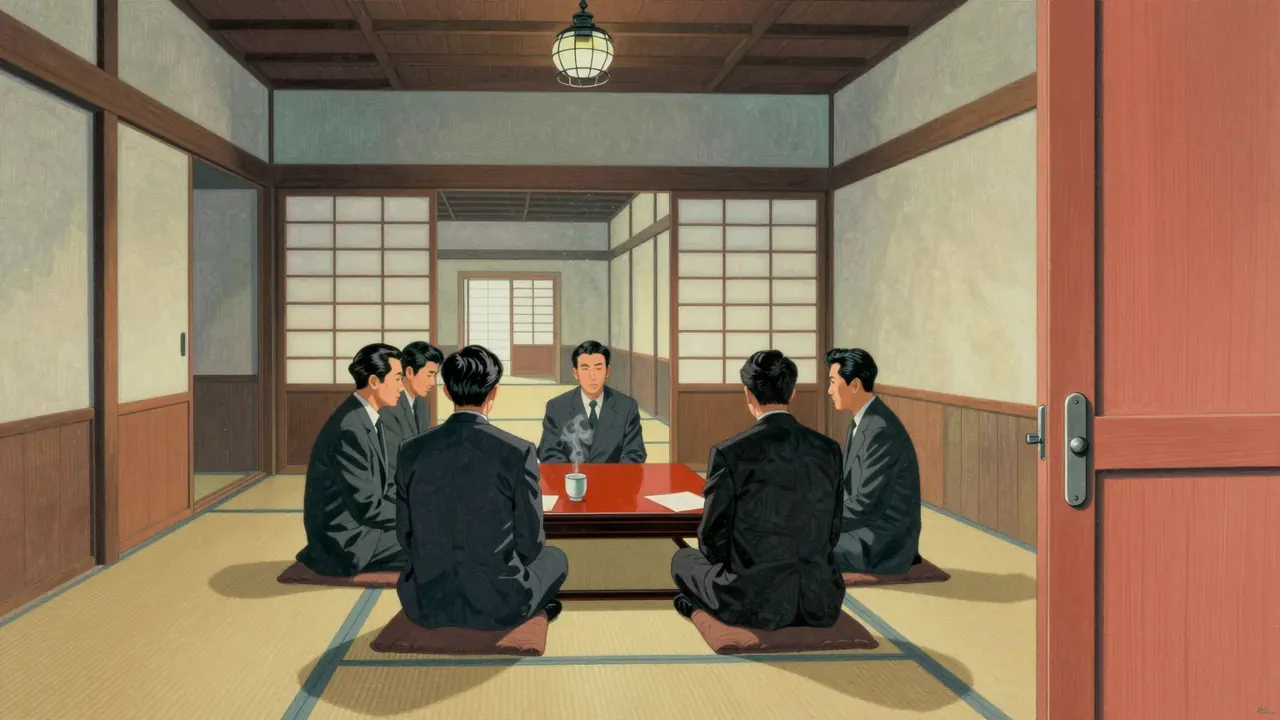
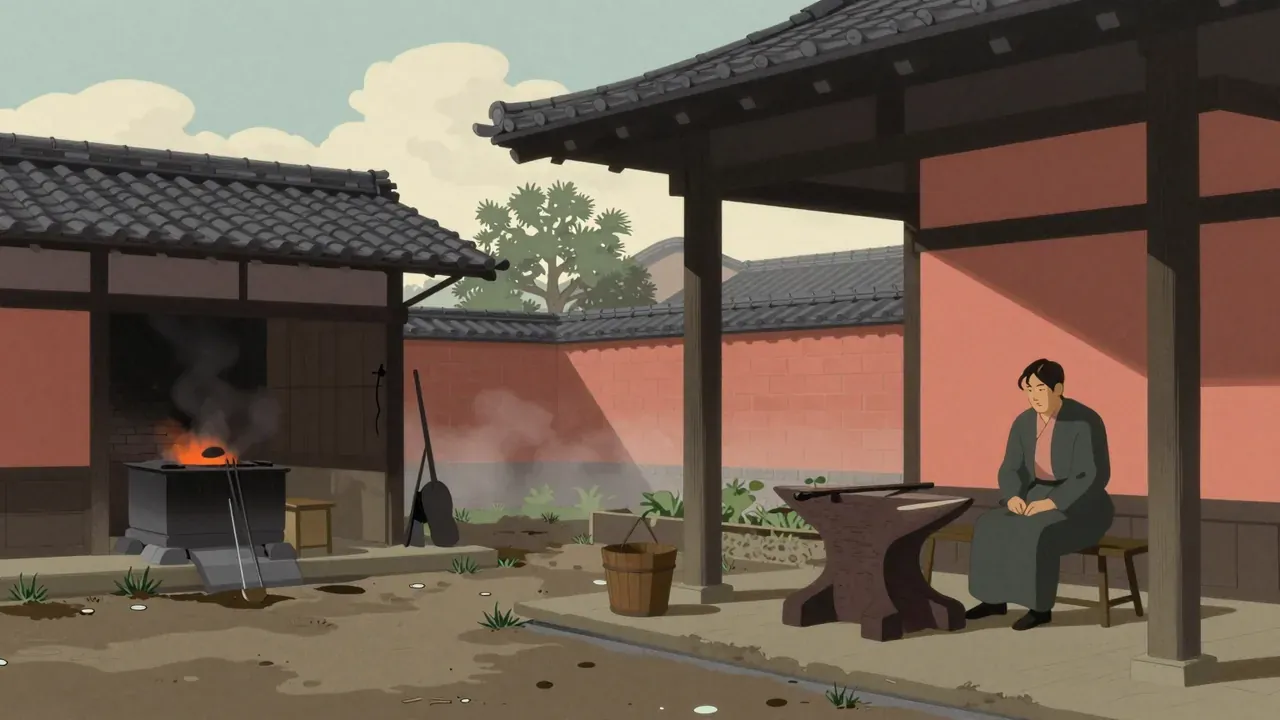
The story unfolds in long, deliberate sequences, each episode lasting several minutes without cuts, often filmed in deep focus and lateral tracking shots that follow Oharu through corridors, gardens, or brothel rooms. Kinuyo Tanaka carries every scene with physical stillness and minute shifts in posture and gaze; her performance avoids emphasis, letting humiliation accumulate in silence. Ichirō Saitō’s score uses koto and shakuhachi sparingly, often dropping out entirely during scenes of confrontation or exposure. Toshio Gotō’s editing sustains duration rather than rhythm — there are no flashbacks, only memory triggered by statues, and no voiceover to explain motive or feeling. The production design avoids ornament: interiors are sparse, costumes muted, light diffused. Even the temple sequence, which opens and closes the film, shows no grandeur — just stone, wood, and weathered faces. Mizoguchi’s direction does not dramatise injustice but presents its repetition: the same door closes on Oharu in six different houses, each time with the same quiet finality. (152 words)
The weight of stillness
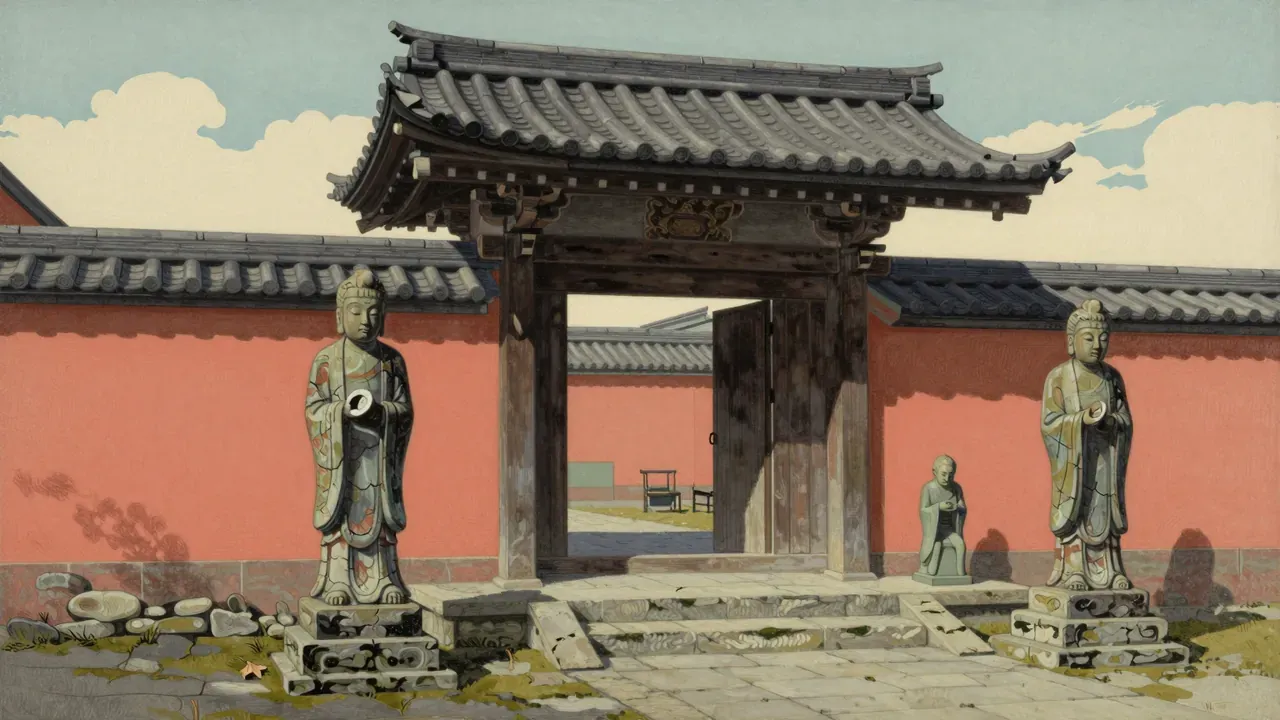
What lands is the cumulative weight of structural constraint. The film makes visible how class and gender operate not through villains but through routine acts: a father’s debt, a lord’s whim, a wife’s jealousy, a nun’s discretion — all function as cogs in the same machine. Tanaka’s restraint gives Oharu dignity without agency, and that paradox holds the film together. The Arhat statues at the beginning and end do not symbolise enlightenment but endurance: their cracked, asymmetrical faces mirror Oharu’s own unvarnished, unidealised presence. The final chase through the daimyō’s compound works because it is not a bid for reunion but for visibility — a single look, denied, then pursued, then lost in confusion. That moment lands not as tragedy but as inevitability made kinetic. The camera does not linger on her face in close-up; it watches her run, then pulls back to show her smallness within the compound walls. There is no music, no cut to reaction — just space, motion, and consequence. The film’s power lies in this refusal to elevate suffering into spectacle. (149 words)
The language of dismissal
What does not land is the episodic structure’s occasional flatness: some transitions between stations in Oharu’s life feel procedural rather than inevitable, particularly the shift from courtesan to lady-in-waiting to fan-maker’s wife. The character of Lady Matsudaira, though performed with precision by Hisako Yamane, remains schematic — her jealousy functions as plot device more than psychological reality. The rape scene in the temple is implied but under-dramatised; its gravity depends on prior knowledge of the source material or cultural context, not on what is shown or performed. Mifune’s Katsunosuke, though pivotal, appears in only one extended sequence; his execution feels abrupt, not because it lacks emotional force, but because the film’s commitment to Oharu’s perspective leaves little room for counterpoint or interiority in others. A viewer unfamiliar with Edo-period social codes may miss the precise inflection of each dismissal — why being sent home after bearing a son is worse than never being taken at all. The film assumes fluency in its world’s grammar. (150 words)
The shape of belief
The themes that matter are inheritance without legacy, labour without reward, and visibility without recognition. Oharu bears a daimyō’s heir but is erased from his lineage; she serves multiple households yet owns nothing; she is seen constantly — appraised, sold, exposed, rebuked — but never truly witnessed. The film treats shame not as personal failing but as social infrastructure: it is the glue that binds hierarchy, enforced not by law alone but by rumour, gesture, and withheld glance. Ageing is rendered without sentiment — wrinkles, stoop, and grey hair appear gradually, never commented upon, never aestheticised. Buddhism here is not solace but setting: temples offer shelter but no sanctuary, nuns enforce rules as strictly as samurai. The film’s deepest concern is with time as accumulation — not of wisdom or grace, but of discarded roles, each one narrowing the space in which Oharu may exist without stigma. Her final identity — wandering nun — is not transcendence but erasure made mobile. She begs not for alms but for permission to pass unseen. (148 words)
The edge of the compound
This film is for viewers who value sustained attention, formal discipline, and moral ambiguity over narrative resolution or emotional release. It suits those familiar with Japanese historical context or willing to sit with opacity — the film offers no glossary, no exposition, no moral framing. It is not for viewers who require clear antagonists, psychological explanation, or forward momentum in plot. Those who expect character arcs or redemptive turns will find it withholding. Some critics have called it ‘cold’; others, ‘devastatingly compassionate’. The difference lies in whether one reads Oharu’s passivity as resignation or resistance. A viewer who values agency above all may reject the film’s central premise — that systemic constraint can exhaust choice to the point where survival itself becomes the only act of will. That verdict would change if the film offered even one moment of collective defiance or institutional challenge — but it does not. (149 words)
The line of the road
Yes, it is worth your evening — but only if you accept its terms: no relief, no rupture, no reward beyond clarity. It asks for ninety minutes of unbroken attention and repays it with a vision of social mechanics laid bare. Its pace is deliberate, its tone uninflected, its ending neither hopeful nor despairing but factual: Oharu walks on. Viewers who prefer irony, satire, or stylistic flourish may find it austere; those who respond to quiet intensity and compositional rigour will find it exacting and unforgettable. The film’s endurance lies not in its sadness but in its precision — every frame confirms the same truth, without embellishment. To call it ‘heavy’ mistakes its method for its mood. It is not a burden to watch, but a calibration: it resets expectations of what drama can do when it refuses to flatter, explain, or console. (149 words)