The origin of it
3 Women is a psychological drama built from a dream, not a script. Robert Altman conceived it during a period of anxiety about his wife’s health, then shaped it into a treatment with Patricia Resnick — no screenplay was written until late in development. The film sets out to trace the fluidity and instability of identity through three women whose personalities bleed into one another across a sun-bleached California desert. It does not aim for narrative coherence but for psychic resonance: a slow, deliberate unmooring of selfhood, where names, roles, gestures and even biological functions shift without explanation. The setting is not backdrop but pressure chamber — arid, reflective, stripped of social texture, amplifying the characters’ internal vacuums. Altman treats the desert as a blank surface onto which desire, imitation and dread are projected. This is not realism; it is dramatised psychoanalytic topology, where the three women function less as individuals than as shifting positions within a single psyche. The film refuses exposition, causality or closure, holding its logic at arm’s length while insisting on its emotional weight. It asks the viewer to sit inside ambiguity, not resolve it.
The shape of it
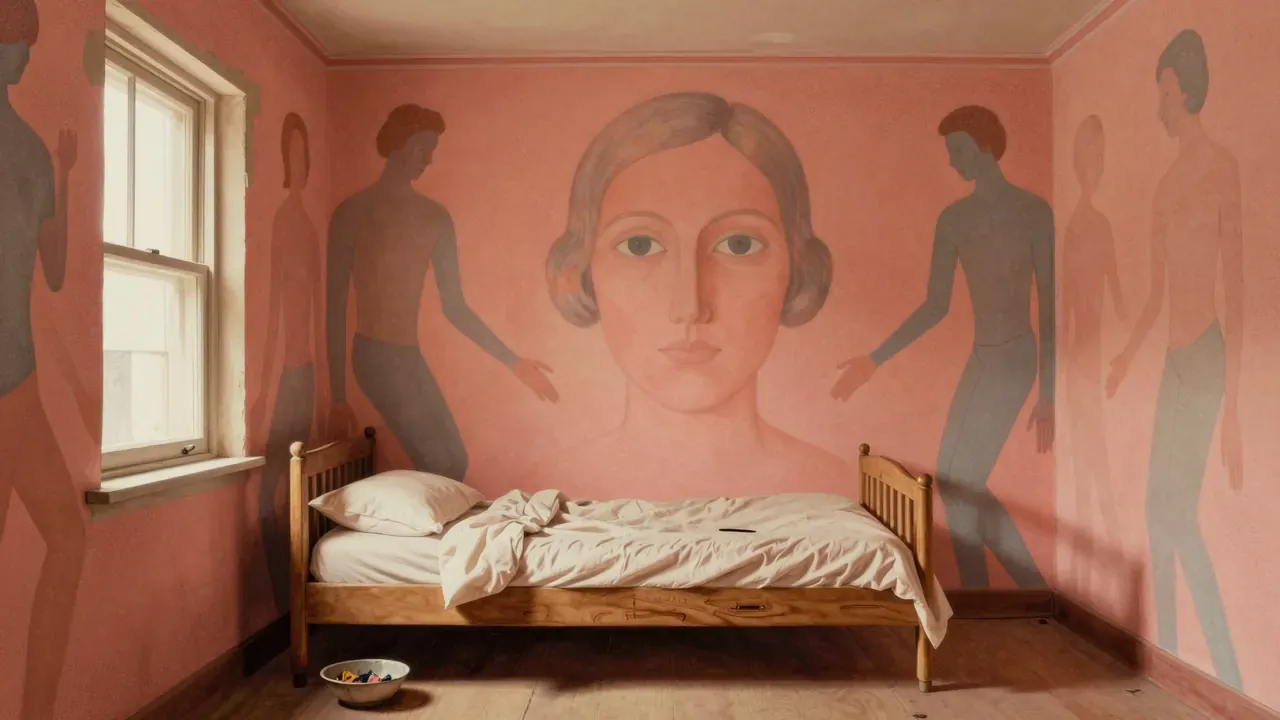
The story unfolds in two distinct movements: first, a brittle, deadpan social study of Millie’s performative confidence and Pinky’s anxious mimicry; second, a disorienting collapse of those boundaries after Pinky’s fall and coma. Shelley Duvall and Sissy Spacek improvise much of their dialogue — particularly Millie’s monologues and Pinky’s halting, earnest interjections — lending the early scenes an off-kilter authenticity. Janice Rule plays Willie with near-total silence, her presence registered through posture, gaze and the murals she paints — images that prefigure the film’s later transformations. Charles Rosher Jr. works with the desert light deliberately: exteriors are bleached and flat, interiors dim and grainy, reinforcing the sense of perceptual drift. Gerald Busby’s score is sparse, mostly piano and strings, often absent for minutes at a time. Altman’s direction avoids emphasis — he lets scenes breathe, holds shots longer than expected, allows silences to accumulate. There are no close-ups to signal revelation; meaning accrues in glances, repetitions, shifts in vocal rhythm. The editing by Dennis Hill is unhurried, sometimes elliptical, trusting the viewer to notice when a gesture or phrase recurs — and when it changes.
The look of it
What lands most firmly is the physicality of the performances — not just what the actors do, but how they occupy space. Duvall’s Millie is all nervous energy: her hands flutter, her voice rises and falls without warning, her laugh cuts short. Spacek’s Pinky moves like someone learning to walk — tentative, unbalanced, hyper-aware of surfaces. Rule’s Willie is stillness made visible: her pregnancy is never discussed, only felt in the way she leans against doorframes or stares at walls. The film’s visual grammar supports this: the repeated use of mirrored surfaces, reflections in swimming pools, double exposures and overlapping dialogue makes identity feel porous and unstable. The desert itself lands as a character — not symbolic in a literary sense, but materially oppressive and indifferent. Scenes at Dodge City, with its dusty shooting range and hollow echoes, generate real unease because they feel lived-in and slightly wrong. Even small details land: the way Millie’s recipes are handwritten in her notebook, or how Pinky’s diary entries grow increasingly fragmented. These are not flourishes but anchors — concrete things that make the abstraction legible.
The rhythm of it
What does not land is any attempt to read the film as allegory with fixed meanings. Assigning Pinky to ‘id’, Millie to ‘ego’ and Willie to ‘superego’ flattens the film’s ambiguity into dogma. Likewise, reading Edgar’s death as literal murder — or Willie’s stillbirth as symbolic castration — imposes a narrative violence the film resists. The film’s refusal to clarify motivation or consequence becomes frustrating if the viewer expects psychological realism or moral resolution. Some sequences — particularly the extended hospital visit and the final tavern scenes — risk monotony without the earlier tension between Millie and Pinky to propel them. The improvisational looseness, while effective in early scenes, occasionally blurs into vagueness: Pinky’s post-coma transformation lacks clear internal logic, and Millie’s regression feels more like a formal necessity than an emotional inevitability. The film assumes a tolerance for sustained uncertainty that not all viewers share — and offers no bridge for those who find its rhythms too slack or its symbolism too opaque.
The mind of it
The themes that matter are identity as imitation, the instability of the self under social pressure, and the desert as both void and womb. Altman said the film is about ‘empty vessels in an empty landscape’, and that phrase holds: none of the women possess stable interiority — they absorb, reflect and recombine each other. The film treats personality not as essence but as performance, learned and discarded like clothing. Pregnancy, infertility, motherhood and childlessness recur not as plot points but as psychic states — Willie’s silent gestation, Pinky’s sudden assumption of maternal authority, Millie’s infantilisation. The desert setting matters thematically: it strips away context, history, community — leaving only surface, repetition and mirroring. Dreams operate not as metaphors but as structural principles: the film itself behaves like a dream, where logic is associative, time is elastic and agency dissolves. The murals painted by Willie — abstract, unsettling, full of eyes and limbs — are not illustrations of theme but manifestations of it: the psyche made visible, unfinished, threatening to swallow its own maker.
The demand of it
This film is for viewers who value atmosphere over exposition, who find resonance in repetition and discomfort in clarity. It rewards patience, attention to gesture and comfort with unresolved endings. It is not for those who require causal storytelling, psychological consistency or moral framing — nor for anyone who finds slow-burn ambiguity indistinguishable from inertia. Those who disliked Persona or Bergman’s Hour of the Wolf may find similar terrain here, though Altman’s approach is flatter, drier, less mythic. A viewer expecting satire or social critique will be disappointed: the film’s irony is structural, not tonal. Someone seeking catharsis or character growth will leave unsatisfied. The film’s power depends entirely on accepting its terms — and those terms exclude narrative payoff. If you need to know why something happens, or who is ‘right’, this is not your film. But if you can sit with a woman staring at a wall for thirty seconds and feel the weight of that stare, then it is.
The weight of it
Yes, it is worth your evening — provided you watch it whole, undistracted, and accept its pace as part of its meaning. Its 124 minutes are not filler but duration made visible: time spent waiting, watching, imitating, forgetting. It repays rewatching not because it reveals hidden clues, but because its repetitions become sharper, its silences heavier. Anyone who values acting as embodied craft, or cinematography as environmental psychology, will find much here. Those who prefer tight plotting or emotional resolution will not. The film’s reputation rests on its strangeness, but its strength lies in its specificity — the exact shade of pink on Millie’s nails, the sound of gravel under tyres, the way light hits a swimming pool at dusk. That specificity makes the abstraction tangible. It is not a puzzle to solve but a state to inhabit — and inhabiting it, once, is enough to change how you see other films about women, about identity, about the places we call home.