The shape of her ambition
When a Woman Ascends the Stairs is a 1960 Japanese drama directed by Mikio Naruse, adapted from a novel by Fumiko Hayashi and scripted by Ryūzō Kikushima. It follows Keiko Yashiro, a widow in her late twenties working as a hostess in a Ginza bar, who seeks financial independence by opening her own establishment — not to escape work, but to honour her late husband’s memory while securing dignity in middle age. The film does not aim for catharsis or resolution; it observes how social constraint, gendered expectation and economic precarity shape daily choices without fanfare or moralising. Naruse treats Keiko’s ambitions as ordinary, not exceptional — her struggle is structural, not psychological. There are no villains, only overlapping pressures: debt, filial duty, sexual vulnerability, professional rivalry, and the quiet erosion of time. The film’s purpose is not to advocate but to register — to show how a woman moves through a world that offers her no clean exits, only stairs to climb, one step at a time. It refuses symbolic uplift or narrative reward, holding its gaze steadily on what persists when hope is rationed. (158 words)
The look of it
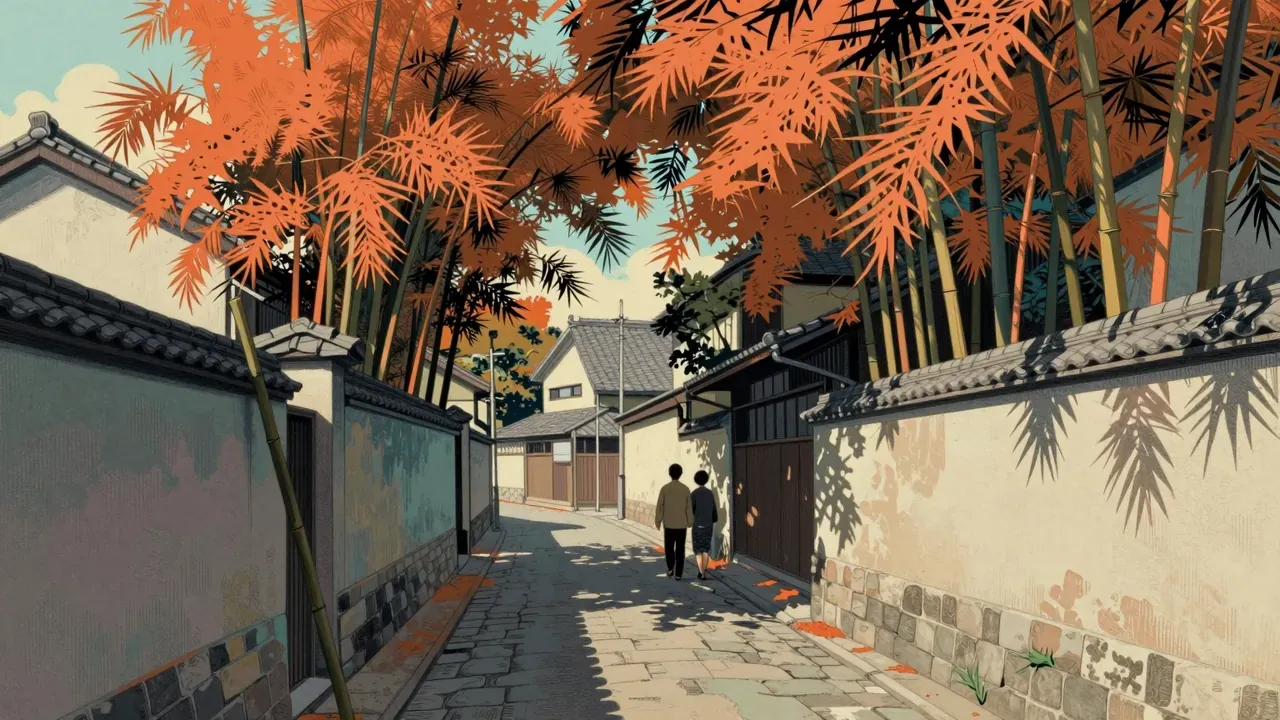
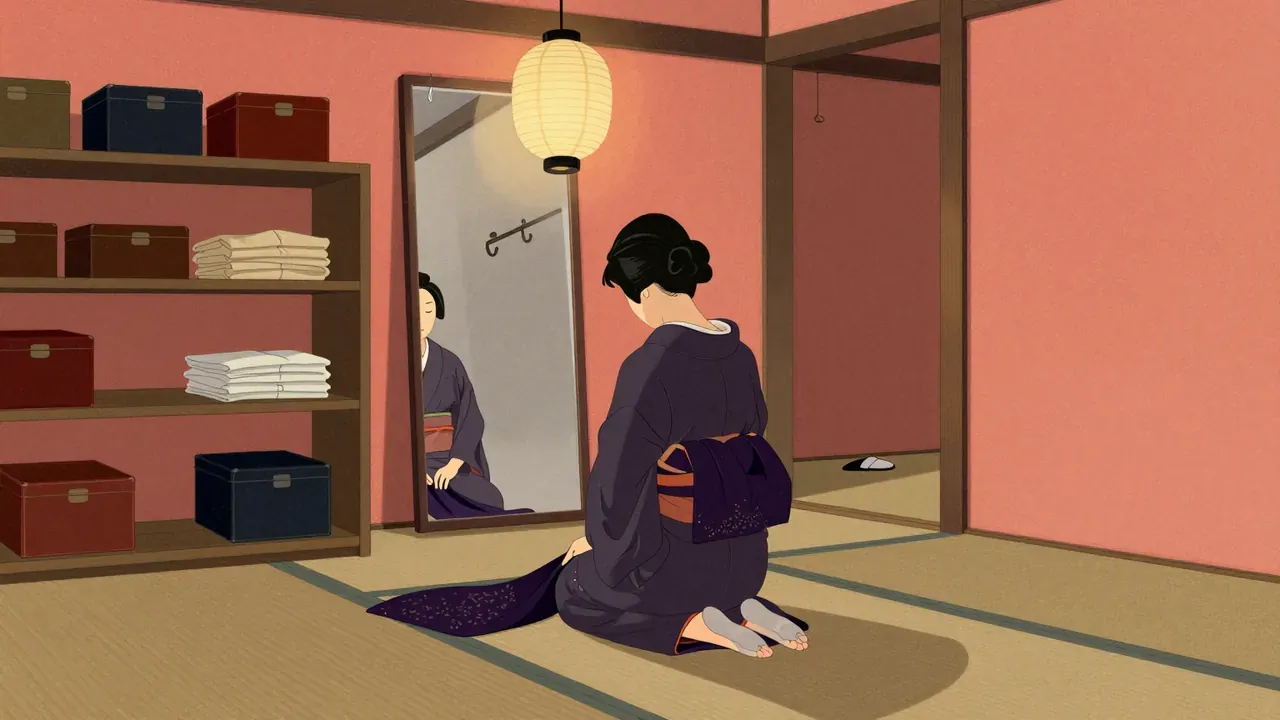
The story unfolds with deliberate, unemphatic pacing: Keiko negotiates loans, visits sick relatives, endures unwanted advances, absorbs betrayal, and returns each day to the bar’s narrow staircase. Hideko Takamine’s performance anchors the film in micro-expression — a pause before answering, a slight tightening of the jaw, the way she adjusts her obi before stepping into view. Masayuki Mori and Tatsuya Nakadai play men whose affection is inseparable from condescension or control; their restraint makes their intrusions more unsettling. Naruse and cinematographer Masao Tamai keep interiors dim and shallow, favouring medium shots that frame Keiko within doorways or behind counter glass, visually reinforcing her containment. Toshiro Mayuzumi’s score is sparse, often absent — silence carries weight, especially in scenes of negotiation or aftermath. Editing avoids emphasis: cuts land without punctuation, mirroring how Keiko absorbs disappointment as routine. The craft serves accumulation, not climax: small decisions compound, small humiliations settle, and no single moment is heightened — because none needs to be. (159 words)
What holds up
What lands is the cumulative force of Keiko’s endurance. Her refusal to collapse — even after Fujisaki’s assault, Komatsu’s slap, or the revelation of Yuri’s suicide — registers not as stoicism but as the only available grammar of survival. The film’s power lies in its refusal to isolate trauma: sexual violation, financial coercion and familial extraction are presented as interlocking conditions, not discrete crises. Takamine’s physicality — the way she walks upstairs, shoulders back but knees slightly bent, breath held just below the ribs — becomes a silent argument against romanticising resilience. The bar’s revolving clientele, each with their own minor desperation, deepen the sense of shared, unspoken exhaustion. Even minor characters like the fortune-teller or Keiko’s mother are drawn without caricature, their advice pragmatic rather than wise. The film lands because it trusts the viewer to notice what is withheld: no flashbacks to the husband, no voiceover justification, no music cue to signal sorrow. What remains visible — the kimono’s sheen, the steam off miso soup, the tremor in a poured drink — carries the weight. (157 words)
Where the frame slips
What does not land is the film’s occasional reliance on exposition that feels external to its visual logic. A few conversations — particularly those outlining Keiko’s family debts — unfold in static two-shots with minimal blocking, leaning on dialogue where gesture might suffice. The nephew’s polio and brother’s legal trouble arrive as narrative necessities rather than lived details; their emotional impact is muted by the lack of prior grounding. Similarly, Yuri’s suicide, though pivotal, is reported rather than witnessed, and her earlier confession lacks the tonal nuance needed to make her decision feel inevitable rather than illustrative. The film’s commitment to understatement occasionally tips into opacity: Komatsu’s final proposal carries little dramatic surprise because his feelings have been signalled only through glances and silences, never tested in action. A viewer unfamiliar with Naruse’s style may find the pacing indistinguishable from inertia, mistaking deliberation for detachment. These are not flaws of intent, but of calibration — moments where the film’s austerity outpaces its ability to transmit subtext without scaffolding. (156 words)
What it weighs
The themes that matter are ageing as economic liability, dignity as labour, and autonomy as debt. Keiko’s body is both asset and archive: her youth must be monetised before it expires, her grief commodified as charm, her chastity treated as collateral. The bar is not a site of liberation but of regulated exchange — where affection is priced, loyalty is loaned, and intimacy is deferred until solvency is achieved. Naruse frames ambition not as aspiration but as arithmetic: every yen borrowed subtracts from future choice. The staircase itself recurs not as metaphor but as infrastructure — a literal, unremarkable ascent that demands posture, balance, and breath control, day after day. Class is rendered through texture: the difference between Keiko’s rented apartment and Yuri’s crumbling premises, the weight of a silk kimono versus a wool coat, the sound of coins dropped into a saucer versus notes folded in an envelope. Femininity is shown as maintenance — of appearance, of reputation, of silence — rather than identity. There is no ‘woman question’ here, only the persistent, unanswerable arithmetic of being a woman in a system that measures value in years, yen, and yield. (159 words)
Who walks with her
This film is for viewers who value precision over propulsion, who find tension in stillness and meaning in repetition. It rewards attention to costume, framing, and cadence — not as stylistic flourishes but as documentary evidence of a world. It suits those familiar with Japanese postwar cinema or with Naruse’s other works, where character is revealed through what is withheld. It is not for viewers who require narrative escalation, moral clarity, or emotional release. Someone expecting a feminist manifesto or a thriller of survival will find it withholding; someone seeking psychological insight may miss the absence of interior monologue. A change in verdict would follow if the film were re-edited to tighten its mid-section or deepen the nephew’s presence — but that would contradict its method. Its worth depends on whether you accept that observation can be argument, and that endurance, when filmed without ornament, is already resistance. (159 words)
What remains
Yes, it is worth your evening — not as entertainment but as calibration. It recalibrates what counts as drama: not confrontation, but continuation; not triumph, but tenacity. Its 111 minutes ask you to sit with the weight of ordinary compromise, to notice how much energy goes into keeping things level. It repays close viewing: the shift in Takamine’s posture between scenes, the way light falls on a sake cup, the rhythm of footsteps on wooden stairs. Someone who prefers plot-driven narratives or finds slow pacing alienating may leave restless — and that is a valid response, not a failure of the film. Its value lies in its refusal to flatter attention: it does not beg to be liked, only to be seen. To watch it is to accept that some stories exist not to resolve but to resonate — quietly, repeatedly, like footsteps ascending. That resonance lingers longer than most climaxes. (158 words)