What the film is trying to do
Les Créatures is a self-reflexive fiction about the unruly genesis of fiction itself. Agnès Varda sets out not to tell a coherent story but to dramatise how narrative emerges from disordered stimuli — a car crash, a mute wife, a coastal island, local faces, half-heard conversations, and the writer’s own fatigue. The film treats inspiration as material: tactile, unstable, resistant to hierarchy. It does not conceal its scaffolding — the repeated red tint, the abrupt shifts between Edgar’s domestic reality and his manuscript’s logic, the visible seams where performance blurs into authorial intervention. Varda shot it on Noirmoutier in autumn 1965, using the island’s tidal rhythms and architectural isolation as structural devices, not backdrops. Her stated aim was to show that disorder must be acknowledged before it can be shaped; the film refuses to tidy that process. It is less a fantasy drama than a dramatisation of the fantasy of control over meaning — the belief that a writer, like a chess player or a remote operator, can orchestrate human behaviour into legible patterns. That belief collapses under its own weight, and the film lets it.
How it works
The story follows Edgar Piccoli, a science-fiction writer whose real-life accident and his wife Mylène’s muteness bleed into a novel he composes about mind control, surveillance, and communal breakdown. Willy Kurant’s cinematography keeps the light flat and coastal — bleached whites, damp greys, sudden washes of red that signal diegetic rupture rather than emotional cue. Janine Verneau’s editing stitches scenes with deliberate awkwardness: cuts land just after comprehension settles, lingering on empty doorways or unblinking faces. Bernard Lajarrige plays Edgar with watchful stillness; Catherine Deneuve’s Mylène communicates through gesture and written notes, her silence never stylised but physically present — a throat held closed, a pen pressed hard. Michel Piccoli appears only as Mylène’s husband in the film-within-the-film, a doubling that unsettles authorship. There are no score swells; Pierre Barbaud’s electronic music pulses like faulty circuitry. The sets by Claude Pignot — especially the stone tower marked ‘off limits’ — function as literal and metaphorical obstacles to narrative resolution.
What lands
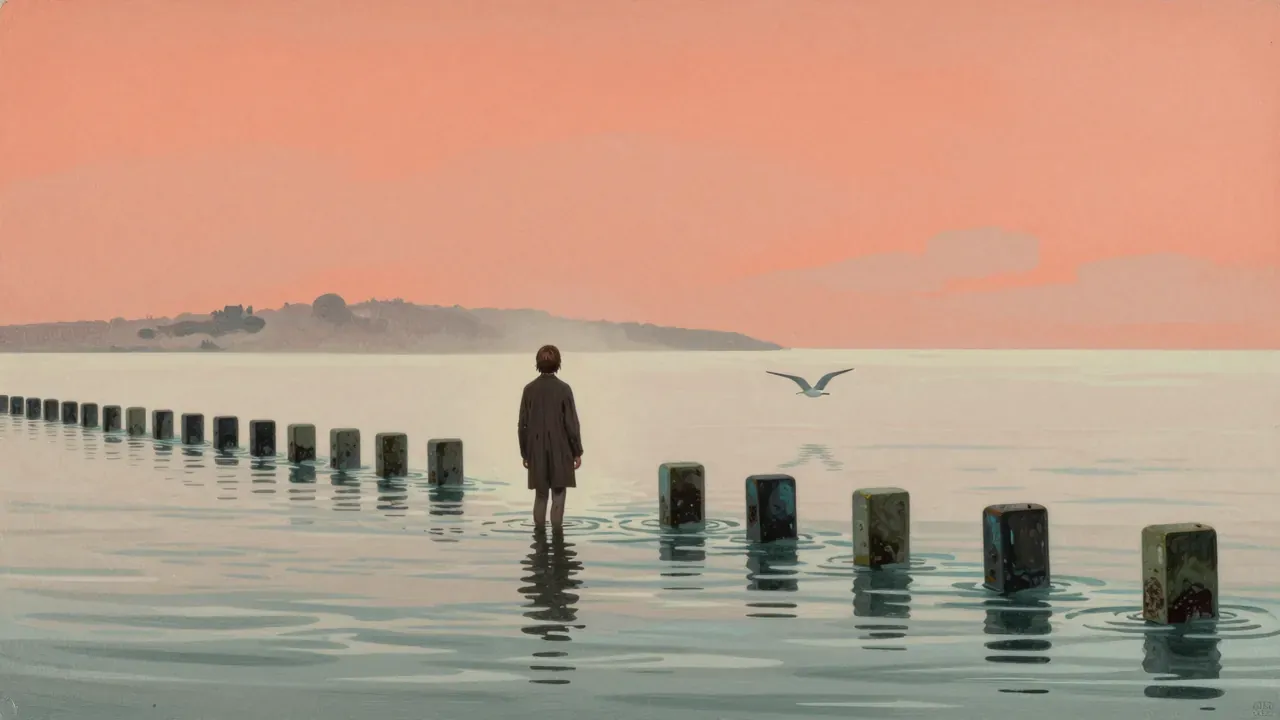
What lands is the texture of creative labour: the way ideas accrete from friction, not flow. The linen vendors’ sheet-ripping scam feels both absurd and inevitable, a minor eruption of chaos that mirrors Edgar’s internal state. The red-tinted sequences do not merely signal ‘fiction’ — they make the viewer complicit in the act of reading intention into randomness. When Edgar smashes the monitoring equipment in the tower, it reads not as catharsis but as exhaustion with interpretation itself. The film’s strongest moments are those where cause and effect refuse alignment: the dead cat with its metallic disc, the hotel manager confirming her cat lives while Edgar stands holding its corpse, the tide rising silently beneath Edgar on the Passage du Gois. These are not plot points but pressure points — places where the film’s refusal to choose between reality and invention produces a sustained, low-level unease. That unease is precise, sustained, and never theatrical. It comes from watching a mind try and fail to impose order on the raw data of lived experience.
What does not
What does not land is the chessboard sequence — an overt allegory that flattens the film’s earlier ambiguity into schematic illustration. Its miniature figures and video monitor reduce the town’s residents to tokens, undoing the specificity Kurant and Verneau have built up in earlier scenes. The ‘remote control’ premise, while consistent with Edgar’s genre, strains credulity without irony or parody; it lacks the wit of Godard’s sci-fi pastiches or the dread of Tarkovsky’s Zone. The film’s dedication to Jacques Demy feels tonally unresolved — a gesture of affection that sits apart from the work’s colder architecture. Some performances falter under the weight of exposition: Eva Dahlbeck’s shopkeeper and Nicole Courcel’s Suzon remain types rather than participants in the film’s central tension. And while the ending — Mr. Ducasse’s real suicide mirroring Edgar’s fictional one — gestures toward uncanny synchronicity, it arrives without sufficient groundwork in shared detail. The parallel feels coincidental, not resonant.
The themes that matter
The themes that matter are failure as method, authorship as contamination, and perception as unreliable infrastructure. Varda treats writing not as revelation but as projection — Edgar’s novel does not interpret the island; it infects it. The metallic discs are not plot devices but metaphors for the writer’s assumption of control: small, inert, easily attached, falsely promising mastery. The film interrogates how stories colonise reality, not through grand lies but through repetition, emphasis, and omission. Silence — Mylène’s muteness, the long pauses between dialogue, the absence of non-diegetic sound — functions as both condition and critique: what cannot be spoken becomes the ground on which narrative is erected. The tidal setting is not picturesque; it is cyclical, indifferent, erasing evidence as reliably as memory does. This is a film about the ethics of attention: who gets named, who remains off-screen, whose suffering becomes plot, and whose becomes background noise. It asks whether any story can avoid becoming a kind of violence — however gentle — against the mess it seeks to contain.
Who should watch it
This film is for viewers who value process over product, who find interest in the gaps between intention and execution, and who tolerate extended ambiguity without demanding resolution. It suits those familiar with mid-1960s French cinema’s formal experiments — not as nostalgia, but as a working vocabulary. It will frustrate viewers who require clear character motivation, causal plotting, or emotional payoff calibrated to conventional arcs. Those expecting Deneuve-led glamour or Piccoli’s star presence as anchoring charisma will be disappointed: their roles are deliberately muted, functional, even withholding. It is not for viewers who need exposition to clarify tone, or who read red tints as mood rather than structural signpost. A viewer who values clarity above all, or who associates ‘arthouse’ with visual beauty alone, will find little purchase here. The film assumes patience with disorientation — not as a gimmick, but as its central subject. Without that willingness, it reads as arbitrary rather than deliberate.
Is it worth your evening
Yes, it is worth your evening — provided you approach it as a document of creative struggle rather than a story to be solved. Its ninety minutes accumulate a quiet, persistent charge: the discomfort of watching someone think aloud in public, with all the false starts and dead ends intact. It repays attention not with answers but with sharper questions about how stories form, who controls their terms, and what gets lost in translation from life to page. Those who reject it tend to do so on grounds of opacity or perceived pretension — critics like Narboni or Cournot, for whom the film’s refusal to cohere felt like evasion. A tighter edit, or a more ambiguous ending that avoided the Ducasse parallel, might have strengthened its rigour. But its flaws are of a piece with its argument: inspiration is messy, and cleaning it up would betray the very thing it seeks to show.