The plunge
Boudu Saved from Drowning is a French social satire in the form of a tightly wound comedy of manners, adapted by Jean Renoir from René Fauchois’s 1919 stage play. It sets out to dissect bourgeois self-satisfaction not through polemic but through sustained, close observation: what happens when a man who refuses all social contract — a tramp who attempts suicide not from despair but indifference — is absorbed into a respectable household and treated as a project? Renoir does not moralise about class or preach about freedom; he stages a collision between two irreconcilable logics — one built on habit, propriety and accumulated comfort, the other on instinct, absence of debt, and refusal of obligation. The film’s ambition is structural rather than rhetorical: to let the household’s efforts at reform expose their own rigidity, and Boudu’s resistance reveal the arbitrariness of the rules they mistake for natural law. It is a film that trusts its situation to generate meaning, not its narrator. (158 words)
The grooming
The story unfolds in strict cause-and-effect sequence: rescue, adoption, grooming, transgression, reward, flight. Michel Simon’s Boudu moves through it like gravity — inevitable, unarguable, physically present in every frame. His performance is neither exaggerated nor underplayed; it is calibrated to the rhythm of domestic routine, making his disruptions land with the force of a dropped plate. Renoir’s direction avoids flourish: camera placement is steady, editing by Marguerite Renoir is functional and unobtrusive, cutting only where narrative logic demands. The Paris locations — bookshop, apartment, Seine banks, boating lake — are used without romanticism; they are lived-in, slightly dusty, lit with naturalistic restraint. Music is sourced entirely from pre-existing works — Strauss waltzes and Daniderff’s light orchestral pieces — deployed not as commentary but as ambient texture, often heard through walls or over distance. There are no flashbacks, no voiceover, no symbolic objects. Every prop serves action: the razor that shaves Boudu, the lottery ticket that buys his wedding, the rowboat that carries him away. Craft here is subservient to behaviour. (159 words)
The disruption
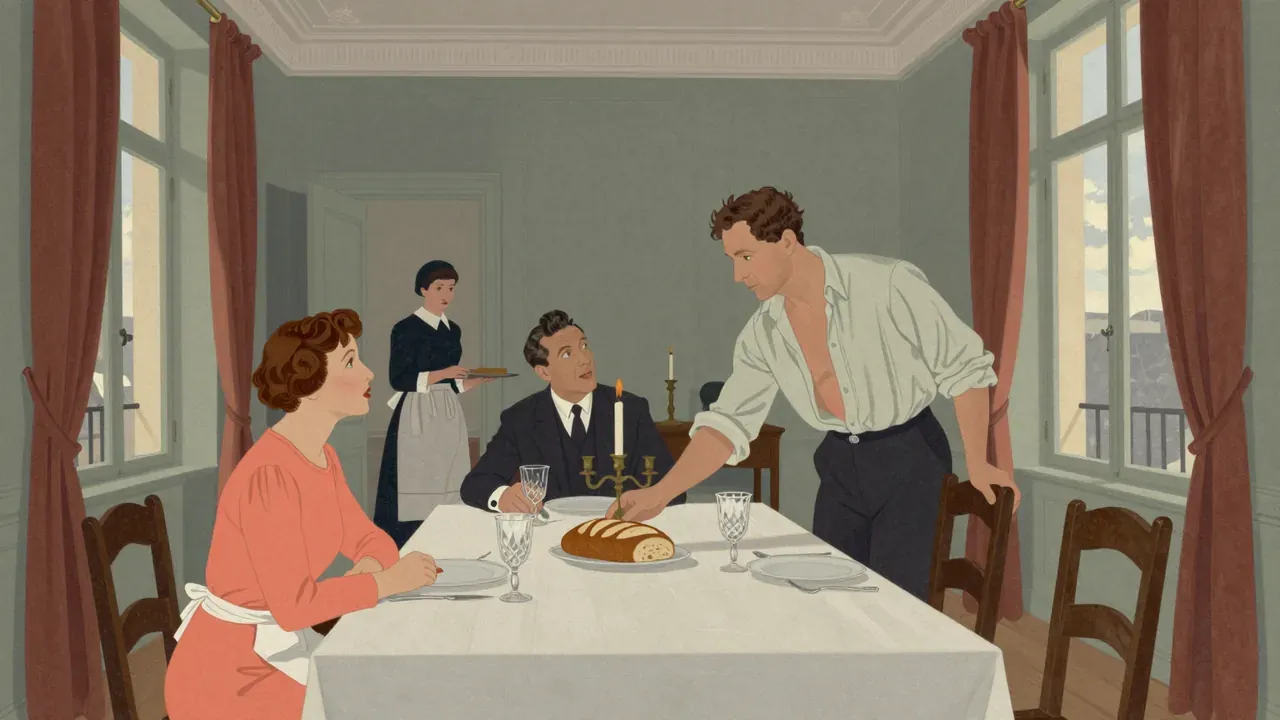
What lands most firmly is the film’s tonal precision: it sustains comic absurdity without tipping into farce, and social critique without slipping into sermon. Boudu’s physicality — his slouch, his unblinking stare, his refusal to sit properly — undermines the Lestingois family’s rituals more effectively than any speech could. The scene where he interrupts dinner by stripping to his undershirt and demanding bread is funny not because it is outrageous, but because it exposes how much of their civility depends on shared silence and unspoken agreement. The lottery win and subsequent marriage proposal work because they follow the family’s own internal logic: if Boudu must be integrated, then integration must include property, status, and conjugality — even when those things are handed to him like props. The final escape in the rowboat lands not as rebellion but as simple continuity: Boudu does not reject society so much as reassert his prior condition, which was never absence, but autonomy. The film trusts the audience to register the quiet triumph in that return. (157 words)
The lottery
What does not land is the sexual violence implied in the synopsis. The film shows Boudu propositioning the maid and behaving aggressively toward the wife, but it treats both incidents with a levity that distances them from consequence — not through irony, but omission. There is no aftermath, no reckoning, no shift in power dynamic beyond temporary embarrassment. This is not due to censorship — the 1932 version was released intact — but to Renoir’s choice to keep Boudu’s actions functionally amoral, part of his general disregard for social code. As a result, modern viewers may find the episodes jarring, not because they are graphic, but because the film declines to acknowledge their weight. Similarly, the resolution — Boudu floating away unpunished, unreformed, unrepentant — risks feeling glib if read as endorsement rather than description. The film assumes a shared understanding of Boudu as archetype, not individual; that assumption no longer holds uniformly. Some will see liberation, others evasion. The gap is not in the film’s execution, but in the ground it presumes beneath the viewer’s feet. (156 words)
The rowboat
The themes that matter are not freedom versus conformity, but the material conditions of each: how dress, address, diet and daily schedule constitute identity long before ideology does. The film asks what ‘reform’ actually means when applied to a person who has never accepted the premise of the system requiring reform. It treats class not as economic category but as somatic habit — the way Lestingois adjusts his cufflinks, the way Boudu licks his fingers after eating, the way the maid folds laundry with exact corners while Boudu leaves his shirt draped over a chair like discarded skin. There is also a quieter theme of temporal dissonance: the family lives in clock time, Boudu in weather time; they plan weddings, he watches clouds. Renoir does not resolve these tensions — he lets them coexist, unresolved, in the same frame. The film’s enduring strength lies in this refusal to choose sides, to moralise, or to offer synthesis. Its vision of human nature is neither optimistic nor cynical, but observational: people persist in their forms, and systems persist in trying to reshape them — with predictable, limited, and often comical results. (155 words)
The aftermath
This film is for viewers who value behavioural precision over plot momentum, who find comedy in timing and posture rather than punchlines, and who are comfortable with ambiguity that refuses to name its own politics. It rewards attention to gesture, to spatial relationships, to the weight of silence between lines. It is not for those who require clear moral alignment, psychological explanation, or narrative closure — Boudu’s departure is not catharsis, nor is it tragedy; it is simply the next thing that happens. Some viewers steeped in post-1960s screen grammar may find its pacing slow, its staging static, its emotional register muted. Others, particularly those familiar with interwar French theatre or early sound-era European cinema, will recognise its economy as mastery, not limitation. A viewer who expects satire to sharpen its knives will leave unsatisfied; one who accepts satire as mirror will find it unnervingly accurate. The verdict shifts depending on whether you watch it as period document or living argument — and the film itself offers no guidance either way. (159 words)
The surface
Yes, it is worth your evening — provided you approach it as a study in social physics, not a story with stakes. Its 87 minutes pass without strain because nothing is forced: performances breathe, scenes settle, the camera waits. You do not need to admire Boudu to be fascinated by him, nor agree with Lestingois to understand his panic. What makes it worthwhile is its consistency of method: every shot, line and edit serves the central question — what happens when two incompatible ways of being occupy the same space? Those who dislike it tend to do so on grounds of tone, not craft: they expect satire to bite, not observe; to judge, not record. If you find the final image — Boudu adrift, smiling faintly, the boat tipping — unsatisfying, it is likely because you wanted resolution, not recurrence. That is not a flaw in the film, but a mismatch in expectation. It remains valuable not as relic, but as calibration tool: a benchmark for how much social fiction can imply without stating, and how little plot it needs to hold attention. (158 words)