The look of it
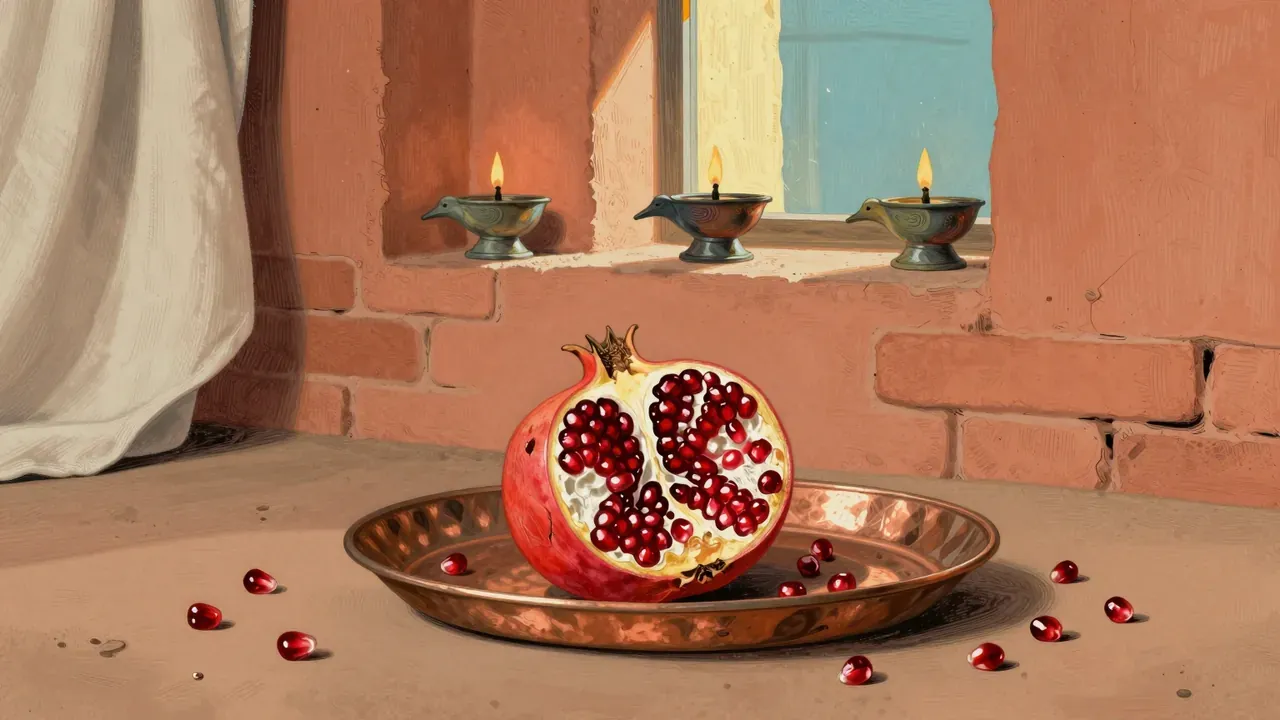
The Color of Pomegranates is not a biography in any conventional sense. It is a sequence of static, painterly tableaux arranged in nine titled chapters — Childhood, Youth, Prince’s Court, The Monastery, The Dream, Old Age, The Angel of Death, Death — each drawn from the life and verses of the 18th-century Armenian ashug Sayat-Nova. Sergei Parajanov intended it as a cinematic equivalent of Armenian illuminated manuscripts and Persian miniatures: a visual rendering of inner poetic logic rather than external narrative causality. There is no dialogue to speak of, no psychological motivation, no linear chronology. Instead, meaning accrues through colour, gesture, texture, ritual object, and symbolic recurrence — a pomegranate cut open, dyed wool lifted from vats, a conch shell beside a feather. The film treats language as image and image as liturgy. Its ambition is not to explain Sayat-Nova but to inhabit his sensibility — to make visible the grammar of devotion, memory, and cultural endurance that shaped his verse. It assumes the viewer will meet it on its own terms: not as story, but as incantation. (142 words)
The way it moves
The film works by refusing the syntax of mainstream cinema. Suren Shakhbazyan’s cinematography holds each composition like a museum panel: frontal, shallow-focus, rich in saturated reds and golds, with figures arranged in deliberate symmetry or ritual procession. Sofiko Chiaureli appears in six roles — poet, muse, angel, mime — often cross-gendered, her face unmoving, her body a vessel for symbolic action. Tigran Mansurian’s score is sparse, modal, punctuated by silence and sudden choral surges. Editing by Parajanov himself is rhythmic but non-narrative: cuts follow the logic of breath, prayer, or pigment, not cause-and-effect. The locations — Sanahin and Haghpat monasteries, Akhtala, David Gareja — are not backdrops but active participants, their stone surfaces and fresco fragments woven into the film’s visual lexicon. Every prop is charged: a comb, a book, a loom, a bowl of pomegranate seeds — all carry weight drawn from Armenian material culture and medieval Christian iconography. Nothing is incidental; everything is placed, lit, and held as if consecrated. (150 words)
What stays
What lands is the film’s unwavering commitment to its own logic. Its stillness is never inert; it generates tension through duration and restraint. A single shot of hands dyeing wool in the colours of the Armenian flag — red, blue, orange — carries more political resonance than any speech could, precisely because it avoids explanation. The recurring motif of blood-red juice soaking cloth into the shape of historic Armenia’s borders lands with quiet, cumulative force. So does the androgynous casting: Chiaureli as both poet and beloved, the bathhouse scene where male and female nudes coexist without hierarchy — gestures toward a pre-modern, non-binary understanding of desire and identity. The film’s refusal to translate itself makes its emotional register feel earned, not imposed. When a child lies curled on a pentagram while a blanket is drawn over him, the image does not demand interpretation — it lodges, persists, reverberates. Its power is tactile, architectural, devotional. It does not persuade. It occupies space and insists on being seen. (149 words)
What resists
What does not land is any expectation of accessibility on first viewing. The film offers no exposition, no character names, no voiceover, no subtitles beyond chapter titles — and even those were rewritten by Soviet censors to obscure Sayat-Nova’s identity. Without prior knowledge of Armenian history, ashug tradition, or Parajanov’s stated references to miniature painting, the imagery remains deliberately opaque. Some sequences — the dream chapter, the angel of death — resist even scholarly consensus on meaning. The restoration reinstated Parajanov’s original edit, but it did not supply a key. Viewers who require narrative scaffolding or psychological realism will find the film impenetrable, not elusive. Its resistance to legibility is structural, not accidental. That is its strength and its limit. It does not fail to communicate; it declines to communicate in ways cinema usually permits. Those who approach it as puzzle or parable will be frustrated. Those who treat it as liturgy may find themselves disoriented, then immersed. (147 words)
What it carries
The themes that matter are cultural survival under erasure, the erotic and spiritual unity of body and text, and the resilience of form when content is suppressed. Parajanov made the film in Soviet Armenia, where religious expression was curtailed and national narratives flattened into socialist realist templates. His recourse was not protest but preservation: embedding Armenian liturgical gesture, textile patterns, manuscript illumination, and oral poetry into every frame. The pomegranate — fruit, symbol, stain — recurs as both life-force and wound. The film’s androgyny is not decorative; it mirrors Sayat-Nova’s own homoerotic verse and Parajanov’s persecution for homosexuality under Soviet law. This is not subtext — it is substrate. The film also treats craft as sacred: weaving, dyeing, calligraphy, chanting — all appear as acts of devotion equal to prayer. Its vision of time is cyclical, not progressive; its history is embodied, not documented. What endures is not the man, but the rhythm of his hand writing, his voice singing, his feet walking the same stone steps as monks centuries before. (146 words)
Who meets it
This film is for viewers who value visual density over exposition, who tolerate ambiguity as a condition of attention, and who accept that some art functions like ritual rather than reportage. It suits those familiar with Armenian or Georgian medieval art, Soviet-era censorship histories, or avant-garde film traditions from Buñuel to Dziga Vertov. It is not for those who rely on dialogue to anchor meaning, who expect character arcs or causal plotting, or who need immediate emotional payoff. A viewer expecting biographical clarity or historical context will leave unsatisfied — and that is not a flaw in the film, but a mismatch of expectation. The 2014 restoration makes it more complete, not more comprehensible. Those who find value in sustained looking, in the weight of colour and silence, in objects treated as relics — they will find it essential. Others will find it alienating by design. No amount of background reading bridges the gap entirely; the film insists on its own terms. (144 words)
What it asks
Yes, it is worth your evening — but only if you give it your full, unhurried attention, and only if you accept that its value lies in duration, not resolution. Seventy-nine minutes spent watching The Color of Pomegranates is seventy-nine minutes spent inside a moving fresco, a living manuscript, a slow-motion liturgy. It does not yield its rewards to distracted viewing or background playback. Its power accumulates in the space between shots, in the grain of wool, the drip of juice, the pause before a hand lifts. Those who watch it once and dismiss it as ‘confusing’ have not met its conditions. Those who return, who let its rhythms recalibrate their sense of time and significance, often describe it as transformative. It is not entertainment. It is an encounter. And like any serious encounter, it asks something of you — patience, openness, willingness to sit with mystery. If you bring those, it repays them fully. If you do not, no restoration or commentary will change that. (145 words)