The shape of longing
Me and You and Everyone We Know is a self-written, self-directed debut feature by Miranda July, released in 2005 under Film4’s UK production umbrella. It sets out to map the quiet, often awkward emotional negotiations of people who speak past one another — not from malice, but from insufficient language, unpractised empathy, or simple misalignment of need and timing. Its method is not satire nor farce, though it uses both lightly; rather, it treats minor social gestures — a folded note, a delayed reply, a child’s blunt question — as structural events. The film avoids conventional romantic escalation or comic payoff, opting instead for cumulative, low-amplitude resonance: moments where connection flickers but does not catch fire, or catches in unexpected places — between strangers, across generations, across screens. It is not trying to resolve loneliness, but to name its textures with precision, and to suggest that attention itself, however clumsy, might be the first ethical act.
The look of it
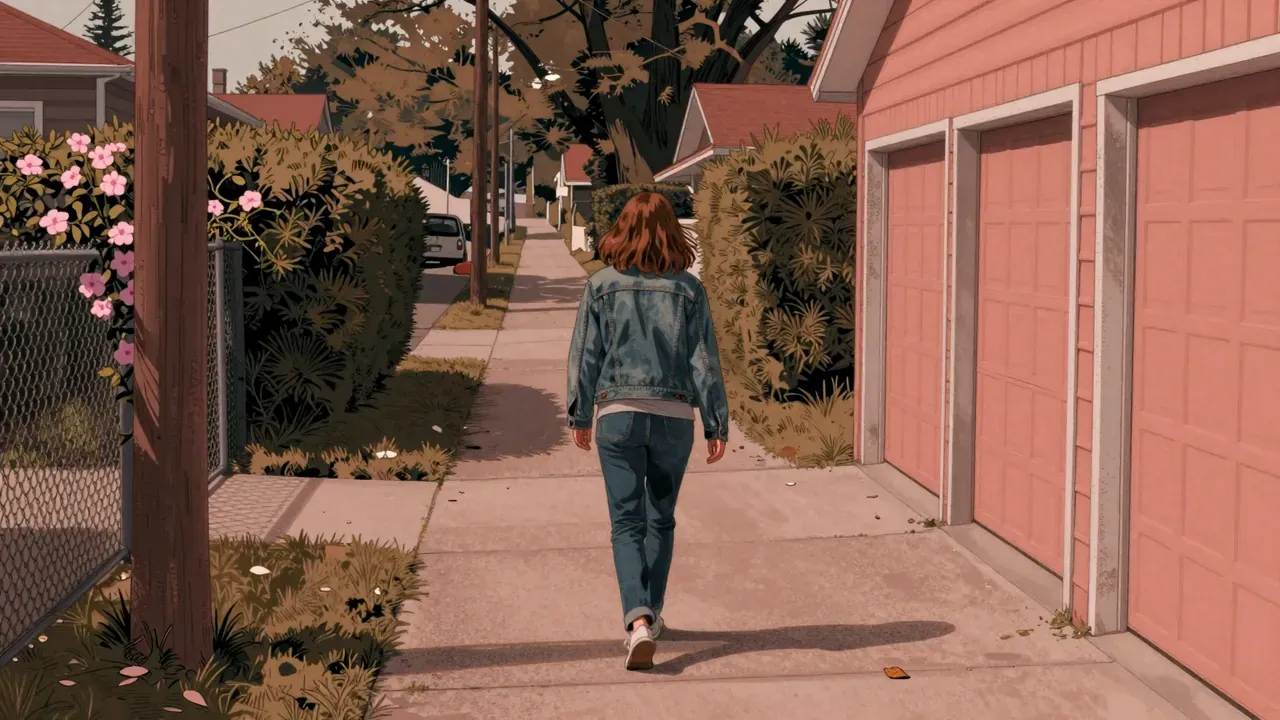
The story follows two parallel threads: Richard Swersey, a recently separated shoe salesman navigating online dating with hesitant sincerity, and Christine Jesperson, an amateur performance artist and part-time children’s cab driver whose work involves staged vulnerability and literal distance — she films herself walking away from the camera. Their paths intersect through shared peripheral characters: Richard’s sons, Christine’s young passengers, and a group of neighbourhood children conducting their own experiments in intimacy and power. John Hawkes grounds Richard in a weary, tactile realism; Miranda July plays Christine with deliberate flatness — a choice that reads less as affectation than as calibrated withholding. Gordon Willis did not shoot this film; Michael Andrews’ score is spare, melodic, and gently intrusive — piano motifs recur like half-remembered thoughts. Editing is unhurried, favouring medium shots and pauses longer than dialogue requires. The production design feels lived-in, not curated: beige carpets, laminated countertops, the faint hum of a suburban afternoon.
What stays
What lands is the film’s fidelity to small-scale emotional logic. A scene in which two children negotiate the terms of a pretend marriage — specifying rules about chores and phone calls — carries more psychological weight than many adult romances because it treats desire and fear as equally articulate, equally negotiable. The film’s use of digital mediation — webcam chats, typed messages, video submissions — feels prescient not because it predicts technology, but because it isolates how interface shapes confession: what we say when we cannot see the other’s face, and how much we edit before hitting send. July’s direction sustains a tone of gentle scrutiny without condescension; even the most naive or misguided characters retain dignity in their attempts. The Sundance jury recognised this originality of vision — not as novelty for its own sake, but as a recalibration of scale: love, grief, curiosity, and shame are all given equal visual and narrative weight, regardless of age or status.
Where it holds still
What does not land is the film’s occasional drift into schematic whimsy — moments where behaviour feels less observed than assigned, as if character were being used to illustrate a thesis on innocence or alienation rather than emerging from it. A subplot involving teenagers filming themselves kissing while holding up handwritten signs begins with pathos but settles into repetition without deepening; the gesture becomes illustrative rather than revelatory. Some performances, particularly among the younger cast, remain deliberately uninflected to the point where distinction between intention and limitation blurs — a risk inherent in July’s style, but one that leaves certain scenes emotionally inert rather than ambiguous. The pacing, while consistent with the film’s ethos, can feel like suspension without tension: there are stretches where nothing appears to be at stake, and the viewer waits for a shift that never arrives. This is not incompetence — it is a formal choice — but it will frustrate viewers accustomed to narrative propulsion or clear cause-and-effect.
What it thinks about
The themes that matter are not grand abstractions but domestic ones: the labour of attention, the ethics of observation, the gap between intention and impact in human contact. It asks how we learn to want, and whether wanting can be taught — or unlearned — through imitation, instruction, or accident. Age is treated not as a category but as a variable in relational grammar: children speak more directly about love and death than adults do, yet are less equipped to hold the consequences of those words. Technology appears not as a force of disruption but as a neutral amplifier — a way to extend reach, flatten hierarchy, or defer consequence. Class is present but muted: Richard’s job loss and Christine’s freelance precarity register as background hum, not crisis. What binds the characters is not shared circumstance but shared incompleteness — a sense that no one fully knows how to be with others, and that every attempt, however flawed, is a kind of courage.
Who it meets
This film is for viewers who value tonal consistency over plot momentum, who find emotional precision more compelling than catharsis, and who are comfortable sitting with unresolved dynamics. It suits those attuned to postmodern American indie sensibilities of the early 2000s — think Hal Hartley or early Todd Solondz — but with less irony and more tenderness. It is not for viewers who require clear stakes, escalating conflict, or character arcs with definable turning points. Those who dislike deadpan delivery, extended silences, or narratives that privilege mood over mechanics will find it frustrating. A viewer who values strong plotting or rapid-fire wit would likely reject its pace and restraint — and that rejection would be reasonable, not a failure of taste. The film’s success depends entirely on alignment with its chosen register; change the rhythm or sharpen the stakes, and it ceases to be itself.
What it costs
Yes, it is worth your evening — provided you approach it as a study in proximity rather than a story with destinations. Its ninety minutes pass without hurry, but not without accumulation: by the end, small gestures — a hand held, a message unsent, a child’s drawing left on a dashboard — carry quiet weight. It rewards attention, not interpretation; you do not decode it so much as inhabit its atmosphere. Those who expect resolution may leave dissatisfied, but dissatisfaction here is part of the design — a reflection of how real connection rarely delivers clean closure. It is not a film to watch while distracted, nor one to consume for escapism; it asks for presence, and repays it with specificity. If your evening is measured in emotional resonance rather than narrative payoff, this film earns its duration. Its modesty is not weakness — it is the condition of its honesty.