The sound of it
My Dinner with Andre is a filmed conversation between two men at a Manhattan restaurant, structured as a single evening’s exchange. It does not dramatise events beyond that table; it has no subplot, no flashbacks, no visual digressions. Its aim is neither to entertain nor to instruct, but to hold space for sustained, unmediated talk — about theatre, perception, fear, comfort, and what counts as real experience. Wallace Shawn and Andre Gregory wrote the script from their own histories and preoccupations, then shaped those materials into a dialectic: one voice drawn to ritual, extremity, and transcendence; the other anchored in daily texture, modest pleasures, and social responsibility. The film refuses the conventions of dramatic escalation or resolution. Instead, it asks whether conversation itself — unspooled, uncut, attentive — can be an act of resistance against habit, distraction, and the flattening of attention. It treats dialogue not as exposition or vehicle, but as event.
The talk of it
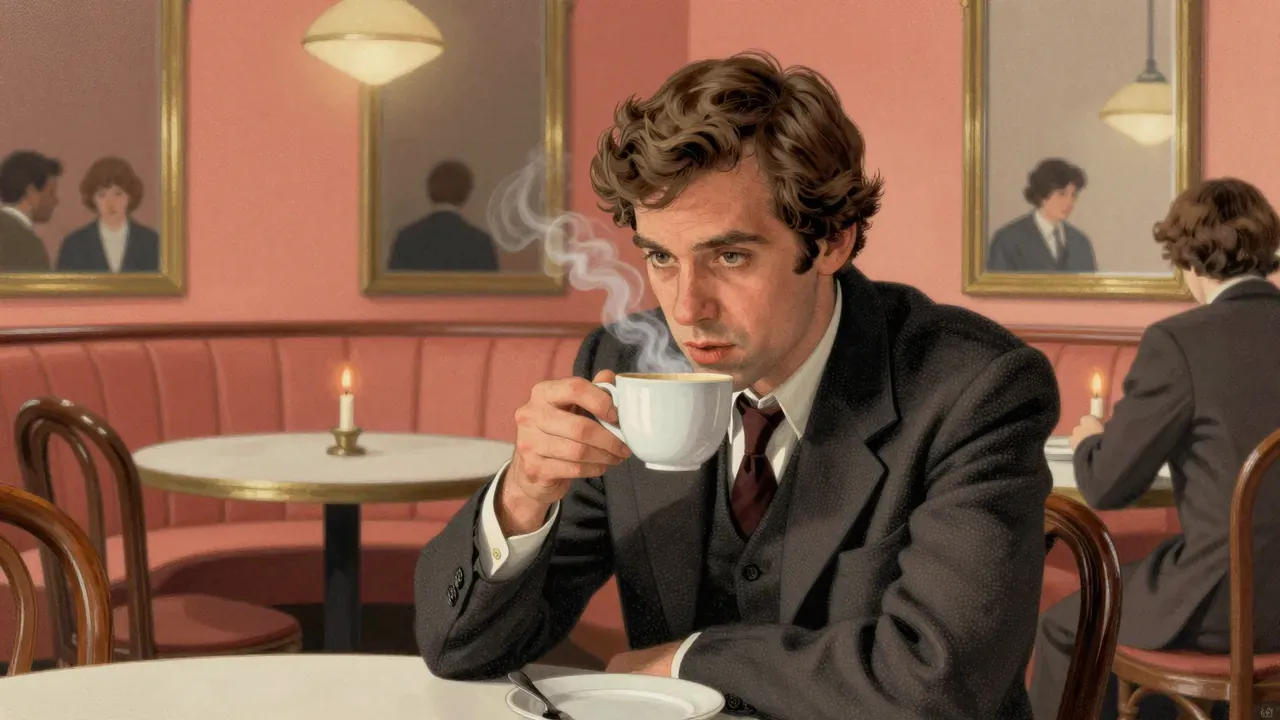
The story is the dinner: Wally arrives early, waits, orders a drink, then sits across from Andre and listens for ninety minutes. There is no action beyond speech, gesture, and minor shifts in posture. Shawn and Gregory perform versions of themselves that are precise, self-aware, and deliberately unstable — neither documentary nor pure fiction, but something closer to philosophical portraiture. Jeri Sopanen’s cinematography keeps the frame tight and steady, mostly two-shots or medium close-ups, with shallow depth of field that blurs the background into warm, indistinct golds and browns. Suzanne Baron’s editing sustains rhythm without punctuation: cuts land on breaths, pauses, glances — never on emphasis, always on continuity. Allen Shawn’s score is sparse, mostly piano motifs that recur like half-remembered thoughts. The set — a recreation of Café des Artistes inside Richmond’s Jefferson Hotel — feels lived-in but neutral, a container rather than a character. Every craft decision serves duration, intimacy, and acoustic clarity.
The look of it
What lands is the sheer weight of presence: the way Shawn’s nervous energy accumulates in his hands and throat, the way Gregory’s stillness becomes magnetic when he recounts being buried alive or walking through Polish forests with Grotowski’s actors. The film makes listening visible — not as passive reception but as physical labour, a kind of vigilance. Its pacing rewards attention without demanding it; the long takes do not feel indulgent because they mirror how thought actually unfolds: associative, hesitant, recursive. The contrast between characters lands not as argument but as temperament — one man’s hunger for rupture, the other’s devotion to continuity. Even the waiter’s quiet interjections — Jean Lenauer’s minimal, unflustered service — ground the abstraction in social reality. The final taxi ride, where Wally notices streetlights and shopfronts with sudden tenderness, lands not as epiphany but as quiet recalibration: the world hasn’t changed, but his relation to it has, just enough.
The weight of it
What does not land is any claim to universality in its concerns. The film presumes a certain fluency in European theatre history, mid-century American intellectual life, and esoteric spiritual practice — references that arrive without gloss or context. Its refusal to explain or translate means some passages — particularly Andre’s accounts of Findhorn or Montauk — risk sounding like insider testimony rather than shared inquiry. The absence of visual variation also works against it in stretches: after forty minutes, the static framing can begin to feel less like discipline and more like constraint, especially for viewers accustomed to kinetic editing or environmental storytelling. The film’s moral gravity — its insistence that ordinary life is a kind of sleep — carries weight only if you accept its premises about authenticity and risk. For those who find comfort, routine, or domesticity intrinsically meaningful rather than suspect, the film may register as quietly condescending rather than challenging.
The risk of it
The themes that matter are not the topics discussed — Grotowski, Saint-Exupéry, ecological communes — but the questions those topics serve. What counts as real experience when most of life is mediated, scheduled, and buffered? How much of our sense of safety is built on denial — of mortality, of power, of collective fragility? Is art possible under late capitalism without becoming either ornament or protest? The film treats these not as abstract propositions but as lived tensions: Andre’s hunger for extremity versus Wally’s attachment to the electric blanket; the terror of totalitarianism versus the exhaustion of paying rent. It circles around a central, unspoken theme: the ethics of attention — what we choose to notice, what we consent to ignore, and how those choices shape both self and society. Mysticism here is not doctrine but method: a way of testing the edges of perception. Humanism is not dogma but practice: showing up, remembering names, tasting coffee.
The test of it
It is for people who value talk as substance, not filler — readers of Sontag or Cavell, listeners of long-form interviews, theatre-goers who watch actors breathe between lines. It suits those comfortable with silence as punctuation, with ambiguity as atmosphere, with unresolved tension as form. It is not for viewers who need narrative propulsion, visual variety, or emotional payoff measured in catharsis. Those who associate ‘drama’ with conflict resolved, or ‘cinema’ with movement and spectacle, will find it inert. People who distrust introspection as self-indulgence, or who see philosophy as abstraction divorced from material conditions, will likely resist its gravity. A viewer who finds the film dull is not wrong — they are responding honestly to its terms. That verdict would change only if the film were recut with narration, cutaways, or illustrative footage, which would betray its central wager: that two people talking, uninterrupted, is enough.
The after of it
Yes, it is worth your evening — provided you approach it as you would a live reading, a long walk with a friend, or a slow meal: without agenda, but with full attention. Its value lies not in what it says, but in how it holds time — making ninety minutes feel neither rushed nor stretched, but simply occupied, fully. It repays rewatching not for hidden details but for shifts in your own listening: what you hear differently at thirty, forty, fifty. It is not urgent, not timely, not ‘relevant’ in the journalistic sense — yet it remains stubbornly present, because its questions outlive trends. Anyone who has ever sat across from someone they love and felt both deeply known and entirely misunderstood will recognise something here. It asks nothing of you except to stay seated, to listen, and to notice what happens in the space between sentences. That is rare. That is enough.