The shape of it
Smiles of a Summer Night is a Swedish period comedy set around the turn of the twentieth century, written and directed by Ingmar Bergman in 1955. It attempts something precise: to stage romantic entanglement not as psychological crisis but as social choreography — a series of near-misses, misread signals, and reversible affections played out over one Midsummer Night. Unlike Bergman’s later films, it avoids interior monologue, theological doubt or existential rupture; instead, it leans into structure, symmetry and theatrical timing. The film adapts classical comic devices — mistaken identity, generational mismatch, servants who see more than masters — and places them within a distinctly Swedish landscape: aristocratic country houses, candlelit parlours, and the long, light-drenched twilight of Scandinavian midsummer. Its ambition is formal and tonal: to sustain wit without cynicism, elegance without detachment, and resolution without simplification. It treats desire as both absurd and inevitable, and fidelity as a habit more than a vow. This is not Bergman unburdened, but Bergman deliberately choosing lightness as a mode of seriousness. Word count: 148.
The timing of it
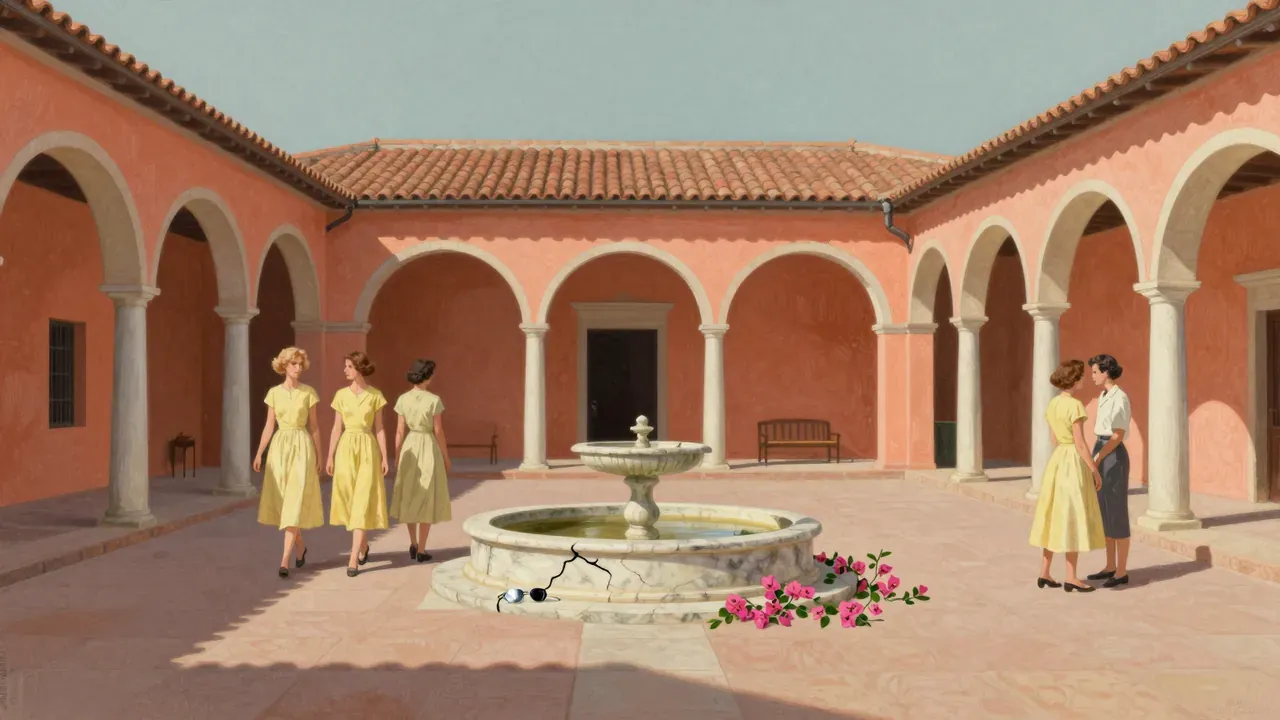
The story unfolds across three interlocking couples and two generations, all converging at Desiree Armfeldt’s country house for Midsummer Night. Gunnar Fischer’s cinematography keeps the lighting soft and even, favouring shallow focus and restrained camera movement that mimics stage blocking — entrances and exits are timed like curtain cues. Oscar Rosander’s editing sustains rhythm without haste, allowing pauses to settle before the next complication arises. Eva Dahlbeck and Gunnar Björnstrand anchor the film with poised, verbally dexterous performances: their characters speak in polished sentences that conceal vulnerability, never breaking character even when exposed. Harriet Andersson’s Petra is its grounded counterpoint — earthy, unsentimental, and physically present in a way the others are not. Erik Nordgren’s score uses waltz motifs and harpsichord flourishes to underline irony without undercutting feeling. The production design, drawn from Jordberga Castle and Filmstaden studios, avoids historical clutter; costumes and interiors suggest class and era through cut and texture, not exposition. Word count: 152.
The resolution of it
What lands most securely is the film’s structural grace — the way each reversal feels earned, each pairing plausible, each resolution quietly satisfying without sentimentality. The Midsummer setting does real work: the short night becomes a temporal frame that compresses consequence and permits forgiveness. Petra’s agency stands out — she arranges the elopement, mediates between classes, and chooses her own lover without apology. The servants’ subplot is neither decorative nor condescending; it runs parallel to the gentry’s, sharing the same emotional logic but different stakes. The Russian roulette scene works because it is played straight — no parody, no undercutting — and its futility is revealed only after the tension peaks. Even minor characters register: Naima Wifstrand’s Mrs. Armfeldt delivers dry wisdom without caricature; Margit Carlqvist’s Charlotte moves from brittle formality to candid yearning without losing dignity. The film’s tone remains consistent: warm but not indulgent, witty but not cruel, elegant but never aloof. Word count: 150.
The omission of it
What does not land is the generational framing of Henrik and Anne’s relationship. Their mutual attraction is established, but the film gives little sense of Henrik’s inner conflict beyond his clerical vocation — his torment reads more as plot necessity than lived contradiction. The implication that young Fredrik Armfeldt is Egerman’s son remains underdeveloped; it hangs in the air without dramatic weight or payoff. Some transitions feel theatrical to the point of stiffness: characters arrive at the country house already aligned in new pairings, with little visible process of persuasion or hesitation. The Count’s jealousy, though vividly performed, lacks psychological grounding — he shifts from rage to reconciliation without visible cause beyond narrative convenience. A few lines of dialogue lean on period formality to the point of stiffness, momentarily breaking rhythm rather than enhancing it. These are not flaws in execution — the acting, pacing and design remain assured — but limits of the film’s chosen register: it prioritises balance over depth, symmetry over surprise. Word count: 149.
The thinking of it
The themes that matter are time, class, and the performative nature of love. Midsummer Night is not just backdrop but condition: its liminal light suspends normal consequences, allowing characters to act outside habitual roles. Class operates not as barrier but as grammar — speech patterns, posture, even silence mark hierarchy, yet the film shows how desire bends those rules without abolishing them. Love is treated as a series of negotiations, not revelations: contracts are implied, renegotiated, broken and renewed through gesture and timing rather than confession. There is no grand declaration, no climactic truth-telling — resolution arrives in shared glances, adjusted seating, a hand placed lightly on an arm. The film also engages with inheritance, literal and emotional: children echo parents’ choices, servants inherit the emotional labour their employers avoid, and even the past — in the form of Desiree’s theatre posters or Mrs. Armfeldt’s memories — is curated, not mourned. These are not abstract ideas but woven into action, costume, and spatial arrangement. Word count: 149.
The watching of it
This film suits viewers who value precision of form, patience with verbal rhythm, and comedy that trusts silence and timing over punchlines. It rewards attention to composition, vocal inflection and the physical language of restraint. Those who expect psychological realism, rapid pacing or explicit moral framing will find it distant or arch. It is not for viewers who require clear cause-and-effect causality, or who dislike theatricality in cinematic storytelling. Fans of Sondheim’s A Little Night Music may approach it expecting musicality of a different kind — they will find it, but in syntax and staging, not song. The film assumes familiarity with European bourgeois manners of the early 1900s, though it explains none of them; its pleasures lie in recognition, not exposition. Anyone put off by Swedish subtitles or period settings should know its humour travels intact — but only if they accept its unhurried pace as part of its logic. Word count: 149.
The worth of it
Yes, it is worth your evening — provided you watch it as Bergman intended: as a chamber piece, not a spectacle. Its 108 minutes unfold with the measured clarity of a well-tuned clockwork mechanism, each gear turning to release the next complication. It repays attention not with revelation but with refinement: a glance held half a second longer, a pause before a line, the way light falls across a staircase at dawn. Those who find it slow do so because it refuses urgency — not because it lacks momentum, but because its momentum is rhythmic, not linear. It would lose its force in a rushed viewing, or on a small screen without careful sound mixing. But seen with full attention, it offers a rare kind of satisfaction: the pleasure of watching intelligence, craft and empathy align without strain. Word count: 149.