Four Stories
I Am Cuba is a Soviet-Cuban co-production made in 1963, released in early 1964, and conceived as a political drama anthology about Cuban life in the years immediately before the 1959 Revolution. It does not narrate the uprising itself but instead presents four self-contained episodes — a shantytown prostitute’s betrayal, a sugar farmer’s dispossession, student unrest at Havana University, and a peasant’s reluctant turn to armed rebellion — linked by a female voice declaring ‘I am Cuba’. The film attempts to ground socialist ideology in human consequence: land seizures, police violence, economic coercion, and the slow erosion of dignity under Batista’s regime. Its ambition is didactic but not simplistic; it seeks to show how structural injustice reshapes individual choice, not to celebrate revolution as spectacle but to trace its roots in accumulated rupture. It was commissioned jointly by Mosfilm and Cuba’s ICAIC, with Soviet technical resources deployed on Cuban soil, and shaped by Kalatozov’s interest in Eisenstein’s unfinished ¡Que viva México! — a lineage of politically engaged, formally audacious Latin American portraiture. (158 words)
The Look of It
The film unfolds through four episodic narratives, each anchored by a named protagonist — Maria, Pedro, Enrique, Mariano — played by Cuban actors including Sergio Corrieri and José Gallardo. Performances are restrained, often internalised, avoiding rhetorical intensity in favour of quiet accumulation: Maria’s silence after her client leaves, Pedro’s lie to his children before setting fire to his home, Enrique’s hesitation when sighting the police chief at breakfast. Sergey Urusevsky’s cinematography dominates the frame: extreme wide-angle lenses, prolonged tracking shots — some lasting over five minutes — executed via custom cable rigs, underwater housings, and infrared film stock borrowed from Soviet military stocks. These choices exaggerate contrast, flatten depth, and force proximity without intimacy. Carlos Fariñas’ score is sparse, mostly diegetic or ambient, leaving space for street noise, chants, and silence. The editing is rhythmic rather than syntactic: scenes bleed into one another through motion or sound, not cuts. Dialogue is minimal and functional; exposition arrives through image or narration, never monologue. The script by Yevtushenko and Pineda Barnet avoids polemic in favour of situational clarity, trusting the camera’s movement to carry argument. (159 words)
What Stays With You
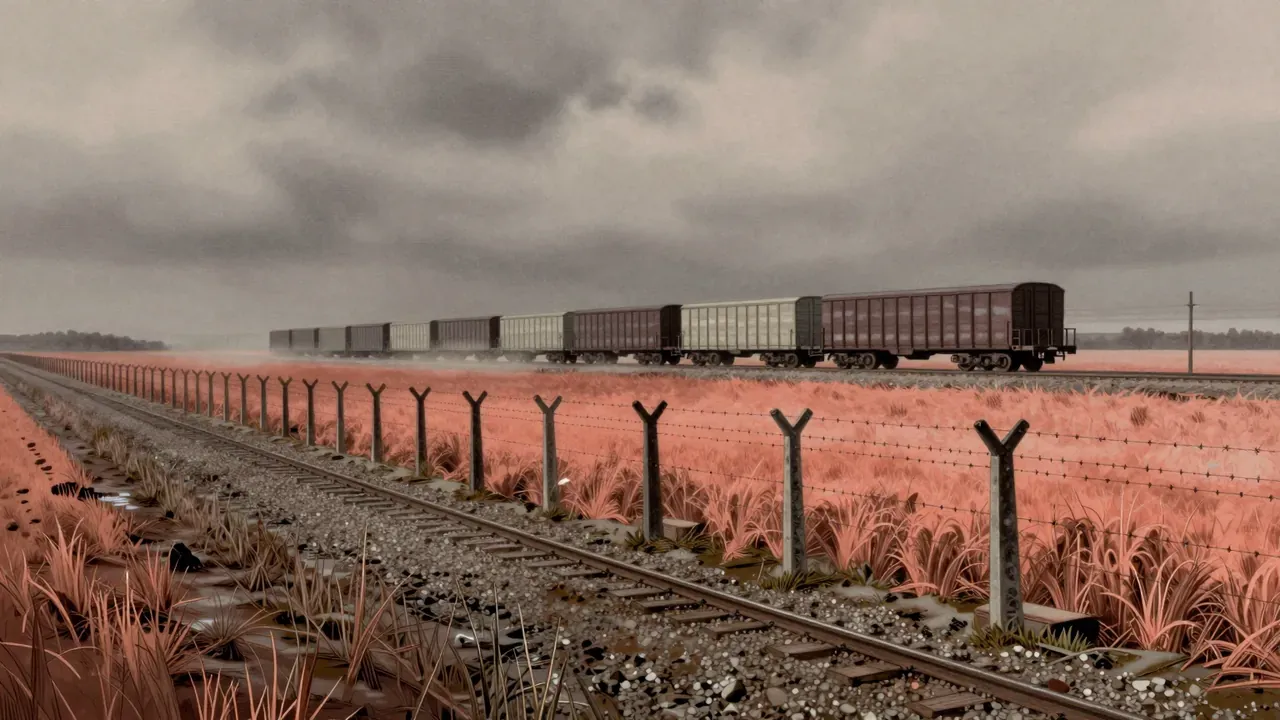
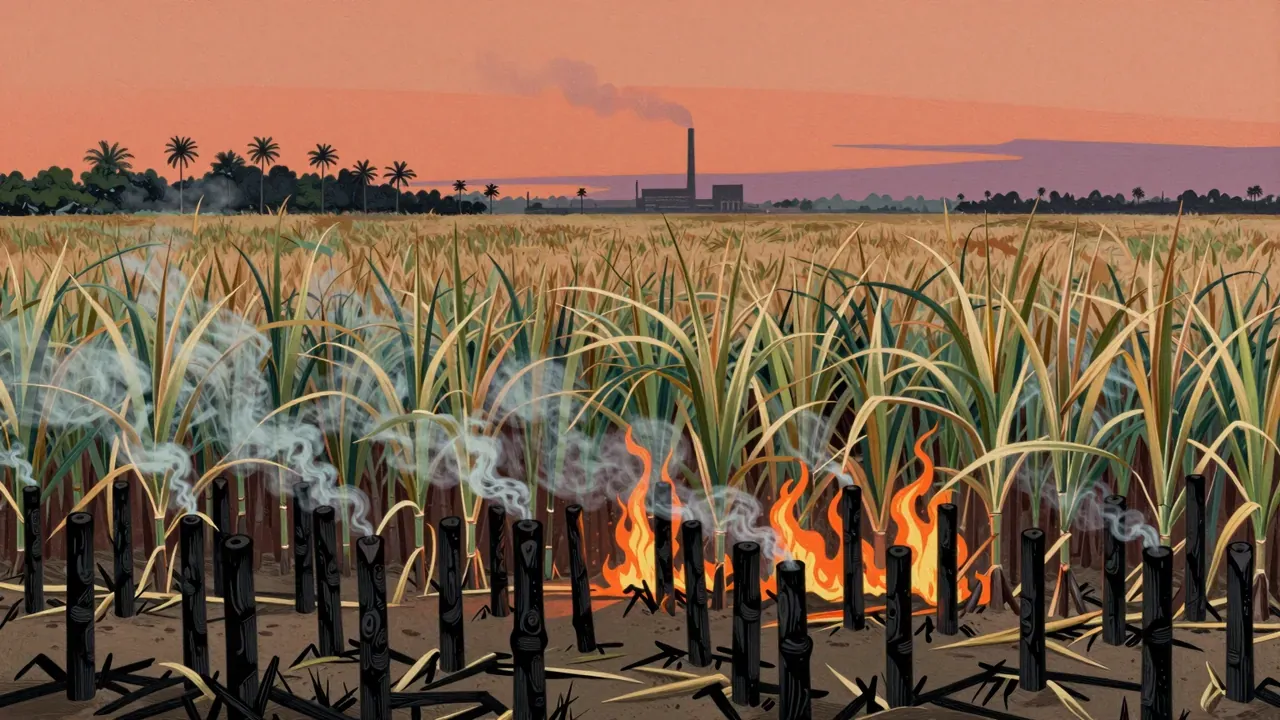
What lands most decisively is the physicality of the camera’s gaze — not as spectacle, but as witness. A shot that begins at street level beside a flag-draped stretcher, rises vertically four storeys, glides sideways through a factory window, then floats out again over rooftops, does not dazzle for its own sake: it maps power, scale, and collective memory in one unbroken breath. The infrared-treated skies — deep black yet unmistakably sunlit — and the bleached whiteness of sugar cane fields make landscape itself a character: fertile, violated, indifferent. The film’s refusal to let subjects look directly at the lens sustains a documentary gravity, even in staged moments. When Pedro lies to his children, the camera holds him at mid-distance, refusing close-up, letting the weight settle in gesture and pause. The narrator’s voice — calm, declarative, never pleading — gives cohesion without explanation. These choices do not soften the film’s politics; they deepen them, by insisting that injustice is visible, tangible, and spatially legible. The technique does not serve ideology as ornament — it enacts it, by making structure visible in movement, light, and duration. (157 words)
Where It Pulls Back
What does not land is the emotional through-line across episodes. The transitions between stories feel abrupt, not architectural: the shift from Maria’s personal shame to Pedro’s agrarian dispossession lacks connective tissue beyond the narrator’s refrain. The fourth episode, Mariano’s conversion from pacifism to insurgency, reads less as earned transformation than narrative necessity — his son’s death arrives with sudden, almost schematic violence, lacking the granular dread built earlier. Some performances falter under the weight of silence: Enrique’s moral crisis is conveyed more by framing than by expression, and his final martyrdom feels preordained rather than felt. The film’s formal rigour occasionally overrides psychological texture — long takes demand attention but do not always yield insight. Critics at the time noted its distance from Cuban lived experience; the Havana premiere drew complaints of caricature, while Moscow found it insufficiently militant. That tension remains: the film observes suffering with precision but rarely lingers where pain resides in the body or voice. Its austerity is deliberate, but it can mistake restraint for absence. (159 words)
What It Is About
The themes that matter are dispossession, visibility, and the grammar of resistance. Dispossession operates on three levels: Maria’s loss of autonomy and sacred object (the crucifix), Pedro’s erasure from land he worked, and Mariano’s destruction of home and child — all tied to external capital (American casinos, United Fruit, aerial bombing). Visibility is both literal and political: the camera’s relentless motion insists on what cannot be ignored — shanties beside hotels, smoke rising from burning cane, blood on pavement — while the characters’ avoidance of the lens suggests a people not yet ready to claim the frame. Resistance is shown not as heroism but as attrition: Enrique’s failed assassination, the students’ flyers scattered and shot, Mariano’s delayed, grief-stricken enlistment. There is no triumphant rhetoric, only consequence. The film treats revolution not as event but as sediment — layer upon layer of insult, injury, and withdrawal until the ground shifts. Class is rendered materially: not as dialogue about inequality, but in the difference between a casino’s polished floor and the mud beneath Maria’s shack. (158 words)
Who It Is For
This film is for viewers who value formal innovation as argument, not decoration — those willing to sit with long takes, muted performance, and political storytelling that trusts image over exposition. It rewards attention to composition, light, and spatial logic. It is not for viewers seeking narrative propulsion, psychological realism, or emotional catharsis on familiar terms. Those who expect character arcs to resolve or thematic statements to be voiced outright will find it withholding. Some historians and Cuban critics have argued the film flattens local complexity into Soviet-aligned archetypes — a view that persists among scholars of Caribbean cinema. A viewer who values historical specificity over symbolic resonance may find its allegorical mode unsatisfying. Its value would change if approached as a document of Cold War cultural diplomacy rather than as a Cuban story — but the film insists on being both, and that duality remains its central friction. (159 words)
Is It Worth Your Evening
Yes, it is worth your evening — but only if you watch it as a work of cinematic architecture, not narrative immersion. Its 143 minutes demand patience, but repay it with sustained visual intelligence few films match. You will not leave moved in the way a conventional drama moves you, but you may leave reoriented — aware of how camera height, lens choice, and duration shape what we register as real. It is not entertainment, nor is it lecture; it is demonstration: of how form can carry ideology without slogans, how movement can map power, how black-and-white film stock can make history feel tactile. Those who dismiss it as emotionally cold miss that its restraint is its method — not a failure of feeling, but a refusal to sentimentalise suffering. It is not for casual viewing, but for attentive, unhurried engagement. If you watch it expecting plot or catharsis, you will be disappointed. If you watch it as a masterclass in seeing, you will be altered. (159 words)