The look of it
Charulata is a 1964 Bengali-language drama, adapted by Satyajit Ray from Rabindranath Tagore’s 1901 novella Nastanirh. It sets out to render with exacting stillness the interior life of a woman whose intelligence and sensibility exceed the scope of her domestic world in late-nineteenth-century Calcutta. Ray does not dramatise political upheaval directly, but situates it as ambient pressure — the newspaper office, the Liberal victory party, the talk of reform — while keeping focus on how ideology, language, and literary aspiration circulate within a marriage, a household, and a single, watchful consciousness. The film avoids exposition, moral framing, or psychological explanation; instead, it builds its argument through duration, composition, and silence. Its ambition is structural as much as emotional: to hold space for unspoken longing without reducing it to plot, to treat restraint as a form of articulation, and to let historical specificity — the cut of a sleeve, the weight of ink on paper, the rhythm of a hand-fan — carry meaning without commentary. It is not a period piece in costume; it is a period piece in syntax.
The weight of a glance
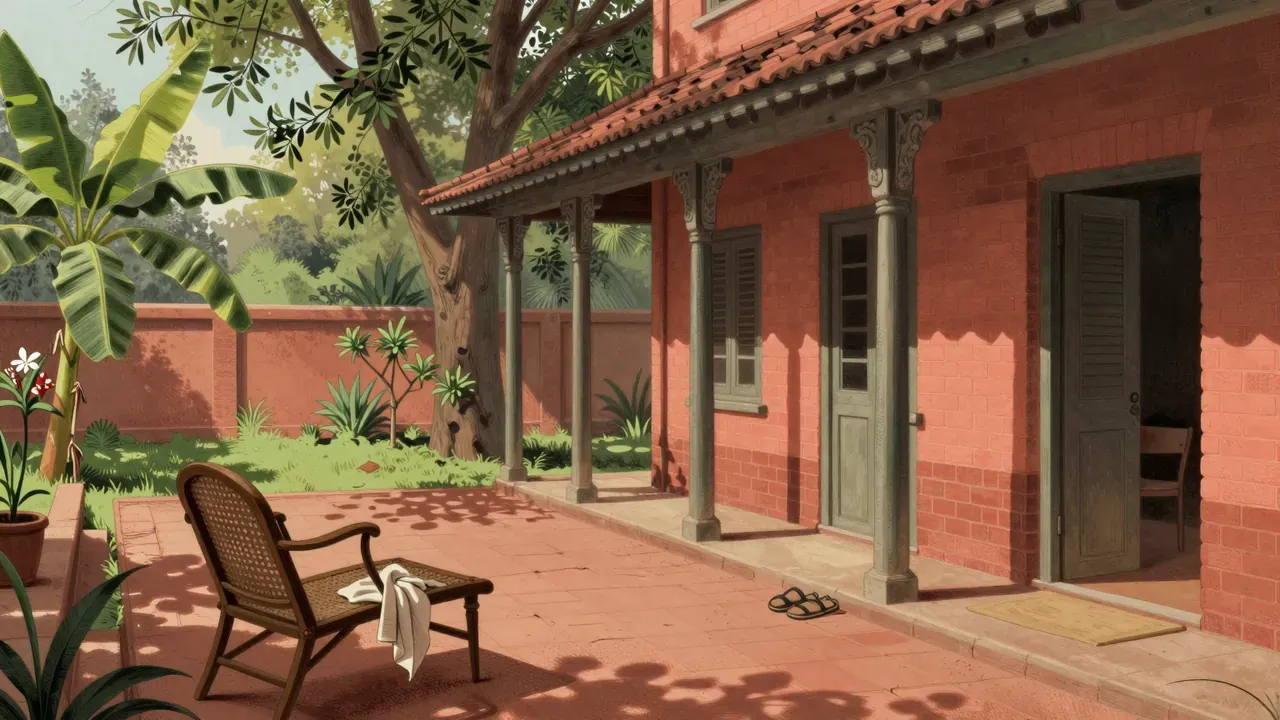
The story unfolds across 117 minutes with minimal incident and no music cues to signal feeling. Subrata Mitra’s cinematography keeps interiors dim and shallow, using deep-focus compositions that place Charu at the centre of rooms she never fully occupies. Madhabi Mukherjee’s performance rests in micro-gestures: a pause before turning a page, the way her fingers tighten on a binocular strap, the slight lift of her chin when Amal reads her writing aloud. Soumitra Chatterjee plays Amal with deliberate lightness — his charm is intellectual, not seductive — and Bankim Ghosh gives Bhupati a quiet, unperforming gravity. Ray’s editing, shaped by Dulal Dutta, favours long takes and rhythmic cuts between glances and objects: a swing, a notebook, a pair of slippers. The music — composed by Ray himself — is sparse, mostly diegetic, and anchored in Rabindra Sangeet sung by Kishore Kumar. There are no flashbacks, no voiceover, no symbolic weather except what appears in frame. Every decision serves the principle that character is revealed only through what is done, not declared.
The rhythm of restraint
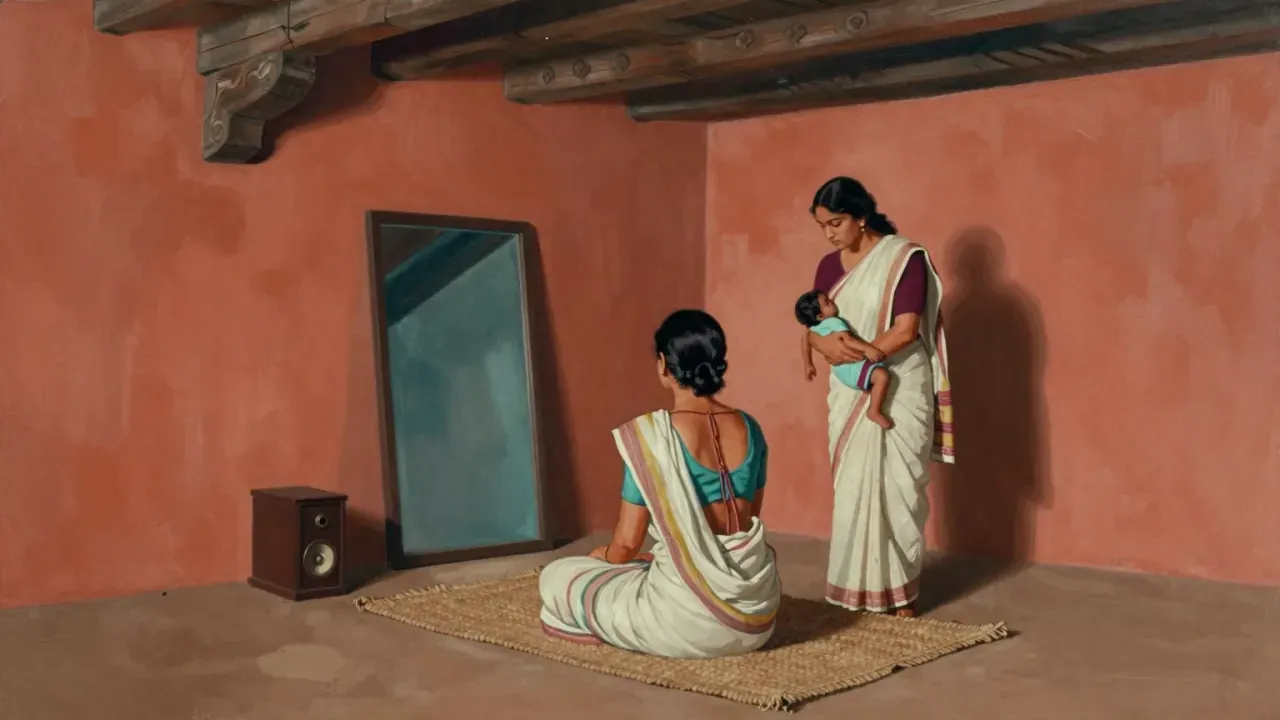
What lands most firmly is the film’s refusal to resolve its central tension. The freeze-frame ending — two hands reaching, then arrested — does not gesture toward ambiguity as evasion, but as fidelity to lived uncertainty. Charu’s loneliness is rendered not through monologue but through sustained observation: the opening shot, where she watches street life through binoculars, establishes a visual grammar of distance that recurs in every framed window, mirror, and doorway. The scene where she sings ‘Fule Fule Dhole Dhole’ on a swing is not lyrical ornamentation but structural punctuation: her voice rises as Amal looks away, and the camera holds her alone in the frame after the song ends. The politics of the era register not in speeches but in paper stock, typeface, and the sound of a press rolling. Even the betrayal by Umapada arrives off-screen, reported second-hand, making its emotional impact land not through shock but through the slow collapse of Bhupati’s posture in the following scene. Nothing feels staged for effect; everything feels observed.
The space between hands
What does not land — or rather, what risks alienating — is the film’s resistance to narrative propulsion. Viewers expecting escalation, confrontation, or catharsis will find none. There is no scene where Charu and Amal confess love, no moment where Bhupati rages or weeps openly, no decisive break or reconciliation. The film’s pacing assumes patience with stillness, and its emotional economy depends on reading absence: the space between sentences, the gap between intention and action, the silence after a name is spoken. Some may read this as withholding, or worse, passivity — particularly in Charu’s final cry of ‘Amal!’ which is neither accusation nor surrender, but an unmoored utterance that refuses interpretation. The lack of score-driven emphasis also means mood is never underlined; a viewer unfamiliar with the social codes of 1879 Calcutta’s bhadralok class may miss the weight carried by a glance across a dinner table or the significance of who handles the paan tray. This is not a flaw in execution, but a condition of its method.
The grammar of 1879
The themes that matter are not announced but accumulated: the gendered division of intellectual labour, the colonial inflection of Bengali modernity, the difference between literacy and authorship, and the quiet violence of domestic containment disguised as care. Charu’s embroidery, her binoculars, her notebook — all are tools of attention, yet none grant agency beyond the domestic sphere until she writes. Even then, publication happens without her husband’s knowledge, and her triumph is immediately followed by retreat. The film treats language itself as contested terrain: Bhupati edits a political paper in English and Bengali, Amal translates European poetry, Charu reads Tagore and writes in Bengali — each linguistic choice mapping a different relationship to power, tradition, and self-expression. The ‘western quality’ Ray named is not stylistic borrowing but structural: the film shares Mozart’s balance of formal discipline and emotional precision, where every note — or frame — must earn its place. Colonialism appears not as backdrop but as grammar: in the furniture, the newspapers, the very idea of ‘culture’ as something separable from politics.
The terms of attention
This film is for viewers who trust duration as meaning, who find tension in withheld gesture, and who value precision over exposition. It rewards attention to texture — the grain of wood, the rustle of silk, the cadence of a line read aloud — and assumes familiarity with the conventions of literary realism and classical Indian aesthetics. It is not for those who require narrative momentum, clear moral positions, or emotional signposting. A viewer who expects the film to ‘take sides’ — for Charu, against Bhupati, or vice versa — will be frustrated: Ray refuses hierarchy among the three leads, treating each as constrained by circumstance, temperament, and history. Those who dislike films where characters speak in full sentences, avoid shouting, and seldom look directly at the camera may find it inert. But the verdict changes if one accepts that stillness here is not emptiness — it is the space where thought, desire, and dignity coexist without resolution.
The freeze-frame of feeling
Yes, it is worth your evening — provided you give it your full, unhurried attention. Its 117 minutes unfold like a sentence written in careful calligraphy: every pause matters, every stroke carries weight. It repays close watching not because it hides secrets, but because it asks you to notice what is present — the tilt of a head, the position of a hand, the way light falls across a floorboard — and to sit with the discomfort of unresolved feeling. Those who prefer faster rhythms, explicit stakes, or conclusive endings will likely feel distanced, even bored. But for anyone willing to meet the film on its own terms — as a study in restraint, a portrait of quiet intelligence, and a masterclass in how cinema can hold space for what cannot be said — it remains as vivid and exacting today as it was in 1964. Its value lies not in what it delivers, but in what it refuses to simplify.