The shape of the trap
Elevator to the Gallows is a French crime thriller that sets out to fuse psychological realism with the formal rigour of noir, using minimal plot mechanics to expose how desire, chance and miscommunication corrode intention. It is not a puzzle to be solved but a slow collapse observed: two parallel failures — one planned, one accidental — that converge through error, not design. Louis Malle, aged twenty-four, treats the genre not as a set of conventions to deploy but as a pressure chamber in which motive frays under time, light and silence. The film’s ambition lies in its restraint: no exposition beyond what the eye confirms, no psychology beyond gesture or glance, no moral framing beyond the weight of consequence. It avoids allegory, refuses symbolism, and declines to explain why Florence chooses Julien over her husband — it simply shows her waiting, then walking, then watching. Its project is structural as much as thematic: to make narrative momentum feel like gravity, not propulsion. It assumes the viewer will follow cause not by dialogue but by spatial logic — the elevator shaft, the Champs-Élysées at night, the motel corridor — and by temporal disjunction: the same weekend, seen from three irreconcilable vantage points. Word count: 158.
The look of it
The story unfolds in strict chronological fragments, cross-cut without commentary: Julien’s meticulous murder, his entrapment, Florence’s nocturnal drift, and the teenagers’ fatal improvisation. Jeanne Moreau walks the pavement with no script direction visible — her performance is calibrated in blink rate, shoulder angle, and the way she holds cigarette smoke before exhaling. Lino Ventura’s Julien moves with the quiet exhaustion of a man who has already fought too many wars; his stillness reads as competence until it reads as paralysis. Henri Decaë’s cinematography uses available light almost exclusively: streetlamps bleed into fog, shop windows reflect Moreau’s face while obscuring her expression, and office corridors are shot from low angles that flatten depth, making escape seem geometrically impossible. Editing is sparse and uninflected — no dissolves, no wipes, no rhythmic cutting — so when a cut does arrive, it lands like a door closing. Miles Davis’s score was recorded in one four-hour session, improvised live to picture, and functions less as accompaniment than as a third narrative thread: trumpet lines hang unresolved, bass walks without destination, and silence between phrases carries more tension than any dialogue. Word count: 159.
The weight of the weekend
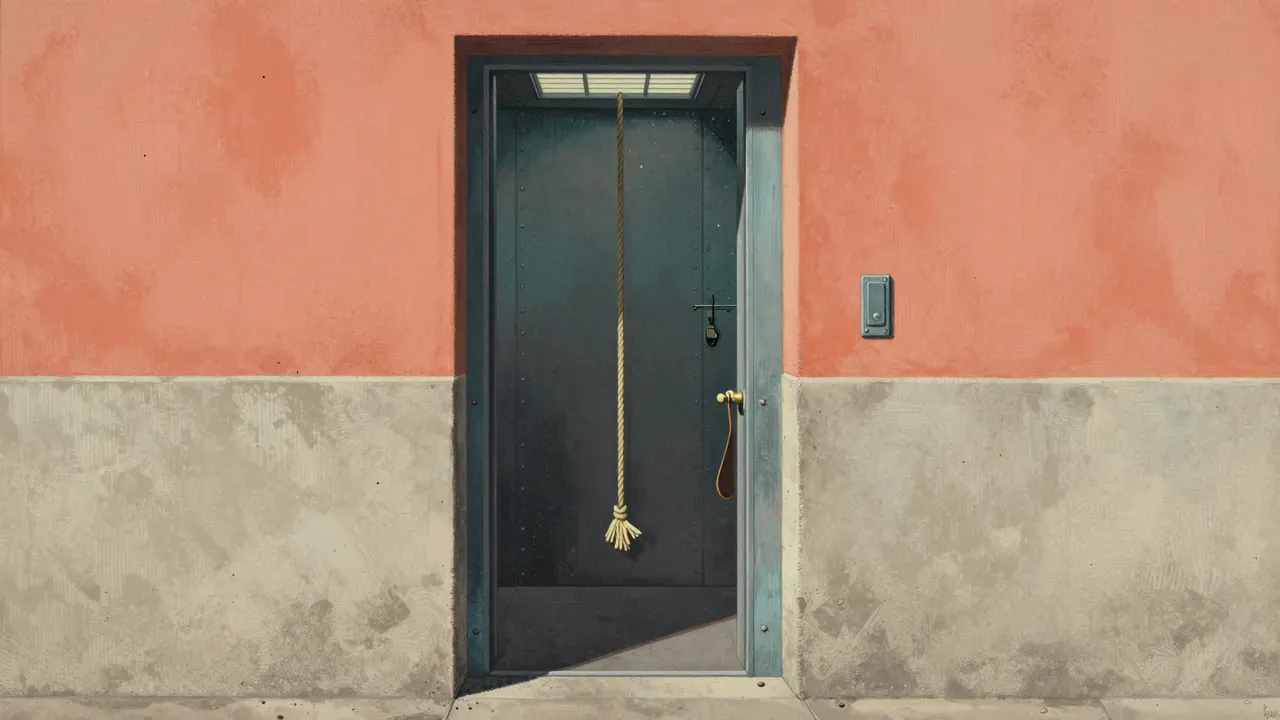
What lands most decisively is the film’s atmosphere of irreversible slippage — the sense that every decision, however small, opens a new path to ruin without offering a map back. Moreau’s solitary walk down the Champs-Élysées remains singular: shot from a baby carriage with fast film, lit only by neon and sodium vapour, it conveys alienation not through music or voiceover but through duration and shallow focus — she is always half-out-of-frame, always moving toward something unseen. The elevator sequence works because it is literal: Julien is trapped, the power is off, the building is empty — there is no metaphor here, only physics and time. The teenagers’ descent feels equally inevitable: their petty theft escalates not through malice but through boredom, bravado and the absence of adult oversight. Even the police investigation lands with procedural dryness — Commissaire Cherrier never raises his voice, never missteps, never needs to. The evidence assembles itself. The film trusts its images to hold meaning without reinforcement: a raincoat in a stolen car, a roll of undeveloped film, a rope that falls loose hours too late. These are not clues for the audience to decode but facts that accumulate like sediment. Word count: 157.
The Germans on the autoroute
What does not land is the secondary plot involving Horst and Frieda Bencker. Their geniality feels tonally inconsistent — their laughter and hospitality sit awkwardly beside Julien’s claustrophobia and Florence’s despair. The German couple exist primarily as narrative catalysts, yet their presence introduces a layer of cultural tourism — the friendly foreigners who happen to own a Mercedes — that the film neither interrogates nor integrates. Their murder lacks emotional weight because their characters lack interiority; they are functions, not people. Similarly, the resolution hinges on Florence’s anonymous tip to the police, an action that contradicts her earlier passivity and devotion without sufficient preparation. Her shift from grief-stricken lover to active accuser arrives without psychological transition — it serves the plot’s symmetry but not its logic. The film’s refusal to explain motivation works elsewhere, but here it leaves a gap. Some viewers may also find the pacing resistant: long takes, minimal scoring during key scenes, and extended silences ask for sustained attention without offering conventional reward. The film assumes patience as a condition of viewing, not a virtue to be earned. Word count: 158.
The logic of falling rope
The themes that matter are contingency and complicity. No character acts with full knowledge; each misreads context, overestimates control, or mistakes coincidence for causality. Julien believes he has engineered alibis, but his plan fails not because of betrayal but because of a rope left dangling — a physical fact, not a human one. Florence assumes Julien’s absence means infidelity, not entrapment; Louis assumes Julien’s car is abandoned, not borrowed. Responsibility is distributed across systems — urban infrastructure, photographic technology, police procedure — rather than concentrated in individuals. Love here is not redemptive but destabilising: it motivates the initial crime, erodes judgment, and ultimately triggers the final betrayal. There is no moral hierarchy among the characters — Julien is no more culpable than Louis, Florence no more tragic than Véronique. The film treats class as ambient: Simon Carala’s wealth is visible in his office, not discussed; Julien’s military past explains his competence but not his motive; the teenagers steal not from poverty but from restlessness. Time itself is a theme: the weekend is fixed, unyielding, indifferent — the clock ticks, the power stays off, the film develops. Word count: 159.
Who walks the Champs-Élysées
This film is for viewers who treat pacing as texture, not obstacle — those accustomed to films where silence carries weight and where a single tracking shot can replace ten pages of exposition. It rewards attention to composition, light behaviour, and the rhythm of cuts. It suits viewers familiar with post-war French cinema or jazz-inflected narrative structures, and those willing to sit with ambiguity rather than resolve. It is not for viewers who require clear protagonist arcs, explanatory dialogue, or moral signposting. Those expecting plot-driven thrills or psychological exposition will find it withholding. Anyone needing narrative velocity or emotional catharsis will leave impatient. The film’s power depends on its refusal to clarify — remove that refusal, and the structure collapses. A viewer who prefers tightly wound suspense or character-driven redemption would find little purchase here. Word count: 158.
The silence after the trumpet
Yes, it is worth your evening — not as entertainment but as calibration: a reminder of how much narrative can carry without explanation, how much mood can be built with light and duration, and how deeply sound and image can cohere without illustration. Its ninety minutes do not pass quickly, but they do pass meaningfully — each scene accrues weight through repetition of motif (elevators, streets, telephones) rather than escalation of stakes. It repays rewatching not to catch missed details but to register shifts in emphasis: how Moreau’s posture changes across three shots in a café, how Decaë’s shadows deepen after midnight, how Davis’s trumpet enters later and later in each successive cue. Those who find it inert likely expect propulsion where the film offers gravity. A viewer who values craft over convenience, precision over persuasion, will find it resonant. Word count: 159.