The day of the visit
A Special Day is a tightly framed Italian-Canadian drama set in Rome on 4 May 1938, the day Hitler visits Mussolini. It attempts something precise: to hold two marginalised lives — a fascist housewife and a dismissed gay radio broadcaster — in quiet, sustained proximity, while the regime’s spectacle surges past their apartment block. It does not dramatise the parade, the speeches or the rallies; instead, it treats the visit as atmospheric pressure, a civic event so total that its absence from the frame becomes its own kind of presence. The film’s ambition is structural and ethical: to let domestic routine and enforced silence speak louder than slogans, and to locate resistance not in defiance but in unscripted attention — a glance held too long, a book lent, a rumba danced without music. It refuses historical exposition, trusting the viewer to infer ideology from gesture, costume, and the weight of official silence around Gabriele’s arrest. Its fidelity is to mood over momentum, to implication over explanation.
The look of it
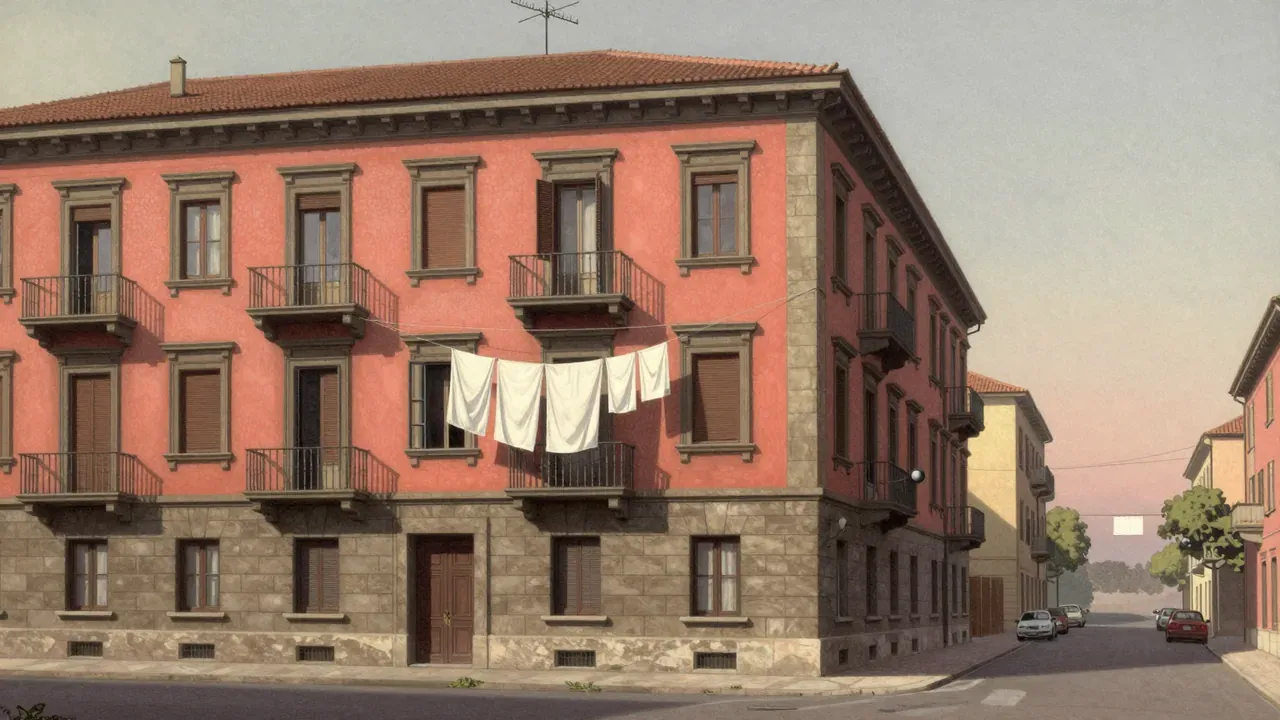
The story unfolds across a single afternoon in one Roman apartment building, with Pasqualino De Santis’ cinematography anchoring it in muted sepia tones and deep-focus compositions that keep Antonietta and Gabriele visually connected even when physically apart. Sophia Loren and Marcello Mastroianni perform against type: Loren’s Antonietta is physically weary, emotionally porous, her gestures small and habitual; Mastroianni’s Gabriele is watchful, sardonic, his charm worn thin by exhaustion. Their scenes rely on rhythm rather than revelation — pauses, interruptions, shifts in posture. Raimondo Crociani’s editing sustains this tempo, avoiding cuts that resolve tension, preferring instead lingering takes that let discomfort settle. Armando Trovajoli’s score is sparse, often absent, leaving room for the clatter of dishes, distant crowd noise, and the hollow echo of footsteps in empty corridors. The long take that enters through the kitchen window establishes not just setting but hierarchy: domestic labour as invisible architecture.
What holds
What lands most firmly is the film’s restraint. Its refusal to moralise or sentimentalise gives the central encounter its gravity: the sex scene is neither redemptive nor transformative, and the film honours that ambiguity. The muted colour grade does not soften history but distances it — not as nostalgia, but as archival remove. The performances land because they withhold: Loren never asks for sympathy, Mastroianni never performs vulnerability, and their mutual recognition feels earned precisely because it is slow, hesitant, and incomplete. The final image — Antonietta reading The Three Musketeers as Gabriele is led away — works not as irony but as quiet rupture: a book, not a banner, becomes the first thing she chooses for herself. The film’s power resides in what it leaves unsaid: the myna bird’s flight, the off-screen arrests, the unopened letter Gabriele leaves behind. These absences are calibrated, not evasive.
Where it strains
What does not land is the film’s occasional reliance on schematic contrast — the fascist husband’s bluster versus Gabriele’s quietude, Antonietta’s domestic confinement versus the street’s collective frenzy — which at times flattens into illustration rather than insight. John Vernon’s brief appearance as a party functionary feels theatrically broad beside the subtlety elsewhere. The script’s decision to name Hitler and Mussolini in the cast list, while factually accurate, risks misreading: neither appears on screen, and their inclusion may mislead viewers into expecting direct confrontation with historical figures rather than their ideological shadow. Some dialogue leans on exposition that the actors’ physicality already conveys — particularly Gabriele’s confession about his dismissal, which lands more strongly in Mastroianni’s silence before speaking than in the words themselves. The film’s rigour occasionally borders on austerity, and its refusal to widen the frame beyond the apartment can feel like constraint rather than discipline.
What it’s really about
The themes that matter are not abstract but embodied: how fascism regulates time (through parades, curfews, birth quotas), space (through surveillance, neighbourly suspicion, the bachelor tax), and intimacy (by criminalising desire and prescribing reproduction). Gender and sexuality are treated not as identities but as sites of state intervention — Antonietta’s six children qualify her for a bonus; Gabriele’s homosexuality marks him for Sardinia. The film insists these are parallel oppressions, not equivalents: one is rewarded, the other punished, yet both are stripped of agency by the same apparatus. Its quietest theme is literacy — not just Antonietta reading, but her learning to read Gabriele, and him learning to read her exhaustion as intelligence. The regime’s language saturates the air — ‘population’, ‘duty’, ‘purity’ — but the film’s moral centre lies in the private, untranslatable grammar of two people sharing bread, dancing badly, and choosing, however briefly, not to lie.
Who it’s for
This film is for viewers who trust slowness, who find tension in stillness, and who value performance as accumulation rather than climax. It rewards attention to texture — the grain of wallpaper, the weight of a curtain, the way light falls across a floorboard — and assumes familiarity with mid-century Italian social history, though it does not require specialist knowledge. It is not for those who need plot propulsion, narrative resolution, or characters who change decisively. Some will find its political critique too implicit, its pacing too deliberate, its ending too muted. Critics who prioritise dramatic escalation over psychological fidelity — such as Vincent Canby, who found the leads ‘too glamorous’ for their roles — would likely remain unconvinced. A different verdict would follow if the film had chosen broader satire or sharper polemic, but its commitment to interiority is consistent and absolute.
Is it worth your evening?
Yes, it is worth your evening — provided you approach it as a chamber piece, not a historical epic. Its 105 minutes pass with the quiet insistence of a clock heard through a wall: steady, unshowy, impossible to ignore. It repays rewatching not for hidden clues but for shifts in emphasis — how a line delivered differently on second viewing alters the balance of power between the two leads, or how the sepia tone begins to feel less like period styling and more like emotional weather. Those who expect catharsis or closure may leave restless, but the film’s purpose is not release but resonance. Its value lies in the space it holds open — between duty and desire, between compliance and quiet dissent, between what is said and what is withheld. That space remains charged long after the credits end.