The sound of it
Opening Night is a psychological drama about an actress’s disintegration in the week before a Broadway premiere. It tries to hold a mirror to performance as self-erasure: not just acting, but the ritual of becoming someone else while losing purchase on who you are. John Cassavetes does not dramatise breakdown as plot device or narrative climax; he builds it as process — slow, repetitive, unvarnished. The film refuses exposition, explanation, or psychological shorthand. It treats Myrtle Gordon’s hallucinations, drunkenness, and script sabotage not as symptoms to be decoded but as facts of her present reality — as real to her as the stage lights or the audience’s silence. This is not a film about mental illness as diagnosis, but about identity under pressure from time, expectation, and the gaze of others. It asks how much of the self survives when every role — daughter, lover, star, mourner — becomes another part to be played, rehearsed, discarded. Cassavetes’ aim is neither catharsis nor commentary, but sustained, uncomfortable proximity to a woman whose boundaries between performance and personhood have dissolved. (158 words)
The look of it
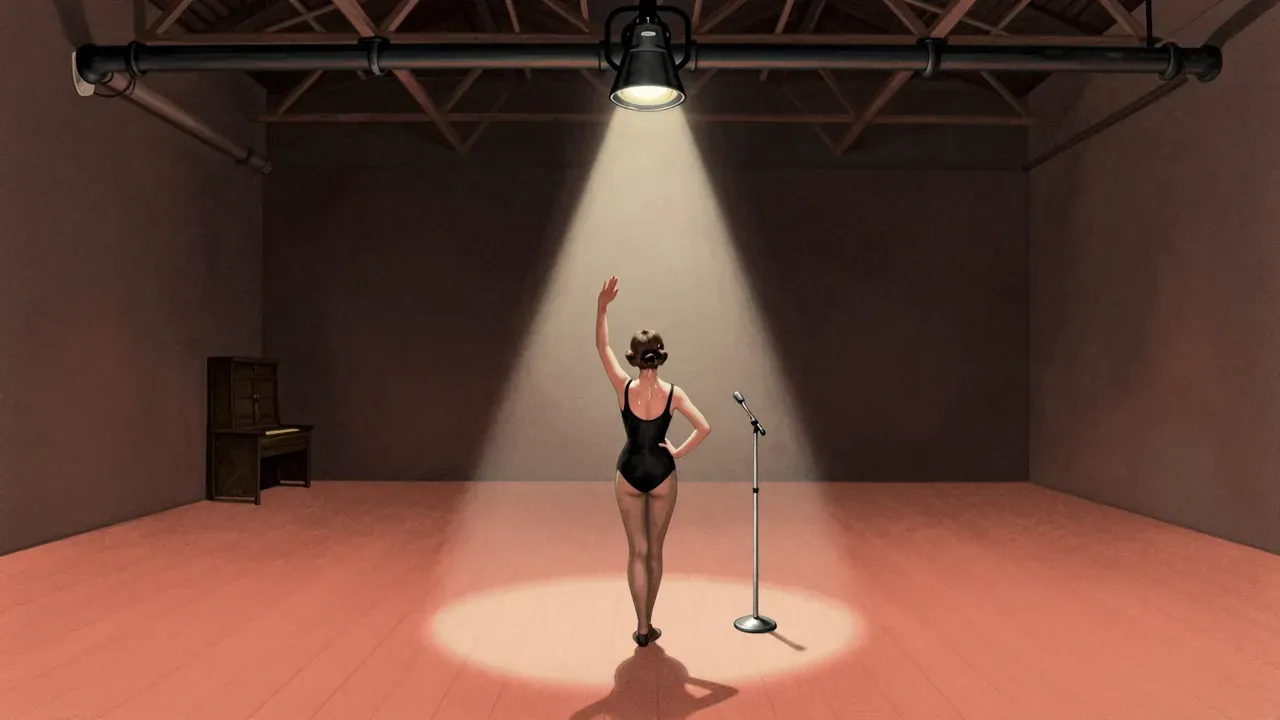
The story unfolds across rehearsals, hotel rooms, and backstage corridors, anchored by Gena Rowlands’ unbroken, physically exacting performance. She moves through scenes with a tremor that never resolves into collapse or recovery — it simply persists, like breath. Ben Gazzara plays Maurice with quiet exhaustion, Joan Blondell’s aging actress Sarah Goode delivers lines with the weight of lived contradiction, and Al Ruban’s cinematography keeps the frame tight, handheld but never frantic, letting faces dominate without flinching. Bo Harwood’s score is sparse, mostly ambient piano and low strings, used only where silence would feel like evasion. There is no editing trickery to signal unreality: Nancy’s apparition appears in the same light, same focus, same acoustic space as everyone else. The theatre sequences were shot at Pasadena Civic Auditorium, and the production design makes no effort to disguise its Californian locations as New York — the disjunction is left unremarked. Cassavetes avoids symbolic colour or composition; what registers is texture — sweat on skin, lipstick smudged across a collar, the grain of a wooden floor under bare feet. Every technical choice serves duration over emphasis, accumulation over revelation. (159 words)
The rhythm of it
What lands is the sheer physical credibility of Rowlands’ performance — not as virtuosity, but as endurance. Her Myrtle does not ‘act out’; she wears fatigue like clothing, speaks in half-sentences that trail off not from uncertainty but from depletion, and stumbles not for effect but because her centre of gravity has shifted. The scene where she throws herself against Sarah’s hotel room wall feels less like breakdown than recalibration — a body reasserting itself through violence when language fails. The final improvisation on opening night works because it arrives without fanfare: no swelling music, no close-up on a tear, just two actors finding rhythm in shared exhaustion, and the audience’s applause sounding like relief rather than triumph. Cassavetes trusts the audience to register meaning in pauses, in glances held too long, in the way Rowlands blinks slowly after a line — not as hesitation, but as the cost of having spoken at all. The film’s power lies in its refusal to separate craft from collapse: every misstep, every slurred word, every missed cue is both symptom and strategy. It lands because it never pretends to explain itself — it simply insists on being witnessed. (157 words)
The presence of it
What does not land is the film’s structural patience when viewed outside its intended context. Its 144-minute runtime rests on repetition — rehearsals that blur, arguments that circle, drinks that refill — and this accumulates meaning only if the viewer accepts that nothing will be resolved, clarified, or redeemed. Some scenes — particularly Myrtle’s extended monologues to empty rooms — risk monotony without the cumulative weight of prior scenes anchoring them. The absence of conventional narrative scaffolding means that viewers expecting cause-and-effect logic, character arcs, or even consistent motivation may find the film withholding rather than rigorous. Cassavetes offers no authorial handhold: no voiceover, no cutaways to reaction shots that confirm interpretation, no musical cue to tell us how to feel. The result is a film that resists assimilation — not because it is obscure, but because it refuses to translate its terms. Those who expect psychological realism to yield insight, or drama to build toward resolution, will leave frustrated. The film does not fail these expectations; it declines to meet them. (156 words)
The weight of it
The themes that matter are ageing as erasure, performance as survival, and grief as contagion. Myrtle does not mourn Nancy as a stranger, but as a version of herself she can no longer access — youth not as memory but as phantom limb. The play within the film, The Second Woman, is never shown in full; its script is a prop, its meaning unstable, its purpose unclear — mirroring how roles become containers for anxieties we cannot name. Cassavetes treats celebrity not as privilege but as exposure: Myrtle is watched everywhere — by fans, directors, writers, lovers — and each gaze compounds her sense of fragmentation. Alcohol is not escapism but calibration: a tool to narrow perception when the world feels too wide, too loud, too full of demands. The film’s most persistent motif is the mirror — literal and metaphorical — not as site of vanity, but as surface where identity fractures under scrutiny. There is no redemption arc, no late wisdom, no reconciliation with time. What endures is the question: when the self is made of parts performed for others, what remains when the curtain falls and no one is watching? (158 words)
The breaking of it
This film is for viewers who value sustained attention over exposition, who find emotional precision more compelling than plot momentum, and who accept that some truths are held in gesture, not speech. It rewards those familiar with Cassavetes’ earlier work — not as prerequisite, but because his methods assume a viewer willing to sit with ambiguity for long stretches. It is not for those who require narrative clarity, psychological closure, or tonal consistency. Anyone expecting a conventional portrait of addiction, trauma, or theatrical life will find it alienating. Critics who dismissed it on release — like the Variety reviewer who questioned its audience — were not wrong about its difficulty, only about its purpose. A tighter edit or clearer thematic signposting would not improve it; it would contradict its central claim — that breakdown is not dramatic punctuation, but daily weather. The verdict changes only if the viewer shifts from asking ‘what happens next?’ to ‘how does it feel to be here, now, like this?’ (159 words)
The leaving of it
Yes, it is worth your evening — but only if you give it your full, undivided attention for its entire 144 minutes. It does not function as background, mood, or casual viewing. Its power emerges from accumulation: the third rehearsal matters because of the first two; the final improvisation lands because of every earlier failure. Viewers who watch while distracted, or who skip ahead, will miss the architecture of its exhaustion. It is not for those seeking entertainment, uplift, or even insight — it offers none of those as deliverables. But for those who want to witness, without mediation, what it costs to remain visible as time passes, it is singular. Detractors argue it mistakes indulgence for intensity; supporters say it honours the labour of staying present in a self that refuses to hold still. Neither side is mistaken — they are measuring different things. The film’s value lies not in what it says, but in how relentlessly, honestly, it shows. (159 words)