The premise
Wild 90 is Norman Mailer’s first film, an improvised, self-financed experiment in collapsing the distance between literary persona and cinematic presence. It attempts to stage a raw, unmediated performance of male bravado — not as narrative drama but as behavioural provocation. Mailer, Mickey Knox, and Buzz Farbar play gangster avatars — The Prince, Twenty Years, and Buzz Cameo — improvising in a Lower Manhattan apartment over four nights. There is no script, no retakes, no rehearsal: the film is built from the repetition, escalation, and exhaustion of their own voices and gestures. Its ambition lies not in storytelling but in testing endurance — of attention, of decorum, of the audience’s willingness to sit with unfiltered, unedited male posturing. It treats the gangster myth not as genre but as psychological mask, worn loosely and discarded often. The title’s reference to Mafia slang for deep trouble signals both its subject and its method: it courts incoherence as authenticity, noise as evidence of life lived without filter. It is less a film about crime than about the theatricality of threat, the ritual of insult, and the slow collapse of performative control.
The making
The story is a loose frame: three men barricaded in a squalid space, armed with props, drinking, insulting, barking, and waiting for an end that never arrives with clarity. Performances are unrehearsed and physically committed — Mailer’s physicality dominates, Knox offers deadpan resistance, Farbar volleys with manic timing. D. A. Pennebaker shoots in black-and-white 16mm, keeping the camera close, handheld but rarely intrusive; he captures sweat, slurred diction, and shifting power dynamics without editorialising. The sound was recorded on magnetic tape, and a technical fault left roughly one-quarter of the soundtrack muffled — Mailer refused to correct it, treating the distortion as part of the film’s texture. Editing reduces 150 minutes of footage to 90, preserving rhythm over coherence. Beverly Bentley appears briefly as Margie, José Torres as the man with the barking dog — their interventions punctuate rather than resolve. There is no score, no lighting design beyond available sources, no continuity checks. Craft here is subtraction: no artifice is added, only what was captured — flaws included — is retained.
The performances
What lands is the sheer physical immediacy of three intelligent men surrendering to absurdity. Their insults land because they are specific, rhythmic, and delivered with escalating commitment — not as jokes but as acts of mutual destabilisation. The barking contest with Torres’ dog achieves a kind of surreal logic: it is ridiculous, but it feels earned by the preceding hours of vocal strain. The knife offered to Mailer’s character carries weight precisely because it arrives without exposition — a gesture stripped of motive, yet resonant with fatalism. Pennebaker’s camerawork avoids condescension; he watches without judging, letting duration do the work. The film’s refusal to explain itself — its rejection of exposition, motivation, or resolution — becomes its most consistent formal choice. In moments where the trio falls into exhausted silence or repeats a phrase until it hollows out, the film touches something real about performance fatigue, about the limits of charisma when sustained too long without rest or redirection.
The rhythm
What does not land is the assumption that repetition equals revelation. The profanity, while historically noted for its density, quickly ceases to shock or signify — it becomes ambient noise, then tedium. The improvisation lacks structural counterpoint: there is no rising action, no pivot, no variation in tone beyond increasing volume and decreasing articulation. The ‘gangster’ premise remains purely nominal; no social context, no stakes, no consequence accrue to the role-play. The muffled soundtrack does not deepen realism — it obstructs it, turning dialogue into guesswork rather than intimacy. Mailer’s insistence on no retakes produces not spontaneity but diminishing returns: by the final third, the energy curdles into monotony, not menace. The film mistakes persistence for intensity, and endurance for meaning. Its refusal of craft — of editing for pace, of sound correction, of even basic framing discipline — reads less as radical honesty and more as abdication: the absence of decision-making mistaken for artistic principle.
The theme
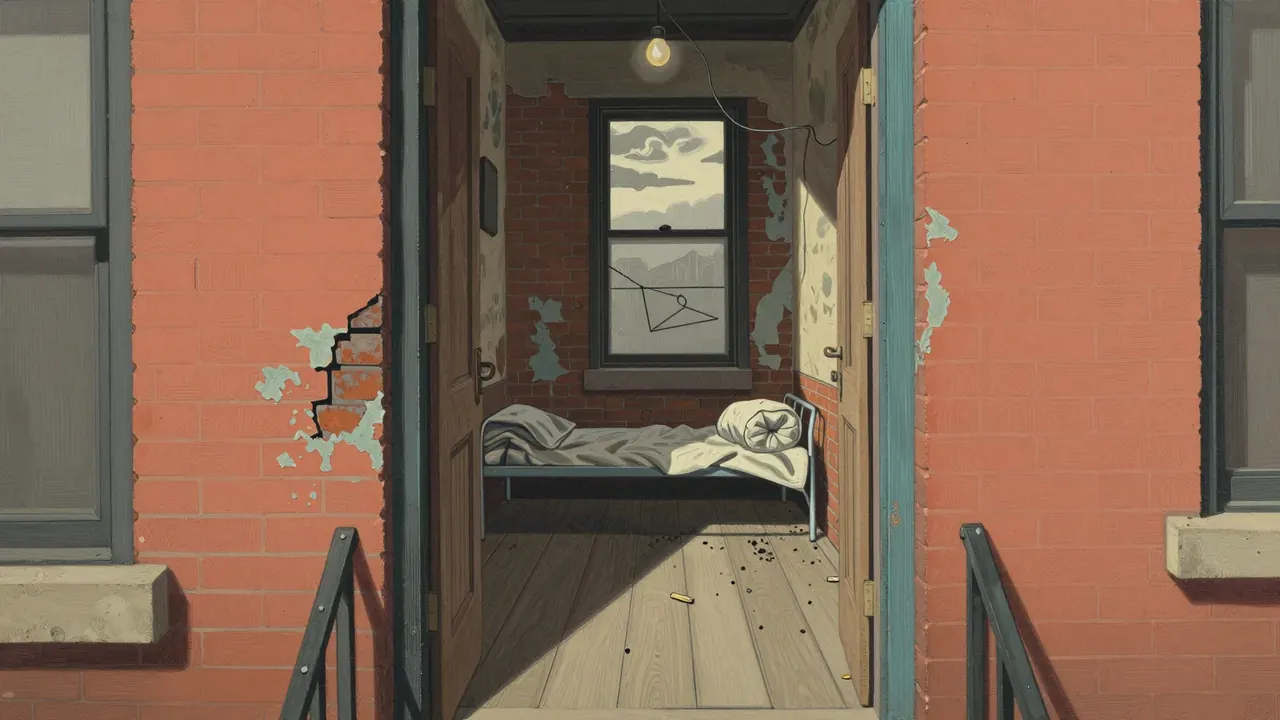
The themes that matter are the performativity of masculinity, the exhaustion of posturing, and the gap between intellectual self-image and bodily limitation. Mailer’s Prince is not a criminal but a writer playing at danger — and the film documents how quickly that game degrades under time and alcohol. It interrogates authorship not as control but as exposure: Mailer writes nothing, directs nothing scripted, yet remains utterly central — his presence is the film’s gravity well. The warehouse setting is not a hideout but a stage stripped bare; the guns are toys, the liquor real. The visitations — by the barking man, by the women with the knife — function not as plot points but as interruptions to the loop, reminders that the world outside persists, indifferent. Wild 90 is less about organised crime than about the solitary spectacle of ego attempting, and failing, to sustain its own mythology. Its deepest concern is the moment when performance stops convincing even the performer — when the mask slips not into vulnerability, but into vacancy.
The audience
This film is for viewers who value process over product, who find interest in the archaeology of failure, and who seek films that test the boundaries of watchability as a formal strategy. It rewards patience with moments of startling physical honesty and rhythmic precision, particularly in its middle stretch. It is not for those who require narrative coherence, emotional through-lines, or intelligible dialogue — nor for anyone unwilling to sit with deliberate monotony as aesthetic choice. Those who admire Pennebaker’s documentary rigour may find fascination in his restraint amid chaos; those who read Mailer as a cultural figure will see a rare, unvarnished document of his mid-1960s persona. Anyone expecting satire, genre commentary, or even coherent improvisation will leave frustrated. The film assumes a tolerance for repetition that few contemporary viewers possess — and offers no apology, no justification, no relief.
The verdict
It is worth your evening only if you approach it as a historical artefact — not as entertainment, not as cinema in any conventional sense, but as a document of a particular moment in American avant-garde practice, when literary fame met low-fi filmmaking with uncompromising literalism. Its value lies in its extremity: as a case study in what happens when authorial control is abandoned without replacing it with collaborative structure. It is not enjoyable in the usual sense, but it is revealing — of Mailer’s contradictions, of Pennebaker’s observational discipline, of the limits of improvisation without scaffolding. Those who dismiss it as amateurish miss its intentionality; those who praise it as revolutionary overstate its influence. It remains a curiosity — compelling in fragments, exhausting in full. Its ninety minutes ask not for engagement but endurance — and whether that endurance yields insight depends entirely on what you bring to the screen.