The shape of it
Being There is a satirical comedy-drama that treats political and social credulity as a structural condition, not a flaw. It does not mock individuals for misreading Chauncey Gardiner — it shows how systems of power, media, and language produce meaning without reference to truth. The film adapts Jerzy Kosiński’s 1970 novel with minimal embellishment, preserving its parable-like austerity: a man who has never left a garden, knows only television, and speaks only in horticultural non-sequiturs is absorbed into the highest echelons of American influence. Its aim is not to expose hypocrisy but to demonstrate how authority coalesces around silence, repetition, and surface coherence — how a vacuum can be mistaken for profundity when the surrounding apparatus demands one. Hal Ashby directs with restraint, refusing caricature or editorial emphasis. The satire is embedded in structure, not tone: every institution — medicine, diplomacy, journalism, the presidency — responds to Chauncey with the same earnest misinterpretation. It asks no rhetorical questions; it simply holds up a mirror calibrated to reflect how little substance is required for consensus. (158 words)
The look of it
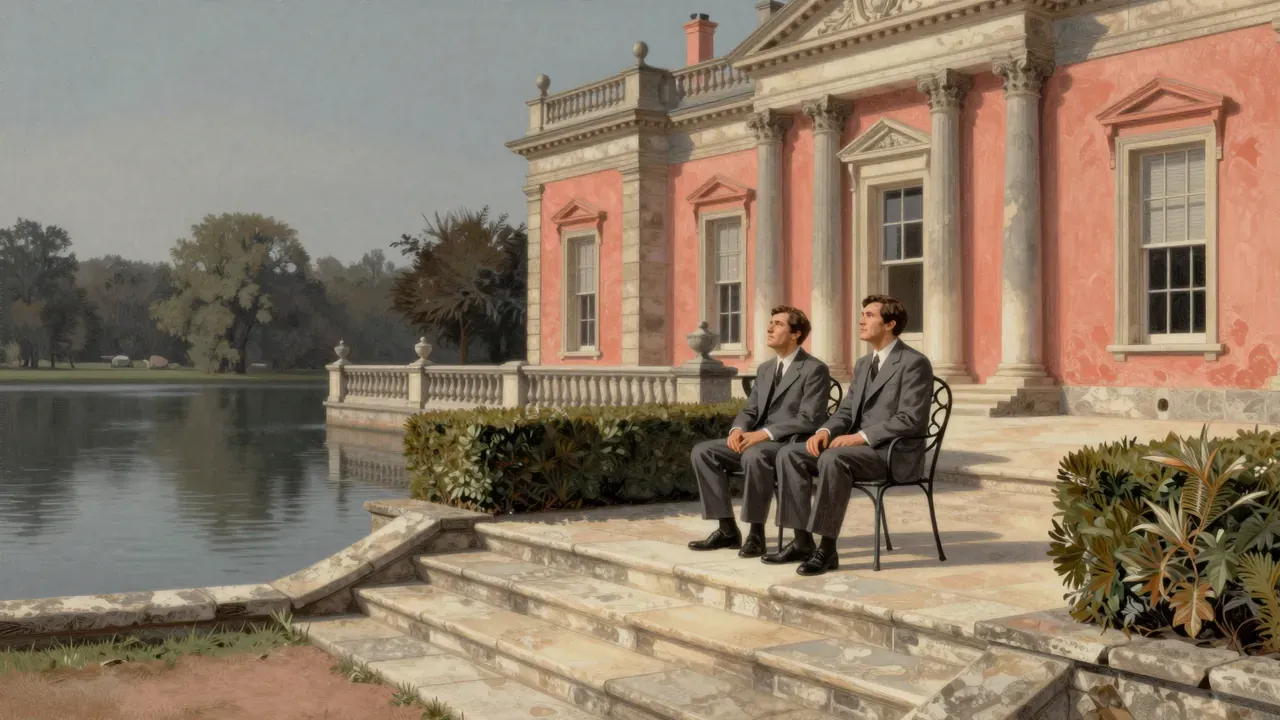
The story proceeds with glacial inevitability, each scene tightening the loop between Chauncey’s literalism and others’ projections. Peter Sellers performs with near-total physical economy: no facial tics, no vocal inflection beyond what the script gives him, his posture fixed in mid-century formality. Shirley MacLaine modulates Eve’s desire and loneliness with quiet precision; Melvyn Douglas gives Ben Rand a weary, lucid warmth that makes his final endorsement feel earned, not absurd. Caleb Deschanel’s cinematography avoids flourish — interiors are lit with soft, even diffusion, exteriors held in crisp, unromantic daylight. Don Zimmerman’s editing sustains rhythm without urgency: pauses linger just long enough to register discomfort, then cut before explanation arrives. Johnny Mandel’s score uses Satie motifs sparingly, their repetition mirroring Chauncey’s speech patterns. The Biltmore Estate grounds the film in tangible opulence, yet feels hermetically sealed — no traffic, no weather, no incidental life beyond what serves the central conceit. Every craft choice reinforces the film’s thesis: meaning is assigned, not discovered. (159 words)
The weight of it
What lands is the cumulative weight of misreading — not as farce, but as quiet, systemic inevitability. Chauncey’s line ‘I like to watch’ lands because it is both utterly sincere and catastrophically misunderstood; the audience hears the double meaning but watches institutions absorb it as policy insight. The talk-show sequence works not through irony but through fidelity: the host’s earnest probing, the studio audience’s respectful silence, the Soviet ambassador’s nodding gravitas — all are rendered without mockery, making the absurdity structural, not performative. The President quoting ‘stimulate growth’ as if it were economic doctrine lands because the film refuses to wink. Even the lake-walking ending lands precisely because it offers no resolution: it is neither miracle nor trick, but image-as-conclusion, demanding no interpretation beyond what is shown. The film’s restraint makes its satire durable — it does not date because it does not rely on topical targets, but on the mechanics of reception itself. That clarity of purpose, sustained over 130 minutes, is rare and exacting. (156 words)
The gaps in it
What does not land is the framing device of Louise’s commentary — her line about ‘rice pudding between the ears’ arrives with narrative weight but no follow-through, functioning more as exposition than insight. The subplot involving Dr. Allenby’s suspicion remains underdeveloped; his internal conflict resolves too neatly, undercutting the film’s otherwise unsentimental logic. The masturbation scene, reportedly a point of contention during casting, sits uneasily: it is neither integrated into Chauncey’s psychology nor used to interrogate Eve’s agency, landing instead as a blunt, isolated provocation. Some supporting performances — particularly Jack Warden’s President — lean into caricature where the rest of the film avoids it, creating tonal friction. The film’s refusal to explain also becomes a limitation in places: the Secret Service’s inability to trace Chauncey strains plausibility not because it is unbelievable, but because the film gives no institutional texture to make that disbelief legible. These are not failures of craft, but of calibration — moments where the film’s rigour falters into either omission or overstatement. (155 words)
The ground of it
The themes that matter are abstraction as authority, television as epistemology, and the erosion of referential language in public life. Chauncey’s speech is not nonsense — it is perfectly coherent within its own domain (gardening), and the film insists that coherence alone is sufficient for uptake in elite discourse. His knowledge is entirely second-hand, mediated by broadcast signals, yet he becomes a conduit for national reassurance. The film treats television not as distraction but as infrastructure: it shapes syntax, gesture, emotional response — even intimacy, as when Eve mimics a kiss from The Thomas Crown Affair. Ageing and mortality are treated with gravity, not metaphor: Ben Rand’s decline is physical, slow, unvarnished, and his attachment to Chauncey reads less as delusion than as a late-life hunger for unambiguous presence. Class operates silently — not through dialogue but through costume (Chauncey’s 1930s suits), space (the Biltmore’s scale), and access (Louise’s exclusion from the estate’s inner rooms). None of these themes are argued; they are embedded in duration, framing, and silence. (157 words)
The pace of it
This film is for viewers who tolerate stillness, value precision over pace, and find intellectual satisfaction in sustained ambiguity. It rewards attention to cadence, costume, and compositional balance — not plot turns or character arcs. It is not for those who require narrative propulsion, psychological exposition, or moral resolution. Anyone expecting satire with punchlines or political critique with villains will leave impatient; the film refuses to name culprits or assign blame. Its pacing assumes a viewer willing to sit with uncertainty for minutes at a time — a disposition increasingly rare. Those who respond to Ealing comedies or early Bergman may find kinship here; fans of rapid-fire satire like Dr. Strangelove or Network may find it inert. The verdict changes only if one values linguistic economy and structural irony over dramatic momentum — a preference, not a deficiency. (152 words)
The surface of it
Yes, it is worth your evening — provided you approach it as a study in reception, not a story to be followed. Its 130 minutes unfold with the weight of a held breath, and its payoff is not revelation but recalibration: after watching, familiar phrases — ‘growth’, ‘balance’, ‘seasonal change’ — carry new, unsettling resonance. It earns its runtime not through incident but through accumulation: each misreading tightens the film’s central proposition. Those who dislike it tend to cite its slowness or perceived coldness, but those objections mistake method for mood. It is not indifferent — it is exacting. To call it ‘cold’ is to miss how deeply it registers Ben’s frailty, Eve’s isolation, or Chauncey’s quiet bewilderment. Its endurance lies in how little it explains — and how much it implies. If you have ninety minutes to spare and are willing to let a film hold its ground without yielding, this is time well spent. (153 words)