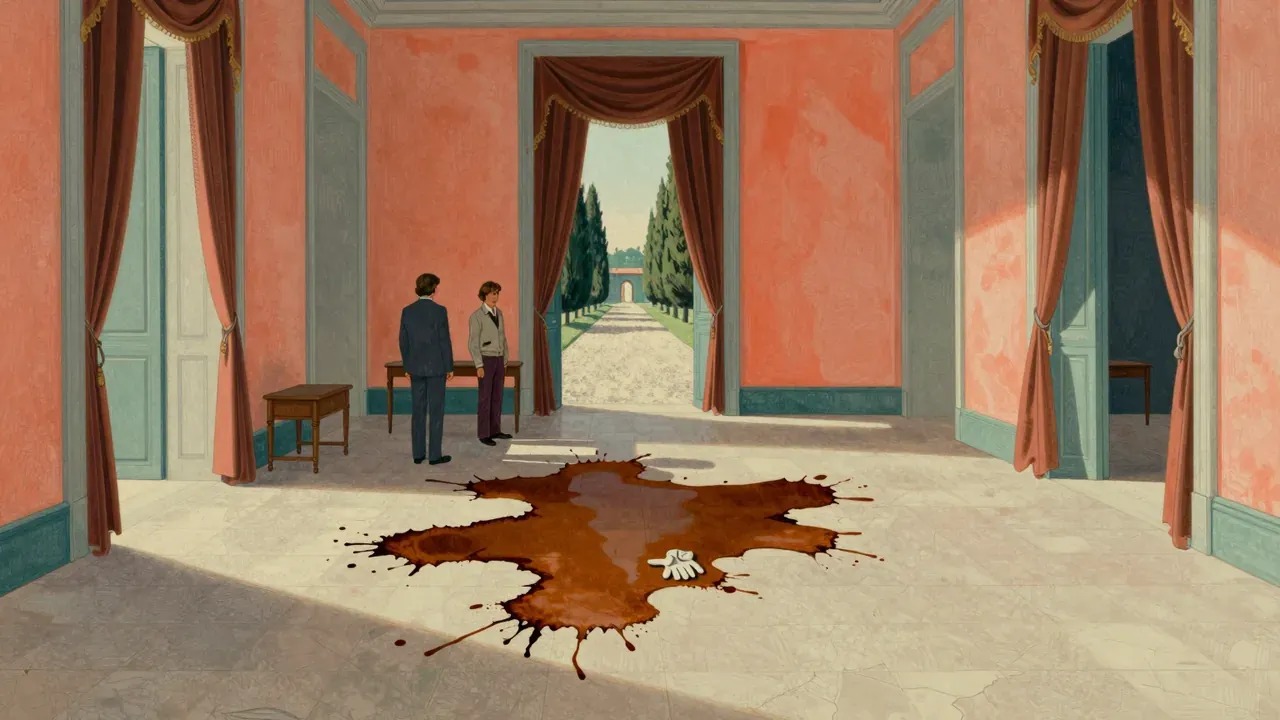
The look of it
Onibaba is a Japanese historical horror film set in the Nanboku-chō period, using the civil war’s collapse of order as the frame for a stark study of moral erosion under scarcity. Kaneto Shindō wrote and directed it not as folklore pastiche but as a deliberate, grounded fable: two unnamed women — one middle-aged, one young — survive by ambushing and killing stray soldiers in a vast susuki grass field, then discarding the bodies into a waterlogged pit. The film’s aim is neither shock nor spectacle, but slow, physical immersion in consequence: how hunger reshapes loyalty, how isolation corrodes empathy, and how superstition becomes a tool of control when language fails. It treats Buddhist parable not as allegory to be decoded but as psychological mechanism — the mask does not symbolise evil so much as make visible the irreversible cost of wielding fear as leverage. Its project is austere, unflinching, and anchored in the weight of bodies, mud, reeds, and breath.
How people move in it
The story unfolds with minimal exposition and no names; character is defined by action and proximity. Nobuko Otowa’s older woman moves with coiled tension, her face often half-obscured by shadow or reed, while Jitsuko Yoshimura’s younger woman registers desire and dread through shifts in posture and gaze rather than dialogue. Kei Satō’s Hachi is all restless limbs and unspoken guilt — his presence tightens every scene he enters. Hikaru Hayashi’s score merges taiko drumming and jazz, but its most potent sound design is silence: wind in reeds, footsteps sinking, the muffled thud of a body hitting water. Gordon Willis is not involved; Kiyomi Kuroda’s black-and-white cinematography keeps the field claustrophobic and luminous at once — low angles from the makeshift tower emphasise the reeds’ height, while interior shots are lit only by firelight or slivers of sun blocked by screens. Slow motion is used sparingly, only where exertion matters: descent into the pit, the mask’s removal, the final leap.
Where the fear lives
What lands is the visceral texture of survival: the way Otowa’s fingers dig into wet earth as she hauls a corpse, the exhaustion in Yoshimura’s shoulders when she drags armour across mud, the unbearable stillness before the masked samurai appears. The reed field functions as both setting and antagonist — impenetrable, indifferent, rustling with unseen movement. The mask sequence works because it refuses explanation: its horror lies in the physical impossibility of removal, not in jump scares or spectral logic. The film’s restraint makes the disfigurement credible — not supernatural punishment but the literal sticking of flesh to mask after rain, a detail rooted in tactile reality. Even the merchant Ushi’s crude proposition feels less like characterisation than environmental data: another man measuring worth in calories and consent. These moments land because they are observed, not interpreted; the camera watches without judgment, letting cause and effect accrue slowly, inevitably.
What circles back
What does not land is the film’s structural reliance on repetition without sufficient variation: the ambushes follow near-identical beats, the warnings between the women grow increasingly circular, and Hachi’s arc lacks internal contradiction — he is simply present, then desired, then dead. The storm sequence strains credulity not for its drama but for its timing: it arrives precisely when narrative tension needs a boost, not when weather or character logic demands it. The BBFC’s initial rejection hints at a deeper issue — the film’s moral ambiguity sits uneasily beside its punishing austerity; it asks the viewer to sit with complicity but offers no counterpoint beyond the younger woman’s flight, which feels less like agency than reflex. The ending’s ambiguity — whether the mask’s binding is metaphysical or merely biological — remains unresolved in a way that reads less like mystery and more like omission. There is no misdirection here, only a narrowing of perspective that leaves some emotional doors unopened.
What the body remembers
The themes that matter are not war or demonology but interdependence and disfigurement — bodily, social, and moral. The pit is not a grave but a sinkhole for reciprocity: each corpse dropped deepens the women’s isolation from any shared code. The mask does not transform the older woman into a demon; it reveals what was already true — that her identity has narrowed to function alone: killer, keeper, controller. Her face, ruined by rain and force, mirrors the landscape’s erosion and the war’s erasure of civic bonds. Buddhism appears not as doctrine but as material condition: impermanence made visible in rotting cloth, shifting reeds, dissolving faces. Class is implicit in the merchant’s ease and the women’s barter; gender is structural — their labour is invisible, their choices constrained by absence, not decree. The film treats trauma not as memory but as residue: something that clings, alters surface, changes how light falls on skin.
Who it holds close
This is for viewers who tolerate long takes, distrust exposition, and value atmosphere over explanation — those who find meaning in texture, silence, and sustained discomfort. It is not for those who require narrative propulsion, psychological clarity, or resolution of moral stakes. Anyone expecting folk-horror spectacle or symbolic neatness will leave frustrated; the film resists decoding, offering instead a slow accumulation of physical fact. Those who admire Kurosawa’s pacing or Mizoguchi’s spatial discipline may find Shindō’s rigour too narrow; others will see his focus as necessary precision. A viewer who values thematic coherence over emotional release will find it rich; one who seeks catharsis or character growth will find it withholding. Its endurance depends on willingness to sit inside a single, unbroken mood — not as atmosphere, but as ethical pressure.
How it lets you go
Yes, it is worth your evening — but only if you accept its terms: no relief, no irony, no distance. Its 103 minutes unfold like sedimentary layers — each scene settling over the last, building weight rather than momentum. It repays attention not through revelation but through recalibration: by the end, even wind in reeds feels charged with consequence. Those who dislike static framing or sparse dialogue will find it exhausting; those who respond to embodied performance and tactile world-building will find it singular. It is not ‘difficult’ by accident — its rigour is the point. To call it ‘slow’ mistakes patience for inertia. Its power lies in refusal: to name the women, to explain the mask, to soften the pit’s edge. That refusal is the film’s argument. Without it, Onibaba would be illustration. With it, it is indictment — quiet, unwavering, and deeply human.