The text on screen
The Importance of Being Earnest is a 1952 British film adaptation of Oscar Wilde’s 1895 stage comedy, directed and adapted by Anthony Asquith. It aims to transpose the play’s verbal precision, social satire and structural symmetry to cinema without flattening its wit or diluting its period specificity. Unlike later adaptations that amplify farce or undercut irony, this version treats Wilde’s text as architecture: every line, pause and reversal is preserved as functional syntax. The film does not seek to modernise, psychologise or expand — it assumes the audience’s familiarity with late-Victorian manners and trusts the language to carry both meaning and momentum. Its fidelity is selective but principled: scenes are re-ordered for cinematic pacing, some interiors opened up, but no character motivation is added, no subtext invented, no joke softened for accessibility. It is a studio-bound, dialogue-driven work that asks the camera to serve the sentence, not the other way around. The ambition is modest in scope but exacting in execution: to let Wilde sound like Wilde, on screen, in 1952.
The rhythm of it
The film works through disciplined restraint. Desmond Dickinson’s cinematography keeps compositions balanced and shallow-focus transitions minimal; lighting is even, never dramatic, letting faces and wigs hold attention without chiaroscuro flourish. Benjamin Frankel’s score is discreet, appearing only between scenes and never under dialogue. Performances are calibrated to the rhythm of the verse-like prose: Edith Evans’s Lady Bracknell lands each syllable like a gavel strike, Joan Greenwood’s Gwendolen floats above sentiment with glacial poise, and Michael Redgrave’s Jack balances exasperation and dignity without slipping into caricature. Michael Denison’s Algernon is lighter than usual — less fey, more grounded — which subtly shifts the dynamic between the two men. Margaret Rutherford’s Miss Prism is quietly devastating in her flustered propriety. Asquith’s direction favours longer takes, as Denison recalled, allowing lines to breathe and reactions to settle. There are no reaction shots for emphasis, no cutaways to underline jokes: the humour lives in delivery, timing and the weight of silence between phrases.
The delivery of it
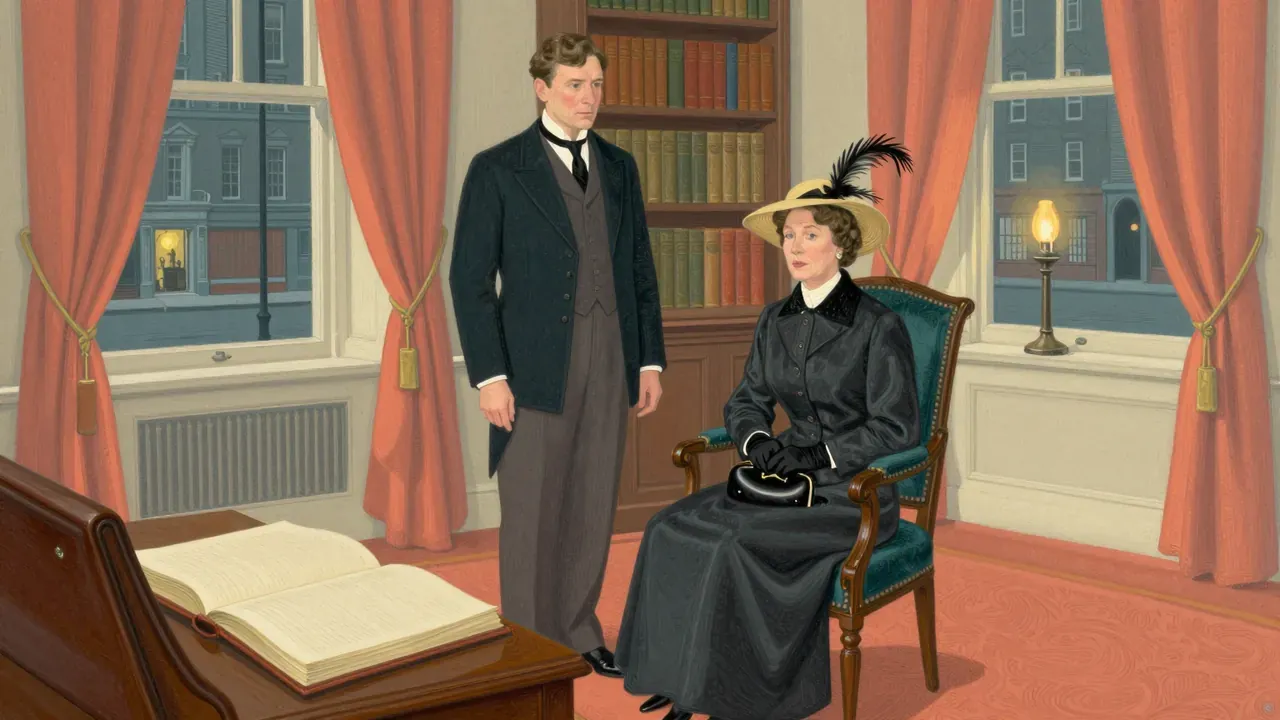
What lands most securely is the integrity of Wilde’s language and the ensemble’s shared understanding of its tonal demands. The film’s greatest successes are moments where form and content align without embellishment: the cigarette-case revelation, the tea-table standoff between Gwendolen and Cecily, Lady Bracknell’s interrogation of Jack’s origins. These scenes retain their theatrical power because the camera stays still, the actors stay present, and the script stays intact. Edith Evans’s ‘A handbag?’ remains definitive not because it is shouted, but because it is timed — a single beat of disbelief before the full force of social horror arrives. The production design, though studio-bound, avoids clutter: drawing rooms feel lived-in but not fussy, costumes signal class without costume-drama excess. Even the minor roles — Miles Malleson’s Canon Chasuble, Richard Wattis’s Merriman — land with economy and clarity. The film earns its reputation for acting excellence not through flamboyance but through consistency: no performer overreaches, no line is undersold, no comic rhythm is rushed.
The limits of it
What does not land is the film’s occasional stiffness when movement or spatial logic is required. The transition from London to the country estate feels abrupt, not atmospheric; outdoor scenes at the manor lack depth or weather, making them visually indistinct from interiors. The decision to keep much of the action within tight framing occasionally flattens physical comedy — Algernon’s entrance as Ernest, for instance, loses some of its absurdity when the camera refuses to widen enough to show his disorientation in the garden. Redgrave’s own reservations about tempo hold weight in places: Jack’s mourning scene drags slightly, and the final exposition about lineage, though necessary, sits awkwardly against the lightness that precedes it. The film’s faithfulness becomes a limitation when Wilde’s stage directions rely on audience imagination — a handbag’s provenance matters more on stage than on screen, where visual proof can feel anticlimactic. Some viewers may find the pace too deliberate, the tone too dry, especially without the live feedback of theatre.
The structure of it
The themes that matter are those Wilde embedded in the structure itself: the arbitrariness of identity, the violence of social taxonomy, and the gap between linguistic precision and moral sincerity. The film does not foreground these as arguments but lets them accumulate through repetition — the name ‘Ernest’ recurs like a motif, its phonetic weight contrasting with its semantic emptiness. Class is treated as a system of enforced performance: Lady Bracknell’s refusal to sanction Jack’s marriage is not snobbery alone, but a defence of institutional continuity. The handbag motif functions as both punchline and metaphor — lineage reduced to lost property, inheritance as accident. Gender roles are upheld with irony: Gwendolen and Cecily wield language with greater authority than the men, yet remain confined by the same rules they parody. The film’s quiet radicalism lies in how little it explains: it assumes the audience recognises hypocrisy when it hears it, and understands that earnestness is less a virtue than a grammatical convenience.
The audience for it
This film is for viewers who value linguistic precision, period texture, and performances that trust the script over the star. It suits those accustomed to stage-derived rhythm, who do not require visual spectacle or narrative urgency to stay engaged. It is not for viewers who expect cinematic dynamism, psychological realism or thematic exposition — those who prefer adaptation as reinterpretation rather than transmission will find it inert. Anyone put off by formal dialogue, static staging or unironic upper-class manners will struggle. A younger audience raised on rapid editing and naturalistic delivery may find it remote unless approached as a study in vocal craft or satirical architecture. Those who dislike Wilde’s style — his disdain for sentiment, his love of paradox — will not be won over here. The film makes no concessions, so its appeal is narrow but deep: it rewards attention to phrasing, not plot mechanics.
The time for it
Yes, it is worth your evening — provided you approach it as a spoken text made visible, not as a story told through image. Its ninety-five minutes pass without strain if you listen closely, and its pleasures compound on rewatch: new inflections emerge, structural echoes become clearer, the discipline of its craft grows more impressive. It is not a film to watch while distracted, nor one that benefits from background viewing. Those who find it slow on first viewing may warm to it later, as Redgrave did — time clarifies its virtues. It is not for fans of broad comedy or modern pacing, but for anyone willing to meet Wilde on his own terms, in Asquith’s restrained translation. Its endurance is not accidental: it survives because it refuses to chase relevance, choosing instead to hold the line on wit, timing and textual fidelity.