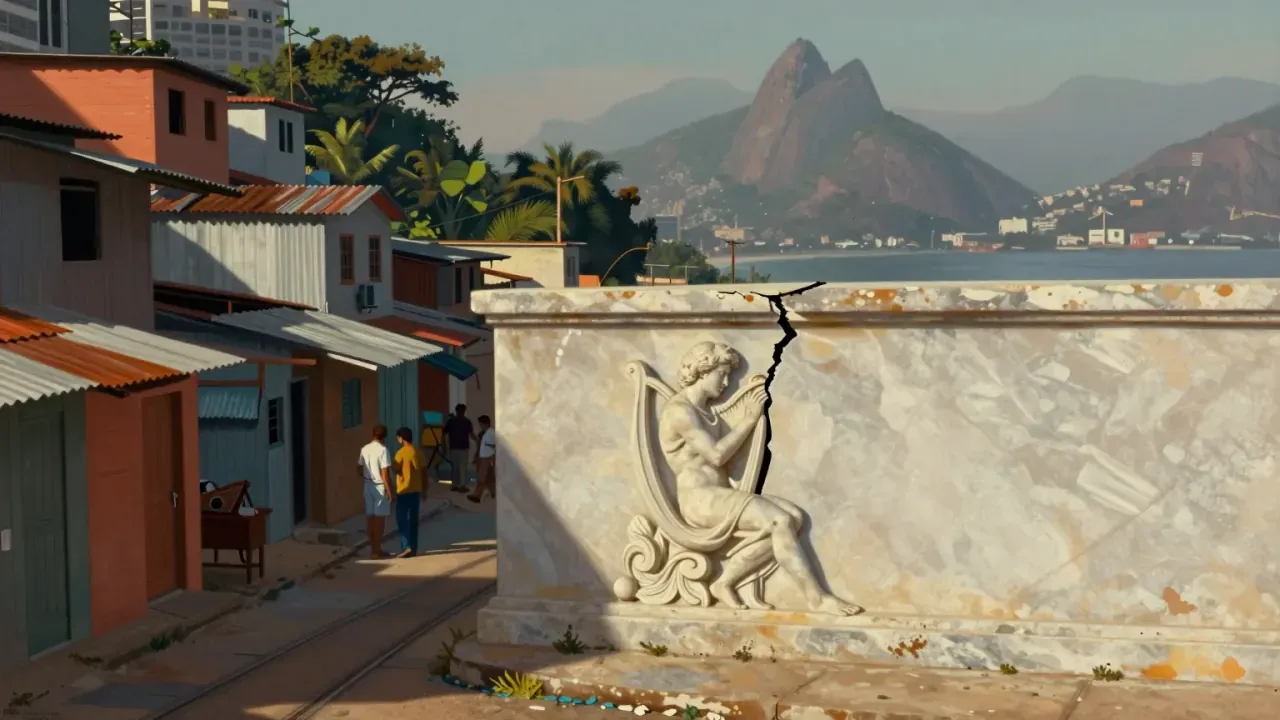
The marble cracks
Black Orpheus is a French-Brazilian-Italian co-production that transposes the Orpheus and Eurydice myth into Rio de Janeiro’s favelas during Carnival, using Vinícius de Moraes’s 1956 stage play as its source. It aims to fuse classical tragedy with Afro-Brazilian life, music, and ritual—not as allegory but as lived texture: samba schools, Macumba ceremonies, trolley depots, and hillside shacks stand in for lyre, underworld, and temple. The film treats myth not as distant archetype but as immediate, bodily force—love, death, jealousy, and grief made visible through movement, costume, and sound. Its ambition is formal and cultural: to assert Brazilian modernity on international terms while drawing from local religious practice, vernacular performance, and bossa nova’s quiet intensity. It does not seek realism but rhythmic fidelity—to the pulse of Carnaval, the logic of dream, the gravity of fate. That it was shot largely on location in Morro da Babilônia, with non-professional actors drawn from the streets and samba circles, signals a commitment to presence over polish. The project is neither documentary nor fantasy in the conventional sense; it occupies a third space where myth breathes through contemporary skin. (158 words)
The myth walks the hillside
The story follows Orfeu, a trolley driver and samba musician, whose engagement to Mira frays when Eurydice arrives in Rio fleeing an unnamed pursuer—Death, costumed as a skeletal figure. Their love unfolds amid preparations for Carnival, with plot beats mapped precisely onto the Greek structure: descent, test, failure, loss. Breno Mello, cast off the street without prior acting experience, moves with physical certainty but limited range; Marpessa Dawn, an American singer with no Brazilian roots, brings vocal warmth and stillness rather than psychological depth. Jean Bourgoin’s cinematography favours wide shots and shallow focus, letting bodies dominate frame space while keeping backgrounds soft and sun-drenched. Andrée Feix edits with percussive rhythm—cuts land like drum hits, especially during parade sequences. The soundtrack, by Luiz Bonfá and Antônio Carlos Jobim, is inseparable from narrative: ‘Manhã de Carnaval’ recurs as motif, not mood music. Vocals are dubbed (Agostinho dos Santos sings for Mello), a choice that flattens character voice but sharpens musical authority. Camus directs with choreographic precision, treating actors as elements in a larger visual score. (159 words)
The parade sets the rules
What lands most securely is the film’s sensory architecture—the way light, sound, and motion cohere into something unmistakably alive. The opening sequence, with its marble relief cracking open to reveal samba dancers, establishes tone without exposition. The Carnival parade scenes have unforced grandeur: hundreds moving in sync, costumes blazing, drums resonating in chest cavity rather than ear. Bonfá’s ‘Samba de Orfeu’ and Jobim’s ‘A felicidade’ do not accompany action but propel it, their melodies functioning as narrative engines. The Macumba ritual sequence avoids exoticism through restraint: low-angle shots of feet stamping, hands clapping, smoke rising—not spectacle but participation. Even Death, played by Olympic triple jumper Adhemar da Silva, carries weight not through menace but stillness and inevitability. The children who bookend the film—Benedito and Zeca—anchor its emotional logic: belief in music’s power to move the sun is treated seriously, not quaintly. These moments succeed because they trust repetition, pattern, and silence as much as dialogue or plot. The film’s conviction in its own symbolic grammar makes those symbols legible, even to viewers unfamiliar with Candomblé or Carnaval tradition. (157 words)
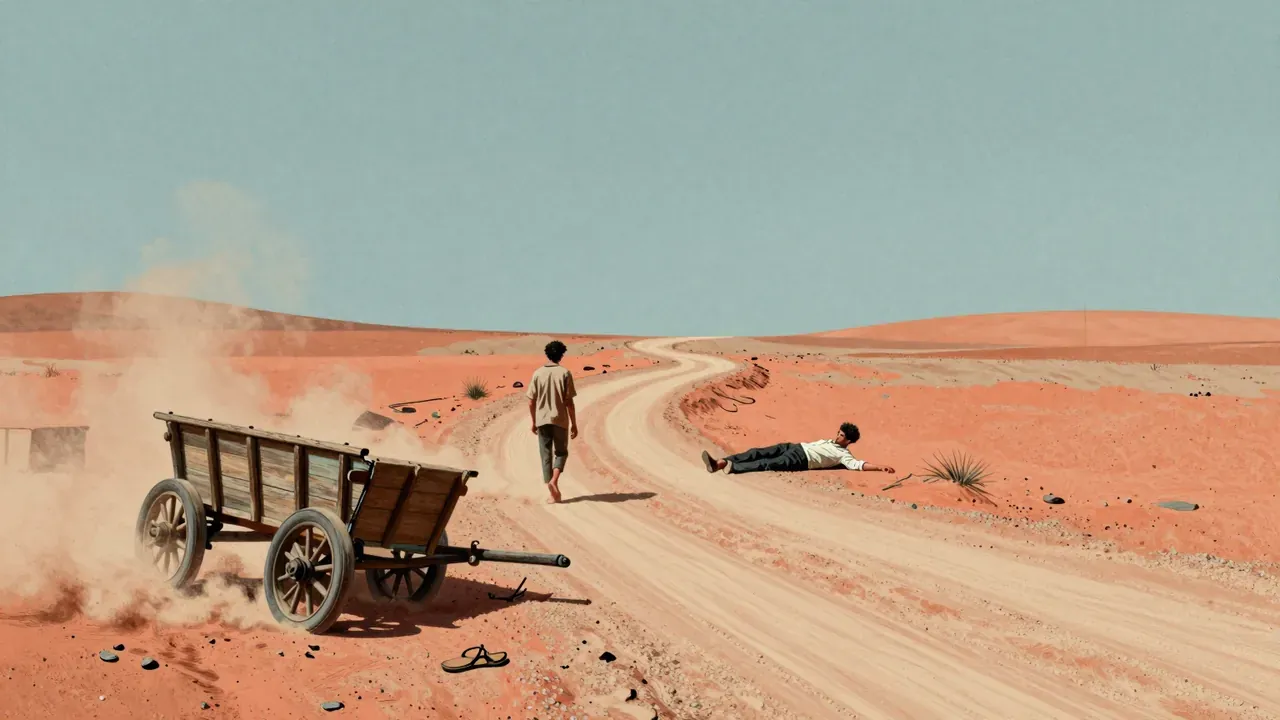
Death wears a carnival mask
What does not land is the psychological scaffolding beneath the mythic surface. Orfeu and Eurydice remain types rather than individuals—their motivations simplified to desire and fear, their interiority flattened by dubbing, staging, and script choices that privilege image over insight. Mira’s jealousy reads as temper rather than trauma; Serafina’s pragmatism lacks social context; Hermes functions only as plot device, not guide. The film’s refusal to locate characters within material reality—no mention of poverty, policing, housing policy, or racial hierarchy—leaves them suspended in aestheticised limbo. This is not abstraction but omission: the favela appears as backdrop, not condition. Brazilian critics objected not to stylisation but to erasure—of class struggle, of Black intellectual life, of the very urban complexity that made Rio’s samba schools politically potent. The casting of non-Brazilians in central roles, combined with Camus’s outsider gaze, compounds this. There is no attempt to translate local nuance—only to extract its colour, rhythm, and danger. The result is a film that feels authentic in texture but hollow in consequence: beautiful, undeniable, yet ultimately unmoored from the people it depicts. (159 words)
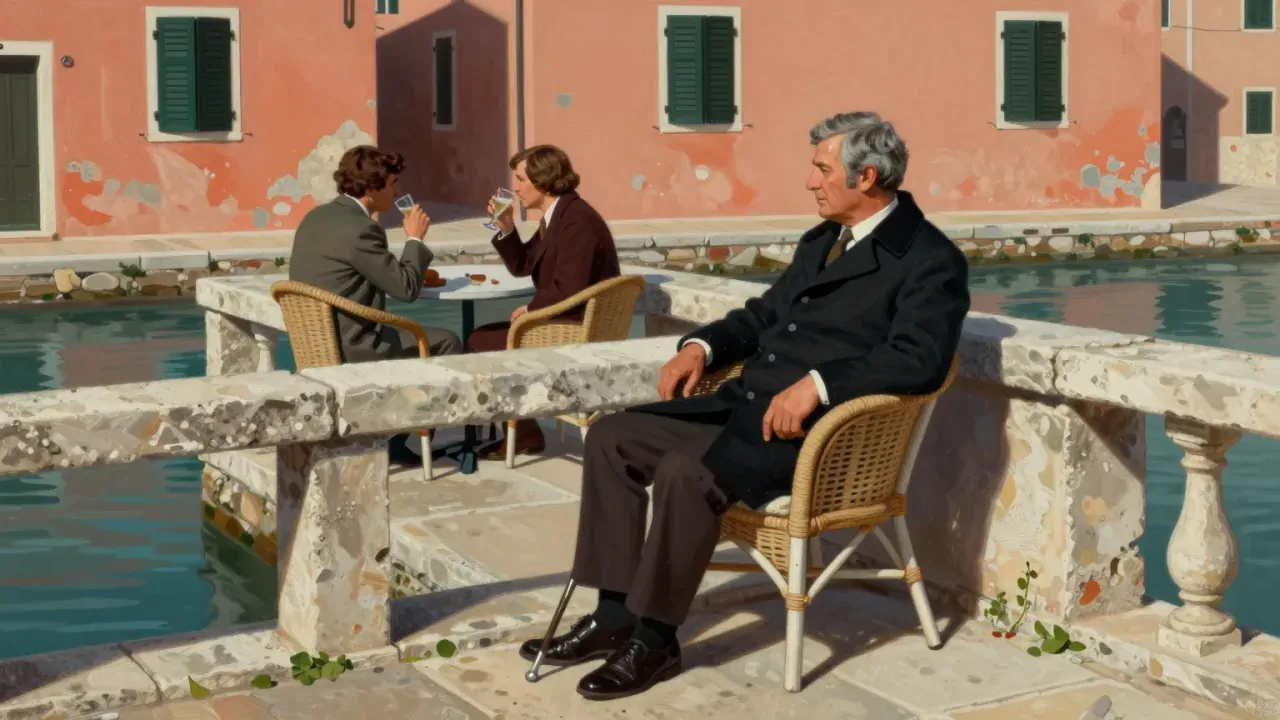
The guitar moves the sun
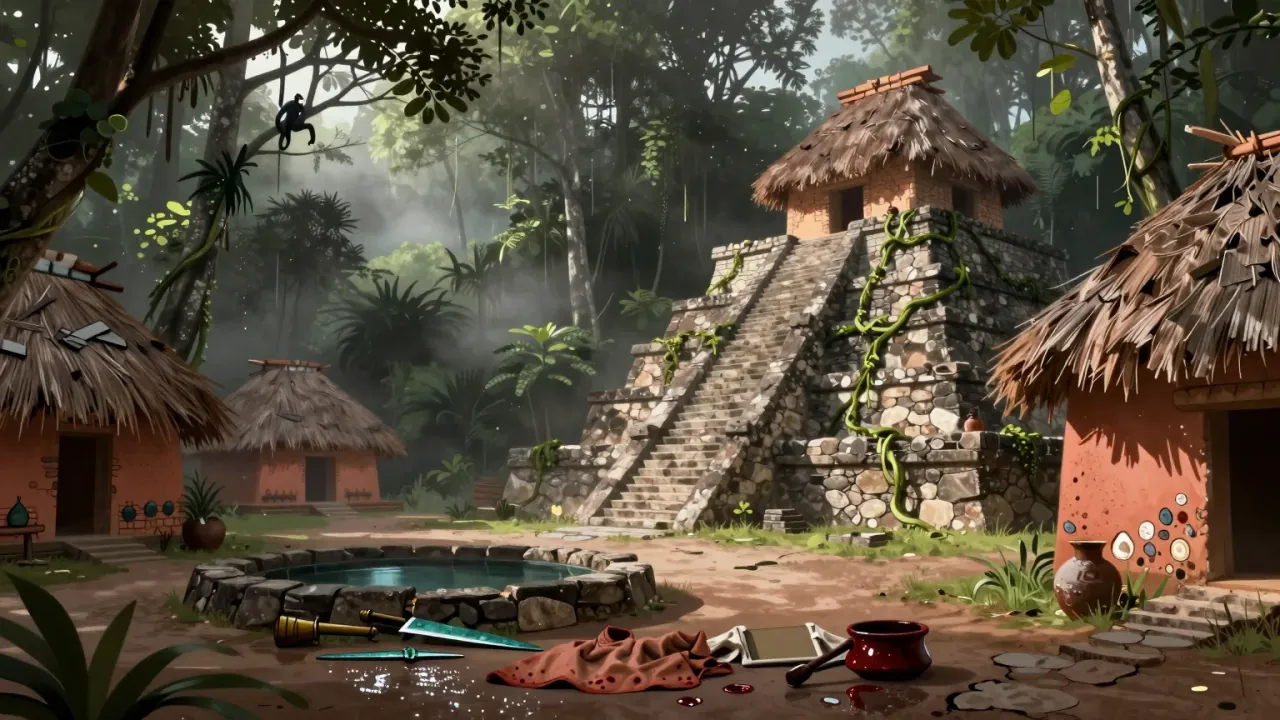
The themes that matter are not those inherited from Greece but those imposed by place and moment: the collision of sacred and secular, the vulnerability of joy in the face of systemic precarity, and the tension between collective celebration and individual fate. Carnaval here is not escapism but rehearsal—a temporary suspension of hierarchy that makes real-world structures more visible by contrast. The Macumba sequence is less about syncretism than about continuity: Afro-Brazilian spiritual practice as unbroken line, not folkloric relic. Death wears carnival costume not to mock ritual but to infiltrate it—suggesting that violence and superstition are not opposed forces but entangled ones. The film’s insistence on music as cosmological force—Zeca playing so the sun rises—refuses metaphor for literal belief, aligning it with oral tradition rather than Western rationalism. Yet it sidesteps the political valence of that belief: in 1950s Brazil, Candomblé was still criminalised in parts of the country, and samba schools were sites of Black organising. The film’s silence on these matters renders its themes poetic rather than historical—elegant, but incomplete. (158 words)
The children take the guitar
It is worth watching for students of film music, myth adaptation, or mid-century global cinema—and for anyone interested in how bossa nova entered world culture. Its visual and sonic coherence rewards close attention, especially in high-resolution restoration. It is not for viewers seeking social realism, psychological depth, or ethical accountability in cross-cultural representation. Brazilian audiences, particularly scholars of race and cinema, have long critiqued its reductive framing; those attuned to such concerns may find its beauty ethically compromised. Someone who values formal innovation over narrative substance will respond more readily than someone who requires character motivation or historical grounding. A viewer expecting anthropological accuracy will be disappointed; one open to stylised parable will find resonance. The verdict shifts if viewed as artefact rather than artwork—as evidence of 1959’s international film economy, not as timeless statement. That distinction is decisive: it changes whether the film feels generous or extractive. (159 words)
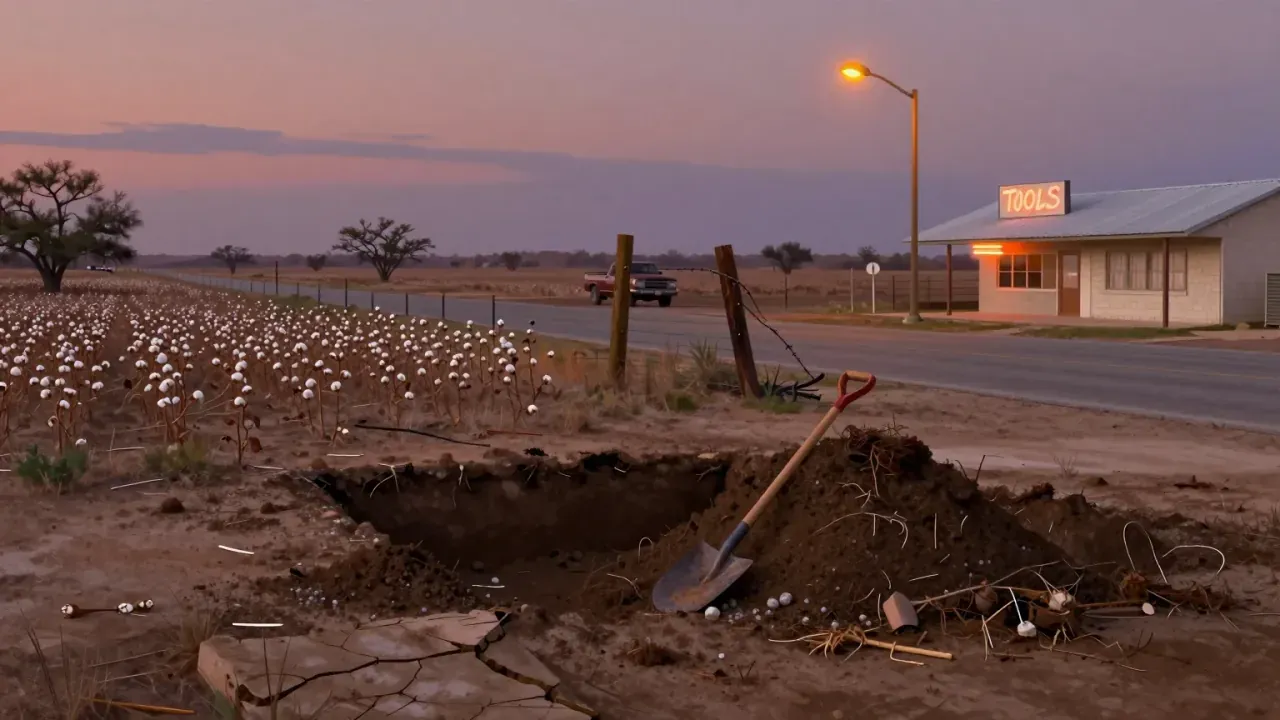
The sun rises twice
Yes, it is worth your evening—but only if you watch it with clear eyes about what it is and is not. It is not a documentary of Rio life, nor a faithful rendering of Moraes’s play, nor a critique of colonial gaze, though it invites all three readings. It is a meticulously composed, sonically vital, visually radiant object: 107 minutes of sustained tonal control. Its power lies in accumulation—repetition of gesture, motif, melody—not revelation. You will not leave understanding more about favela life, but you may feel the weight of a drumbeat in your ribs longer than expected. Those who resist its aesthetic logic will find it hollow; those who yield to it may find it haunting. It demands surrender to rhythm over explanation. To dismiss it as exoticism alone is to miss its craft; to praise it uncritically is to ignore its omissions. The middle path—attending to both—is where its value resides. That requires patience, not passive consumption. (158 words)