The first breath back
Le deuxième souffle is a French crime film from 1966, adapted by Jean-Pierre Melville and José Giovanni from Giovanni’s novel of the same name. It sets out to depict the final arc of a man whose code — silence, loyalty, self-possession — has structured his life inside and outside prison, and whose collapse is not moral but structural: the world no longer honours the terms he observes. It is not a thriller that pivots on suspense about outcome, nor a heist film that fetishises mechanics or payoff. Instead, it treats criminality as a profession with its own etiquette, hierarchy, and fatalism, and treats police procedure not as cat-and-mouse but as patient, institutional pressure applied to brittle human certainty. Melville does not ask whether Gu Minda is good or bad, but whether a system built on mutual non-disclosure can survive when every party — state, gang, family — begins to break its own rules. The film’s ambition is austere: to show how dignity erodes under sustained, unblinking scrutiny, and how a man’s last act may be less about escape than about restoring narrative control. Word count: 148
The look of it
The story unfolds in long, deliberate sequences: Gu’s escape, the double murder at Manouche’s flat, the platinum heist on a coastal mountain road, the hospital breakout, the final ambush in the stairwell. Lino Ventura plays Gu with minimal inflection — posture, pause, and the weight of a glance do the work. Paul Meurisse’s Commissaire Blot moves through scenes like a civil servant auditing a failing enterprise: calm, methodical, never raising his voice. Marcel Combes’ cinematography avoids flourish: interiors are lit with flat, even sources; exteriors favour overcast daylight and shallow depth of field, flattening space rather than deepening it. Bernard Gérard’s score is sparse — strings held in suspension, piano notes spaced like footsteps. Editing by Monique Bonnot and Michèle Boehm sustains duration: shots hold past comfort, cuts land without emphasis. There are no flashbacks, no voiceover, no exposition beyond what characters say to each other — often nothing at all. The craft serves restraint, not mood. Word count: 152
How it holds together
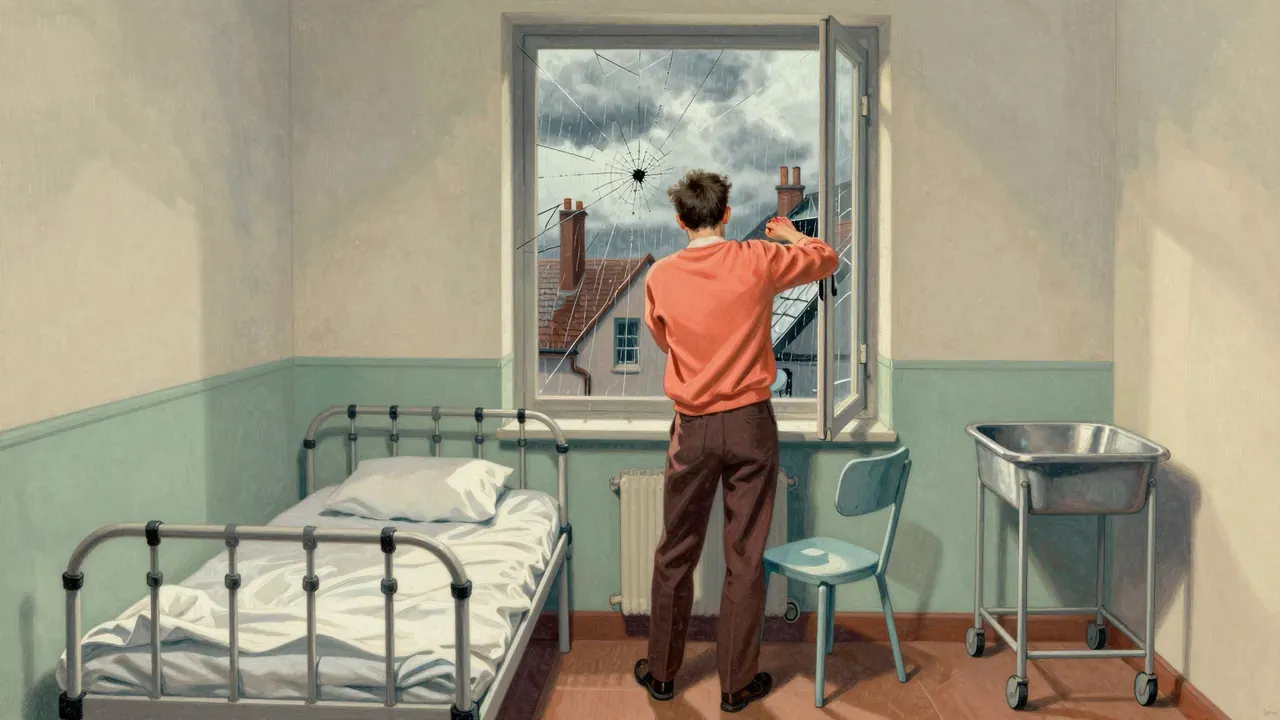
What lands is the cumulative effect of Gu’s diminishing agency. His authority is never shouted but asserted in small acts: stepping into frame before others speak, choosing where to sit, lighting a cigarette after a killing without looking at the bodies. The platinum heist works because its execution is procedural, not spectacular — the violence is swift, unceremonious, followed by quiet radio chatter and the sound of tyres on gravel. The scene where Gu punches his hands through glass is not cathartic but disorienting: the camera stays static, the blood is dull red, the sound is muffled. Even the final stairwell shootout feels less like climax than exhaustion made visible — Gu firing upward while slumped, then falling without drama. The film’s emotional register is not grief or rage but erosion: the slow loss of options, of aliases, of trust, of time. That register holds because Ventura never gestures toward pathos, and Melville refuses to underline it. Word count: 150
Where it gives way
What does not land is the Marseille section’s pivot into procedural convolution. Once Gu leaves Paris, the narrative fractures: Fardiano’s torture feels abrupt and under-motivated; Orloff’s sudden moral turn lacks grounding in earlier behaviour; the logic of Jo’s fear — that Gu might retaliate for an extortion attempt already punished — strains credibility without deeper setup. The film assumes familiarity with underworld codes it does not restate, leaving some alliances and betrayals opaque. Christine Fabréga’s Manouche remains emotionally legible but narratively passive: her function is largely reactive, and her final walk past the barricade gains weight only if the viewer has already accepted Gu’s internal logic as absolute. The 144-minute runtime also tests patience in stretches where pacing serves atmosphere over momentum — particularly the extended hospital sequence, which risks monotony without sharper tonal contrast. Word count: 149
What it says about loyalty
The themes that matter are silence as currency, loyalty as liability, and professionalism as both armour and trap. Gu’s refusal to inform is not ideological but occupational: it is how he retains standing, how he secures future work, how he keeps his sister safe. When Blot records him implicating Ricci, the violation is not of truth but of contract — the state breaks the unspoken rule that information trades only between equals. The platinum heist fails not because of error but because Gu’s presence alone attracts attention: his reputation precedes him, and reputation is incompatible with anonymity. The film treats justice as indifferent machinery — Fardiano tortures, Blot manipulates, lawyers bargain — while honour operates on a different, shrinking plane. Even Gu’s death is not tragic in the classical sense but terminal: the moment his code ceases to be functional, he has no further use for breath. Word count: 147
Who it is for
This film is for viewers who value precision of tone over plot propulsion, who find tension in stillness and weight in silence, and who accept that a protagonist’s moral coherence may be more compelling than their redemption. It suits those familiar with Melville’s earlier work — Le samouraï, Bob le flambeur — or with the French noir tradition where cops are bureaucrats and criminals wear trench coats not as costume but as uniform. It is not for viewers who require clear motivation for every character decision, who expect escalation in set pieces, or who need emotional cues amplified by music or editing. Those who find 1960s French realism too dry, or who prefer crime narratives anchored in psychology over protocol, will likely disengage. A tighter cut — perhaps removing twenty minutes of Marseille interludes — would sharpen its focus, but that is not the film Melville made. Word count: 150
Why it stays with you
Yes, it is worth your evening — provided you watch it as a study in controlled diminishment, not as entertainment with release points. Its power lies in how little it offers and how much it sustains: the weight of a paused glance, the significance of a door left open, the gravity of a name spoken once and never again. It rewards attention to gesture, to framing, to the rhythm of pauses between lines. Those who approach it expecting suspense or catharsis will leave unsatisfied; those who accept its terms — that dignity is performative, that loyalty is transactional, that endings are administrative — will find it quietly devastating. It is not a film to enjoy, but one to absorb, and its impact lingers in the spaces between scenes, not within them. Word count: 149