The look of it
The Eternal Breasts is a biographical drama about Fumiko Nakajō, a Hokkaidō-based tanka poet who lived from 1922 to 1954. It does not aim for historical completeness but for emotional fidelity: to render her divorce, poetic awakening, double mastectomy, and final year with quiet precision. Kinuyo Tanaka directs without embellishment — no symbolic dissolves, no lyrical interludes — treating illness and creativity as co-occurring facts, not metaphors. The film avoids framing Nakajō’s life as tragedy or triumph; instead, it holds space for contradiction: her love for her tutor Hori remains unacted upon, her maternal grief over losing custody of her son is registered in silence more than speech, her poems are shown being written, read aloud, published — never explained. It tries to do what few Japanese studio films of the mid-1950s attempted: centre a woman’s interiority without recourse to melodrama or moral judgement, using the tools of classical narrative not to resolve tension but to sustain attention. This is not a portrait of ‘resilience’ as virtue, but of presence as practice. (158 words)
The pace of it
The story unfolds in measured episodes: separation, relocation, poetry circle attendance, diagnosis, surgery, affair, decline. Yumeji Tsukioka carries it with minimal inflection — her face registers fatigue before pain, concentration before inspiration. Masayuki Mori’s Hori is restrained to the point of opacity; his marriage to Yōko Sugi’s Kinuko is shown through shared glances and unshared rooms. Kumenobu Fujioka’s cinematography favours natural light and shallow focus, especially in the Hokkaidō exteriors where wind moves grass and paper scrolls alike. Takanobu Saitō’s score uses koto and shakuhachi sparingly, often dropping out entirely during hospital scenes. Kimihiko Nakamura’s editing avoids rhythm for its own sake: cuts follow breath, not beat. There is no flashback structure, no voiceover narration — even Nakajō’s poems appear on screen only as handwritten text, legible but uninterpreted. The film’s craft serves refusal: refusal of exposition, of psychological shorthand, of catharsis. It trusts the audience to sit with duration — a hospital corridor walk lasting twelve seconds, a poem recited without reaction, a letter left unread on a tatami mat. (159 words)
The weight of it
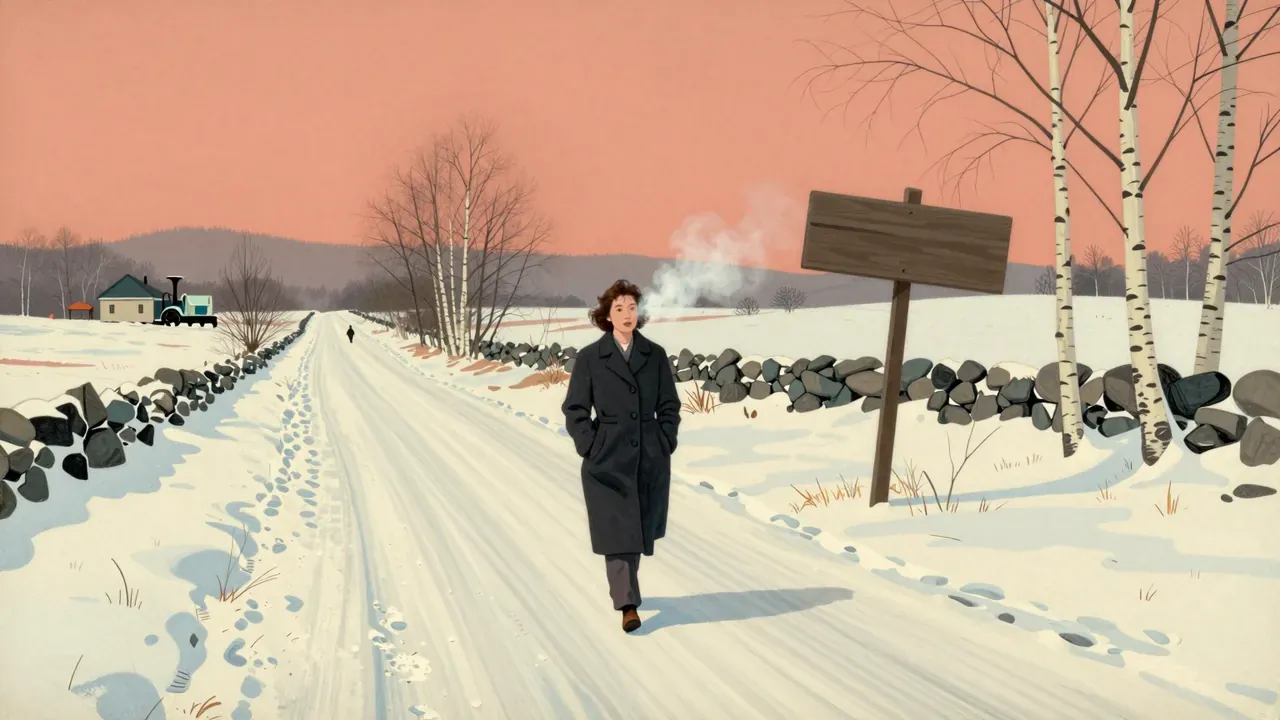
What lands is the accumulation of small, unremarkable acts: folding laundry while listening to a radio broadcast of her own poem; adjusting a sleeve after surgery; correcting a student’s tanka line with two quiet words. These moments land because they are anchored in physical detail — the weight of a hospital gown, the grain of a wooden floor, the way light falls across Tsukioka’s collarbone in an early scene, then vanishes from it later. The film’s restraint makes the few departures from it carry weight: a single close-up on Tsukioka’s hands tearing up a letter, held for seven seconds; a brief, unbroken take of her walking alone down a snow-dusted road after the mastectomy, coat unbuttoned against the cold. The location shooting in Hokkaidō grounds the film in weather and season — rain, wind, late autumn light — so that time passes not as plot progression but as bodily experience. Even the medical scenes avoid clinical abstraction: we see bandages, hear coughs, feel the chill of tiled floors. Nothing is elevated to symbolism; everything is permitted to be ordinary, and in that ordinariness, deeply felt. (157 words)
The gaps in it
What does not land is the treatment of Nakajō’s journalism — the newspaper series by Ōtsuki — which arrives abruptly and departs without consequence, its tone and impact left unexamined. The character of Ōtsuki himself remains underwritten: his motivations, his ethics, his relationship to Nakajō beyond romantic convenience, are all withheld. Similarly, the film’s handling of class is muted: Nakajō’s mother lives modestly, yet no economic pressure is dramatised, no material constraint shapes her choices. The divorce proceedings occur off-screen; the legal and social machinery behind them is invisible. Some viewers may find the film’s refusal to clarify these dimensions frustrating — not because it lacks depth, but because it declines to supply context the script assumes the audience already holds. Others may object to the near-absence of Nakajō’s actual poetry on the soundtrack: we hear lines read once, then move on, without musical or rhythmic emphasis. This is not negligence, but design — yet it risks leaving the central act of creation feeling peripheral rather than constitutive. (156 words)
The thought in it
The themes that matter are embodiment, authorship, and time. Embodiment is treated not as metaphor but as condition: the body is site of pleasure, pain, labour, language, and erasure — all at once. Authorship is shown as iterative and communal: Nakajō writes, revises, reads aloud, receives feedback, publishes, rewrites — never in isolation, never as revelation. Time is neither linear nor redemptive: it thickens around illness, stretches in waiting, compresses in memory, but never resolves. The film quietly challenges the notion that female creativity must be framed by sacrifice — here, the mastectomy is not a crucible but a fact among others, neither purifying nor defining. It also questions the expectation that biography must culminate in legacy: Nakajō’s poems circulate, win prizes, are quoted — but the film ends before any monument is erected, before any archive is opened. What remains is the texture of daily life, the weight of a notebook, the sound of a pen on paper — all of which persist without needing to mean something larger. (155 words)
The audience for it
This film is for viewers who value sustained attention over exposition, who find emotional resonance in stillness, and who accept that a life need not be ‘explained’ to be honoured. It suits those familiar with mid-century Japanese cinema’s pacing and restraint, or those willing to adjust to it. It is not for viewers who require narrative propulsion, psychological clarity, or thematic signposting — the film offers none. Those expecting a conventional biopic, or a feminist polemic, will find it withholding. Scholars like Alexander Jacoby argue the illness narrative overshadows Nakajō’s agency as writer; others, like Armendáriz-Hernández, see her sexuality and creativity as inseparable and fully present. A different verdict would follow if the film had integrated Nakajō’s published work more structurally — if her poems shaped scene transitions, or if their rhythms informed the editing. As it stands, it asks for patience, not agreement. (159 words)
The time it takes
Yes, it is worth your evening — provided you watch it without demand for payoff. Its 110 minutes unfold with the gravity of lived time, not plotted time. You will not leave with answers, but with impressions: the smell of ink, the sound of a door sliding shut, the way light changes on a wall over ten minutes. It rewards attention, not interpretation. Those who prefer films that clarify rather than accumulate may find it unrewarding — and that is a valid objection, not a flaw. The film does not fail to deliver meaning; it refuses to package it. Its value lies in its refusal: to reduce Nakajō to symbol, to treat illness as allegory, to let poetry serve plot. If you can sit with ambiguity, with quiet, with the unspoken weight of a glance between two people who love each other but do not touch — then this film meets you where you are. It does not ask for your admiration. It asks only for your time. (159 words)