The logic of it
Ghost Dog: The Way of the Samurai is a genre hybrid that treats the samurai code not as exotic ornament but as a functional, internal logic for its protagonist — a Black hitman in contemporary New Jersey who lives by Hagakure while working for an Italian-American crime family. It does not attempt realism, nor satire in the conventional sense; instead, it constructs a self-contained moral and aesthetic system where violence, silence, pigeons, ice cream trucks, and Rashōmon coexist without explanation. Jarmusch builds this world through subtraction: no exposition on Ghost Dog’s past, no justification for his beliefs, no translation between languages or codes. The film tries to hold two irreconcilable systems — feudal Japanese bushido and late-20th-century urban organised crime — not as opposites in conflict, but as parallel structures both rooted in hierarchy, obligation, and ritualised death. Its ambition is structural coherence over narrative plausibility, and its success depends on whether the viewer accepts that a man can be both wholly modern and wholly archaic at once. Word count: 148
The look of it
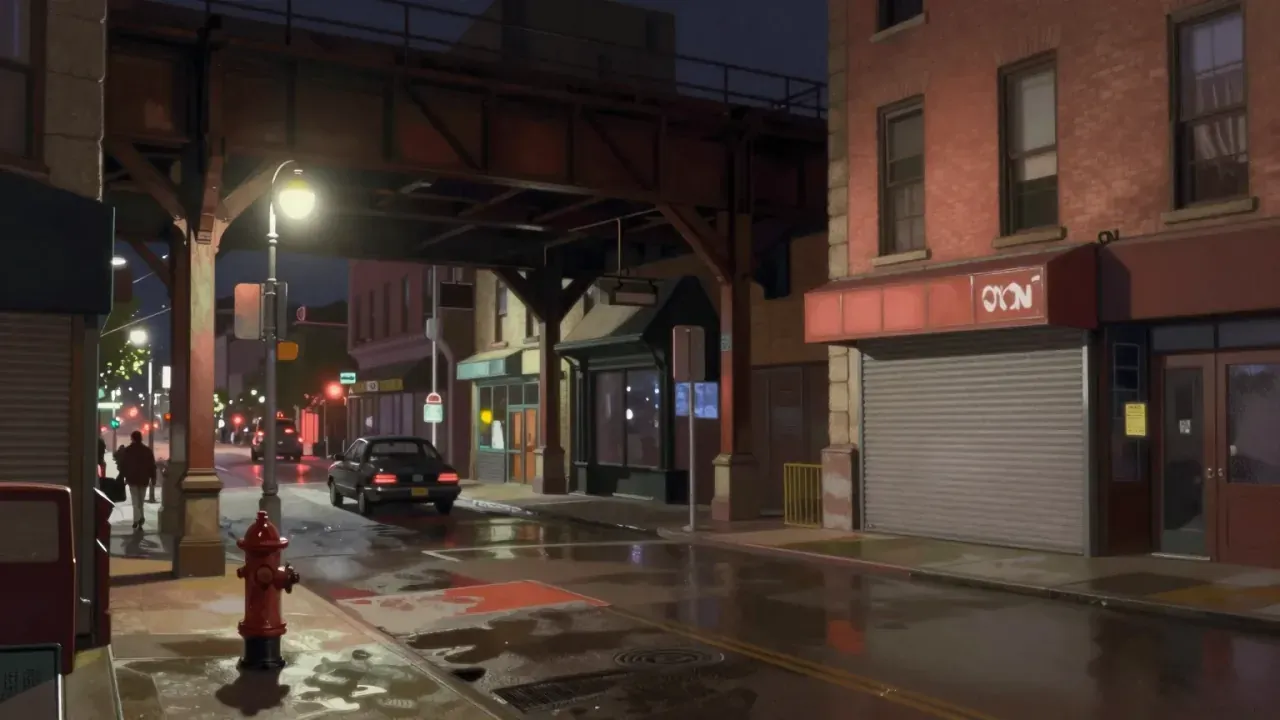
The story unfolds with deliberate, uninflected pacing: Ghost Dog kills, reads, feeds pigeons, visits Raymond and Pearline, then kills again. There are no flashbacks, no voiceover, no psychological unpacking. Forest Whitaker’s performance is physically still, tonally even, never signalling inner conflict — he simply is the role, as if the character were a fixed point in space rather than a developing arc. Robby Müller’s cinematography avoids dramatic contrast: daylight is flat, interiors are softly lit, night scenes glow with muted neon and streetlamp amber. RZA’s score blends Wu-Tang’s sparse, loop-based hip-hop with traditional Japanese instrumentation and ambient textures, never underscoring emotion but anchoring mood. Jay Rabinowitz’s editing sustains long takes and abrupt cuts alike, preserving rhythm over momentum. The craft choices all serve restraint: no close-ups linger for emphasis, no music swells for revelation, no dialogue explains what the image already states. This is not minimalism for austerity’s sake, but for fidelity to a worldview in which meaning resides in action, not interpretation. Word count: 152
What holds still
What lands is the film’s quiet insistence on dignity within absurdity. Ghost Dog’s rituals — feeding pigeons, reading Hagakure aloud, bowing before Raymond’s ice cream truck — feel neither ironic nor pathetic, but grounded in their own gravity. The relationship between Ghost Dog and Pearline works because it rests on shared silence and mutual respect, not sentimentality. The use of homing pigeons as communication devices feels plausible within the film’s logic, not whimsical. RZA’s score integrates seamlessly, lending weight to scenes that might otherwise drift: the low thump of a bassline under Ghost Dog walking across a rooftop, the sudden hush before a kill, the warmth of a sampled koto beneath Raymond’s French muttering. Even the cartoons — brief, unexplained interludes — land as atmospheric punctuation, not comic relief. The film’s tone remains consistent: solemn, unhurried, lightly detached. It never asks the viewer to laugh at its characters or pity them; it asks only that they observe them as they are — people living by rules others have forgotten how to read. Word count: 150
Where it stays thin
What does not land is the mobsters’ dimensionality — they remain functional figures, not individuals. Henry Silva’s Vargo, Victor Argo’s Sonny Valerio, and Joseph Rigano’s Louie speak in flat, declarative lines, and their motivations stay surface-level: loyalty, survival, protocol. Their cartoon-watching scenes, intended as cultural counterpoint, risk flattening them further into caricature, especially when juxtaposed with Ghost Dog’s interiority. The film’s refusal to explain its own worldbuilding also alienates some viewers: the fictional state names, the unexplained pigeon network, the lack of geographic signposting — these are not mysteries to solve but stylistic givens, and those expecting narrative scaffolding will find themselves adrift. The ending, while thematically coherent, offers no catharsis or resolution beyond Ghost Dog’s quiet acceptance of death; it resists emotional payoff in favour of formal closure, and that resistance may feel like evasion to viewers seeking moral reckoning or emotional release. Word count: 149
The weight of layers
The themes that matter are stoicism as practice, not philosophy; cross-cultural synthesis as lived reality, not academic concept; and the persistence of ritual in a disenchanted world. Ghost Dog does not quote Hagakure to sound wise — he follows it as a daily discipline, like brushing teeth or checking a weapon. The film treats Japanese, African-American, Italian, and French elements not as ‘influences’ but as coexisting strata of one American life: Ghost Dog reads Rashōmon, eats Chinese takeout in an Italian-run restaurant, listens to Public Enemy, and speaks English with no trace of dialectal code-switching — because he does not switch. His identity is not fragmented; it is layered, and the film refuses to prioritise one layer over another. Violence is presented as inevitable, not glamorous or tragic — a fact of his vocation, like rain in Jersey City. The theme of silence matters too: not as absence, but as active choice — in language, in expression, in response. That silence is where the film locates its most precise observations about power, memory, and continuity. Word count: 149
Who walks with it
This film is for viewers who value atmosphere over exposition, who find resonance in repetition and stillness, and who accept that a character’s inner life need not be verbalised to be legible. It suits those familiar with Jarmusch’s earlier work — Dead Man, Down by Law — or with Melville’s Le Samouraï, Suzuki’s Branded to Kill, or the Wu-Tang Clan’s aesthetic sensibility. It is not for viewers who require clear cause-and-effect plotting, psychological motivation, or moral clarity. Those expecting a conventional crime thriller, or a deconstruction of gangster tropes, will find Ghost Dog withholding. Those who dislike deadpan delivery, long pauses, or non-linear emotional arcs will likely disengage. A viewer who values narrative propulsion over tonal consistency would reasonably reject it — and that verdict would be defensible. What would change it? A tighter integration of the mobsters’ perspective, or a single scene granting them interiority, would shift the balance — but that would also break the film’s central constraint: Ghost Dog’s world is defined by what he sees, not what he explains. Word count: 149
How long it lasts
Yes, it is worth your evening — provided you approach it as a sustained mood piece rather than a story with stakes. Its 116 minutes pass without hurry but never drag, held together by Whitaker’s unwavering presence, Müller’s lucid images, and RZA’s textured score. It repays attention not with plot twists but with accumulating detail: the way light falls on a rooftop at dusk, the rhythm of a pigeon’s wingbeat, the weight of a book passed from hand to hand. Those who watch it expecting conventional engagement may leave unsatisfied — but that dissatisfaction stems from mismatched expectations, not failure of execution. A viewer who values precision of tone, coherence of vision, and restraint in performance will find it richly rewarding. It is not a film to consume, but one to inhabit for its duration — and that inhabitation lingers longer than many louder, faster films. Word count: 149