The text of it
The Gospel According to St. Matthew is a 1964 Italian film that adapts the biblical text of Matthew’s Gospel with near-literal fidelity, using its words as spoken dialogue and structuring the narrative from Nativity to Resurrection without interpolation or invention. Pier Paolo Pasolini, an atheist Marxist, made it not as historical reconstruction but as mythic re-consecration — a deliberate act of remythologisation that absorbs two thousand years of Christian storytelling into the image. He rejected John for mysticism, Mark for vulgarity, Luke for sentimentality, and chose Matthew for its stark, parabolic force and structural clarity. The film does not seek psychological realism or biographical plausibility; instead, it treats the Gospel as sacred text first, cinematic material second. Its ambition is liturgical rather than expositional: to present the story not as past event but as enduring presence, anchored in the bodies and landscapes of mid-twentieth-century southern Italy. It is less about Christ as man or God than about the Gospel as collective memory made visible — austere, communal, unadorned, and insistently textual. (158 words)
The look of it
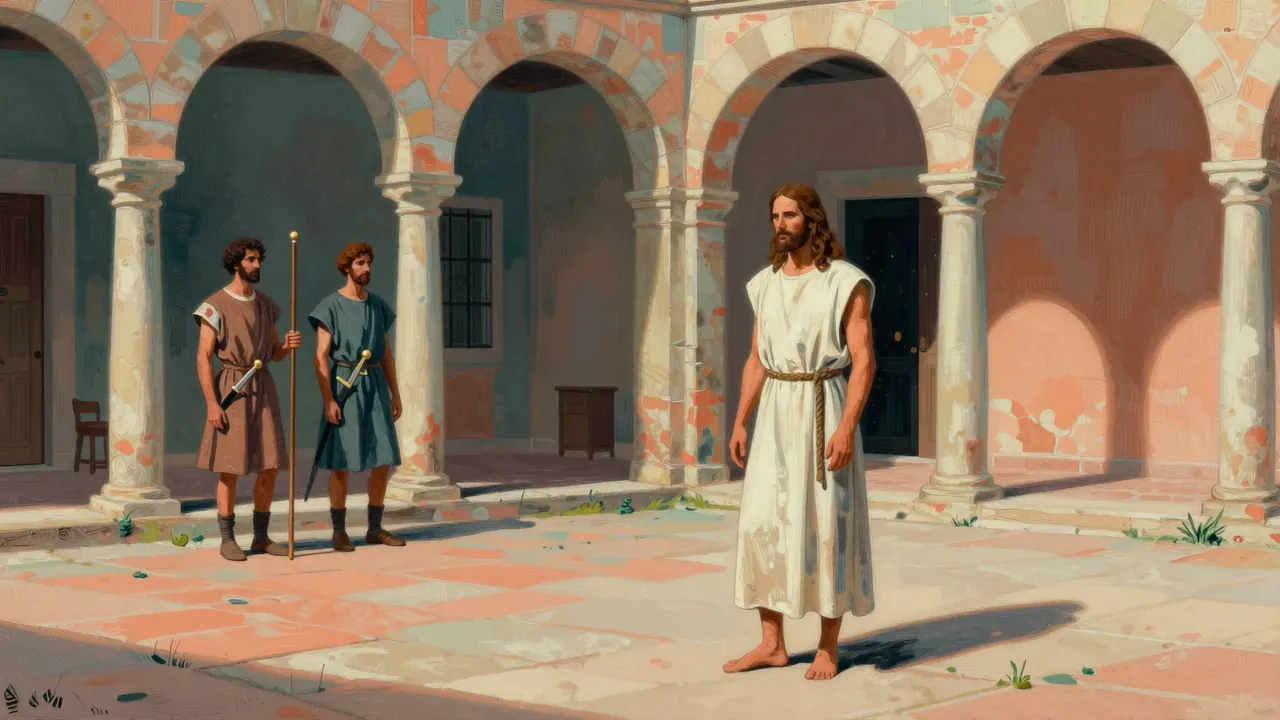
The film works through radical formal restraint and documentary-inflected composition. Tonino Delli Colli’s black-and-white cinematography avoids dramatic lighting or expressive distortion: exteriors are sun-bleached and shallow-focused, interiors are dim but legible, with long takes and static frames that recall early silent cinema or Byzantine iconography. Editing by Nino Baragli is sparse and rhythmic, often holding on faces mid-sentence or cutting on silence. Performances are non-professional and unmodulated — Enrique Irazoqui’s Jesus speaks with quiet gravity but no charisma, Susanna Pasolini’s elderly Mary registers grief without theatricality, and the crowd scenes feel assembled rather than staged. Much dialogue is post-dubbed by professional voices, creating a subtle disjunction between lip and sound that reinforces the text’s primacy over psychology. Luis Bacalov’s score blends Gregorian chant, South American folk motifs and modernist dissonance, underscoring ritual rather than emotion. The film’s coherence comes not from character arcs or plot propulsion but from textual fidelity, geographical consistency and visual repetition — baptism, trial, crucifixion each follow the same compositional grammar. (159 words)
The place of it
What lands is the film’s unwavering commitment to its own method: the austerity becomes persuasive, the stillness accumulates weight, and the refusal of interpretation creates space for the text to resonate on its own terms. The casting of non-actors from Matera and Barile grounds the divine in tangible poverty — their weathered faces, bare feet and threadbare clothes do not illustrate scripture so much as inhabit it. The Sassi cave dwellings, shot without set decoration, function as both historical stand-in and contemporary indictment: this is not Palestine then, but Italy now, bearing the same weight of faith and neglect. The trial sequences, filmed with handheld immediacy, land with visceral urgency because they abandon reverence for proximity — Christ’s silences read as resistance, not passivity. The resurrection scene, stripped of spectacle, gains solemnity from its refusal to explain. Even the music, when it swells, does so like liturgy — not scoring emotion but marking transition. This is not a film that wins viewers over; it holds them at a distance until they adjust their posture, and once adjusted, many find the distance itself becomes the point. (157 words)
The pace of it
What does not land is any attempt to read psychological motivation into the characters — Jesus remains opaque not by design but by absence of interiority, and his disciples register as types rather than people. The film’s rejection of exposition assumes familiarity with the Gospel, leaving viewers without that knowledge adrift in ritual without context. Some sequences — particularly the Sermon on the Mount — become visually monotonous: repeated medium shots of Irazoqui speaking directly to camera, with minimal reaction or variation, test attention without offering compensatory insight. The dubbing, while intentional, occasionally fractures presence: seeing a young Spanish student speak Italian words he did not utter makes the performance feel mediated twice over — first by translation, then by voice. The film’s moral certainty also sits uneasily beside Pasolini’s stated atheism; the tension is intellectually compelling but emotionally unresolved, leaving moments of doctrinal emphasis feeling unearned rather than earned. And though the neorealist method suits humility, it struggles with transcendence — the resurrection lacks awe not because it is understated, but because the film’s grammar has no vocabulary for the uncanny beyond silence and light. (159 words)
The weight of it
The themes that matter are poverty as theological condition, language as sacred vessel, and myth as historical sediment. Pasolini treats economic destitution not as backdrop but as spiritual fact — the disciples are landless, the crowds are hungry, Herod’s violence is bureaucratic and banal. The film insists that faith emerges from material need, not philosophical choice. Language matters because it is never paraphrased: every line is Matthew’s, untranslated and unsoftened, making syntax itself a character — abrupt, imperative, repetitive. This turns the film into a study of how dogma forms through repetition and rhythm. Myth matters as accumulated meaning: Pasolini’s Christ is not the historical figure but the figure as refracted through centuries of devotion, persecution, art and doctrine. That is why the film feels both ancient and immediate — it shows how stories harden into structures, how belief becomes architecture, how suffering becomes liturgy. There is no critique of institutional religion here, only a re-enactment of its foundational texts as living tissue — worn, patched, vital. The film’s politics are implicit: its peasants are not picturesque, its authorities are not caricatured, and its miracles are presented as events that happen within, not outside, the world’s logic. (158 words)
The demand of it
This film is for viewers who value textual fidelity over emotional access, who find power in restraint, and who are comfortable sitting with silence longer than most films allow. It rewards patience, familiarity with the Gospel, and openness to liturgical pacing. It is not for those who expect narrative momentum, psychological development or cinematic embellishment — viewers seeking explanation, motivation or catharsis will leave frustrated. Those who associate religious film with uplift or spectacle will find it austere to the point of severity. It is also unlikely to serve well as an introduction to either Pasolini or biblical narrative: its assumptions are too specific, its methods too uncompromising. A viewer who values historical accuracy over theological resonance may object to the southern Italian setting as anachronistic. Someone who reads the Gospels as allegory rather than proclamation may find its literalism flattening. But for those who believe form can be devotion, and austerity a kind of generosity, it remains singular. (159 words)
The length of it
Yes, it is worth your evening — not as entertainment but as encounter. Its 131 minutes ask for attention, not absorption; they offer duration, not diversion. It repays close viewing not because it reveals hidden layers but because its surface — the text, the faces, the light — deepens with time. You do not need to be religious to feel its gravity, but you do need to accept its terms: no irony, no commentary, no psychological scaffolding. Those who dislike slow cinema, distrust religious subject matter, or require clear character motivation will find it unrewarding. Yet its influence is undeniable — from Dreyer to Tarkovsky to contemporary filmmakers working in devotional modes — and its integrity remains unbroken. It does not argue for belief; it enacts the weight of belief as cultural fact. To watch it is to submit to a different rhythm of thought — one measured in breaths, not beats. That is rare. That is valuable. (159 words)