The look of it
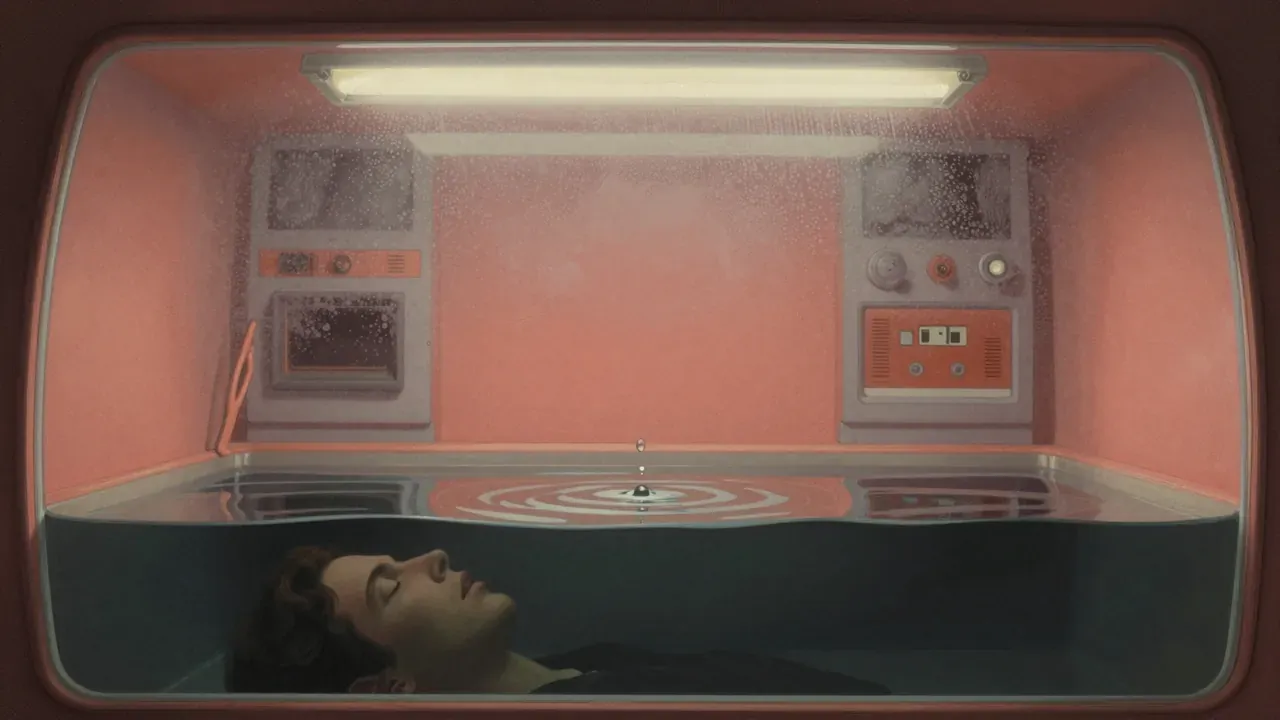
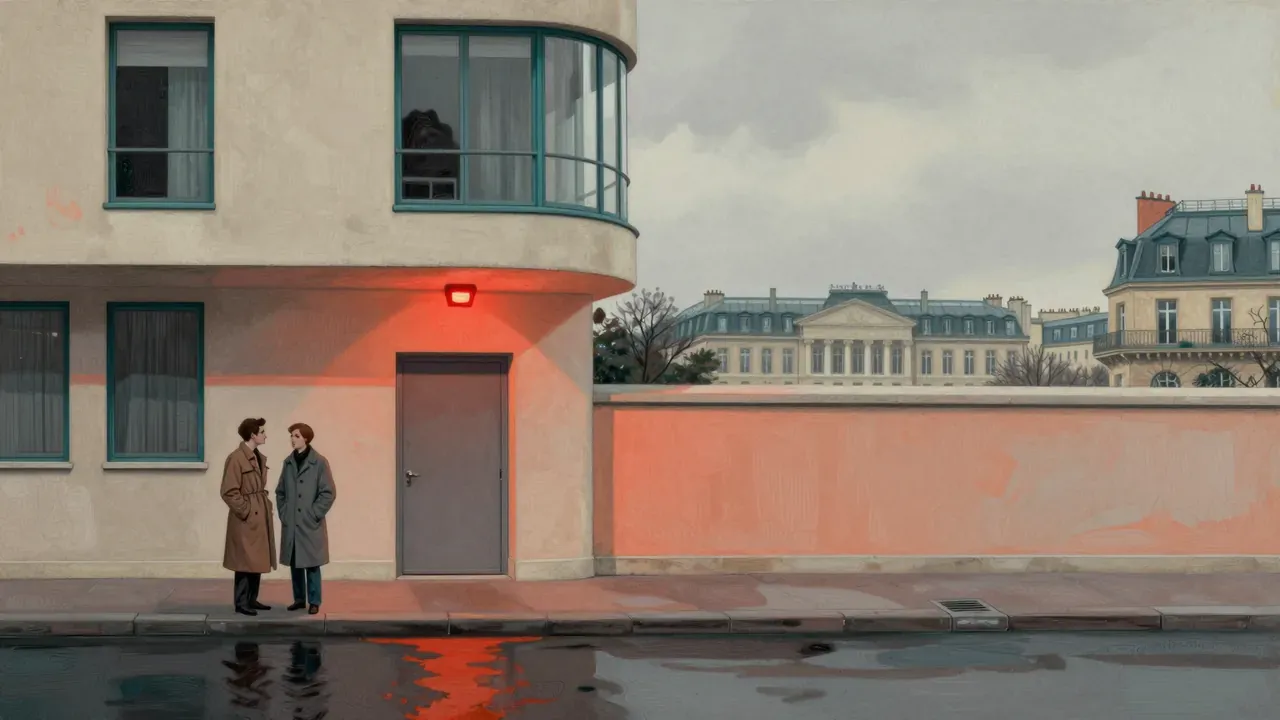
Alphaville is a French New Wave science fiction film that uses the conventions of detective noir and dystopian speculation not to imagine a future, but to dissect the present: mid-1960s France, the Cold War, technocratic rationalism, and the erosion of language and feeling under systems of control. It does not attempt realism in setting or futurism in design; instead, it repurposes existing Parisian architecture — glass office blocks, hotel lobbies, motorways — as the infrastructure of a totalitarian city-state governed by Alpha 60, a sentient computer that bans ambiguity, poetry, and selfhood. Jean-Luc Godard’s aim is neither prediction nor escapism, but provocation: to stage a collision between embodied, flawed human consciousness and an ideology dressed as logic. The film treats genre not as scaffolding for plot, but as a dialectical tool — the trenchcoat, the Ford Mustang, the voiceover — all borrowed from pulp fiction and reloaded with philosophical weight. Its ambition is structural and linguistic: to make the audience feel the violence of enforced meaning, and the quiet radicalism of saying ‘I love you’ in a world where that phrase has been deleted from the dictionary. Word count: 148.
The shape of the story
The story follows Lemmy Caution, a hard-boiled secret agent played by Eddie Constantine, as he infiltrates Alphaville to locate a missing colleague, confront its creator, and dismantle its ruling AI. But narrative progression is secondary to rhythmic repetition, deadpan interrogation, and abrupt tonal shifts. Performances are deliberately flat or stylised: Constantine’s weary stoicism, Anna Karina’s affectless delivery as Natacha, and Howard Vernon’s hollow authority all serve the film’s anti-psychological register. Raoul Coutard’s cinematography avoids chiaroscuro drama; instead, he holds on static shots of elevator doors, empty corridors, and blinking console lights, using available light and real locations to ground the absurd in the banal. Agnès Guillemot’s editing sustains a staccato pace, cutting away before resolution, while Paul Misraki’s score — part jazz theme, part theremin-laced unease — underscores irony rather than emotion. Dialogue is sparse, often delivered like bureaucratic incantation, and much of it was improvised on set, with no functional script beyond a provisional treatment. Word count: 152.
What holds up
What lands is the film’s sustained tonal discipline: its refusal to indulge in spectacle, exposition, or catharsis. The tension arises not from suspense about outcomes — Caution’s survival is never in doubt — but from watching how language buckles under pressure. Scenes where Caution recites poetry to Alpha 60, or where Natacha slowly grasps the word ‘love’, land because they are underplayed, not heightened. The visual strategy — modernist buildings treated as alienating monuments, neon signs spelling out corporate slogans like religious dogma — remains potent precisely because it avoids digital artifice. The film’s dry humour also endures: the Ford Galaxie misidentified as a Mustang, the dictionary-as-Bible, the execution theatre’s polite applause. These details do not wink at the audience; they accumulate quietly, building a world whose internal logic feels both ridiculous and chillingly plausible. The Golden Bear win was not for spectacle or sentiment, but for this precise calibration of form and idea — a rare instance where austerity serves argument, not just aesthetic preference. Word count: 150.
What gives way
What does not land is any expectation of conventional character development or emotional payoff. Caution remains opaque, his backstory (a Guadalcanal veteran) mentioned once and never explored. Natacha’s transformation from blank cipher to feeling subject happens off-screen, signalled only by her final line — which arrives without musical swell or close-up. The film’s resistance to psychological motivation can read as indifference, especially to viewers accustomed to cause-and-effect storytelling. Some improvisational choices — particularly extended silences or non-sequiturs in dialogue — feel less like Brechtian distancing and more like unresolved rehearsal. The lack of explanation for Alpha 60’s origins or mechanics may frustrate those seeking coherent worldbuilding. And while the critique of scientism is sharp, the film offers no alternative system — only the fragile, untheorised assertion of love and poetry as resistant acts. That refusal to resolve is deliberate, but it leaves no foothold for empathy beyond intellectual alignment. Those who need moral clarity, narrative closure, or emotional scaffolding will find the film withholding, even hostile. Word count: 154.
What it’s really about
The themes that matter are the weaponisation of language, the erasure of interiority under totalising logic, and the political weight of poetic syntax. Alphaville treats dictionaries not as neutral records but as instruments of control — words banned not for danger, but for their capacity to generate contradiction or feeling. Alpha 60’s demand that people say ‘because’ instead of asking ‘why’ is not sci-fi fantasy but a distillation of behaviourist psychology, positivist philosophy, and mid-century management theory. The film’s debt to Bergson and Éluard is structural: duration, intuition, and lyrical rupture are presented not as decorative flourishes but as epistemological counterweights to algorithmic certainty. Even the architecture functions thematically — glass walls that permit surveillance but not warmth, concrete plazas that suggest order but produce alienation. Godard links fascism not to brute force alone, but to the slow, administrative elimination of ambiguity: love becomes illogical, grief becomes inefficient, memory becomes obsolete. The film’s enduring relevance lies here — not in its vision of computers, but in its diagnosis of how systems flatten meaning by standardising speech, suppressing silence, and outlawing the subjunctive. Word count: 156.
Who it’s for
This film is for viewers who value conceptual rigour over emotional accessibility, who find pleasure in formal constraint, and who approach cinema as argument rather than entertainment. It rewards patience with repetition, attention to framing and rhythm, and familiarity with French post-war philosophy and poetry. It is not for those who require narrative propulsion, psychological realism, or tonal consistency — nor for viewers who see genre as a contract to be honoured rather than interrogated. Anyone expecting a thriller, romance, or even a conventional dystopia will be disappointed. A viewer who values strong performances with clear arcs, or who needs visual spectacle to sustain engagement, should look elsewhere. The film’s power depends entirely on accepting its terms: that ideas are dramatised through posture, pause, and placement of the camera — not exposition or climax. Change the premise — add backstory, explain Alpha 60’s origin, soften Caution’s detachment — and the film collapses into genre pastiche. Word count: 150.
Is it worth your time
Yes, it is worth your evening — but only if you arrive prepared to meet it on its own terms. It demands no more than 89 minutes, yet asks for active, unsentimental attention: to notice how a corridor shot echoes a prior one, how a repeated phrase acquires new weight, how silence functions as punctuation. Its brevity is part of its precision — there is no filler, no concession to pacing norms. Those who dismiss it as cold or obscure miss how tightly its austerity serves its purpose: to make the return of feeling feel earned, however quietly. It is not ‘difficult’ for difficulty’s sake; every choice — the real locations, the unvarnished performances, the refusal to score emotion — tightens the film’s central claim. A viewer who watches expecting catharsis or clarity will leave frustrated. But one who watches listening for the cracks in the logic — the tremor in Karina’s voice, the flicker of hesitation before ‘Je vous aime’ — will find it resonant, rigorous, and unexpectedly tender. Word count: 150.