The look of it
Fanny and Alexander is a semi-autobiographical period drama set in early-twentieth-century Uppsala, centred on the Ekdahl family — particularly siblings Fanny and Alexander — as they navigate grief, remarriage, and authoritarian discipline after their father’s death. Ingmar Bergman wrote it intending it as his final feature film, and its structure reflects that valedictory impulse: not a tight psychological thriller like his earlier work, but a capacious, episodic chronicle of domestic life, memory, and imagination. It seeks to reconstruct the texture of a privileged yet emotionally volatile childhood — one where fantasy and reality blur, where theatre and religion compete for authority over perception, and where familial love functions both as shelter and constraint. The script draws directly from Bergman’s recollections of his grandmother’s home, his father’s pastoral severity, and his own early encounters with storytelling, magic lanterns, and moral absolutism. Though framed as a child’s perspective, it is neither sentimental nor simplifying; it treats childhood as a site of acute observation, unprocessed trauma, and latent agency.
How it moves
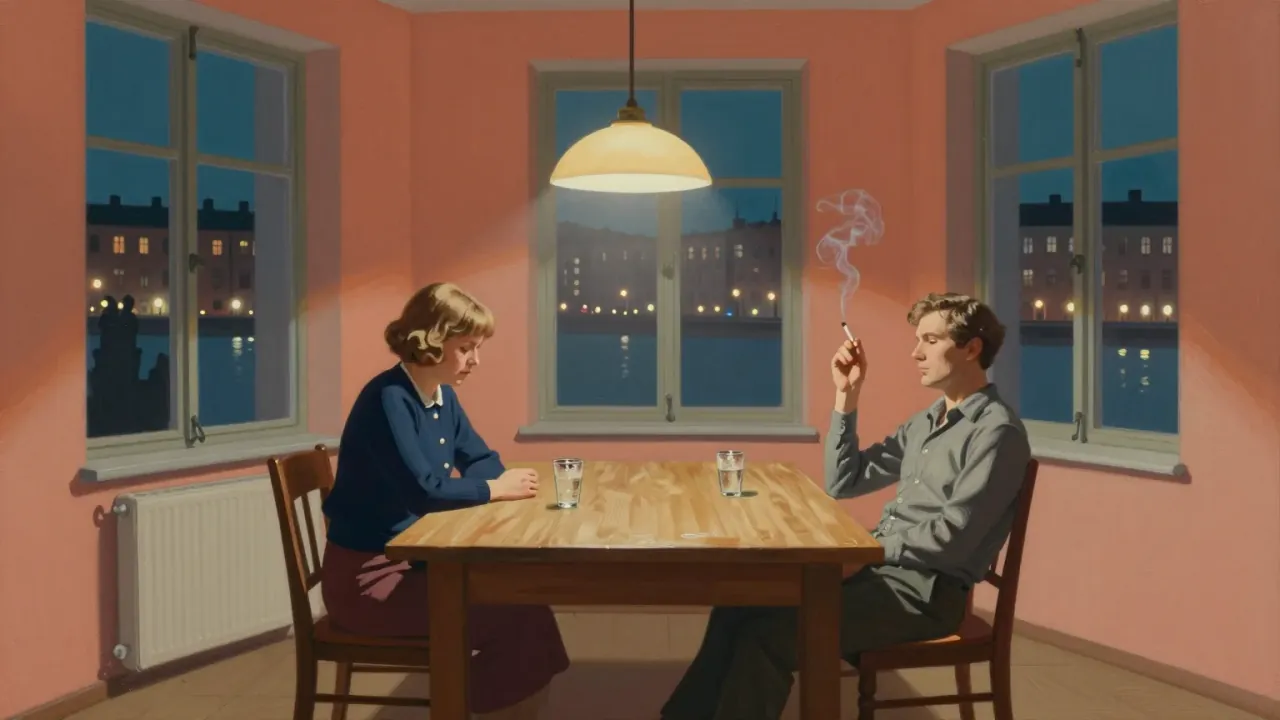
The narrative unfolds in three distinct movements: the warmth and theatricality of the Ekdahl household; the cold symmetry and punitive silence of Bishop Edvard’s residence; and the labyrinthine, ambiguous sanctuary of Isak Jacobi’s world. Sven Nykvist’s cinematography sustains this architecture: candlelit interiors glow with amber diffusion, while the bishop’s rooms are rendered in sharp, high-contrast monochrome tones, their windows barred by shadow. Sylvia Ingemarsson’s editing moves deliberately, allowing scenes to settle without hurry — a pillow fight lingers, a magic lantern’s beam holds, a confession unfolds across several takes. Performances avoid declamation: Börje Ahlstedt’s Oscar is tenderly flawed, Ewa Fröling’s Emilie carries quiet fracture beneath composure, Jan Malmsjö’s Edvard is terrifying not through rage but through stillness and procedural certainty. Lena Olin, Harriet Andersson, and Gunn Wållgren anchor the periphery with granular specificity. Daniel Bell’s score is restrained, often absent — sound design dominates instead: creaking floorboards, rustling silk, the muffled thud of a door closing in a corridor too long to echo back.
What stays with you
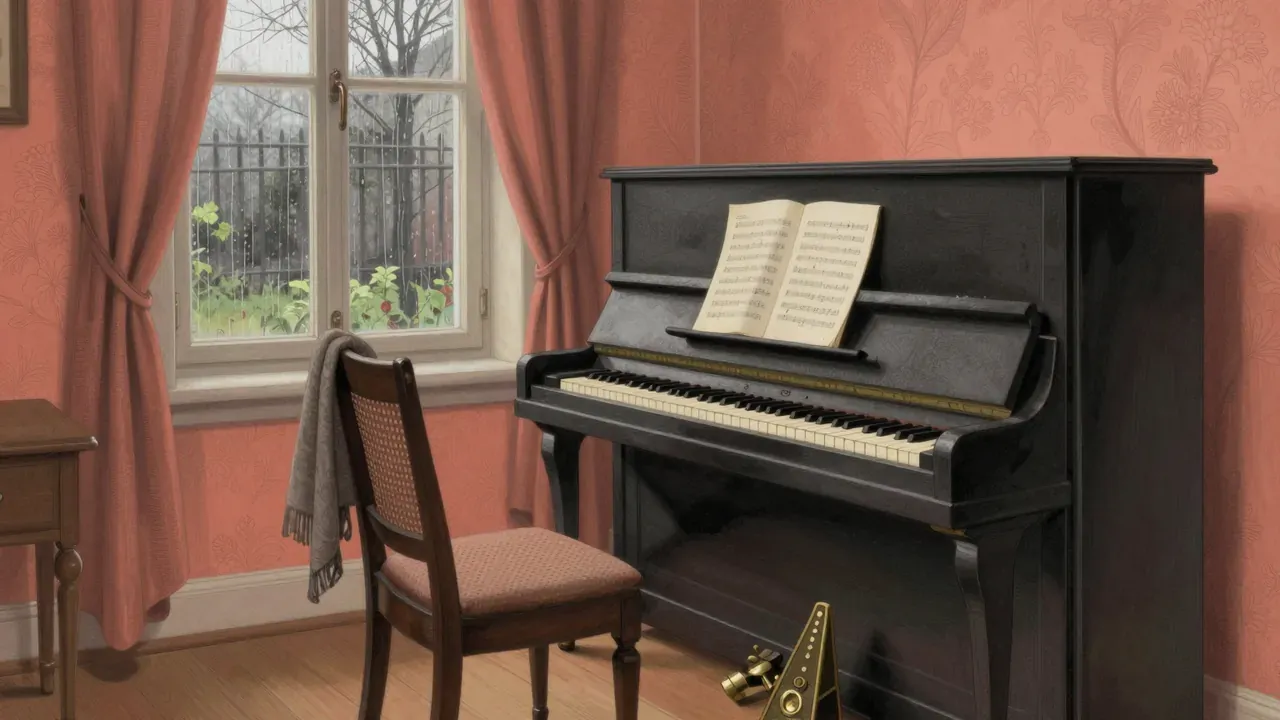
What lands most firmly is the film’s tactile fidelity to memory — not as nostalgia, but as sensory sediment. The Ekdahl home feels lived-in because it is cluttered with function: stage props double as furniture, embroidery hoops hang beside religious prints, a gramophone shares shelf space with a Torah scroll. This density makes the shift into Edvard’s house physically jarring: fewer objects, sharper angles, colder light, less air. Alexander’s imagination — expressed through whispered stories, drawings, and silent glances — registers as credible rather than whimsical because it is treated as a survival mechanism, not a flourish. The sequence in which he is confined to a darkened attic room lands with cumulative dread, not shock; the horror is structural, not sensational. Even the supernatural elements — the ghost of the bishop’s first wife, the apparition in the nursery — are presented without fanfare, as natural extensions of a worldview where the unseen is routinely consulted. These moments do not ask to be believed; they ask to be accepted as part of the film’s internal logic, and the film earns that acceptance through consistency of tone and detail.
Where it wanders
What does not land is the film’s occasional drift into anecdotal sprawl — episodes that feel like remembered fragments rather than dramaturgical necessities. A subplot involving Alexander’s older sister Amanda vanishes when Linn Ullmann was unavailable, leaving a gap in the family’s generational hierarchy that is never acknowledged or compensated. Some secondary characters — particularly those tied to the theatre troupe — appear and recede without sufficient anchoring, their motivations opaque. The transition from Edvard’s house to Isak’s world, though visually rich, lacks a clear emotional pivot: the relief feels earned more by contrast than by cause. The film’s length — 188 minutes — does not fatigue because of pacing, but because certain sequences (a formal dinner, a Yuletide service) repeat thematic beats without deepening them. There is no misstep in craft, but there are stretches where the film’s generosity of attention begins to resemble indulgence — moments that serve Bergman’s personal archaeology more than the story’s forward motion. This is not a flaw in intent, but a consequence of its ambition to be both memoir and myth.
What it’s really about
The themes that matter are inheritance, authority, and the material conditions of imagination. The film interrogates how belief systems — Lutheran doctrine, Jewish mysticism, theatrical illusion, childhood fantasy — compete for legitimacy in shaping perception and behaviour. Authority is examined not only in its institutional forms — the bishop’s pulpit, the headmaster’s cane — but in its domestic iterations: Emilie’s deference, Helena’s benevolent control, Isak’s enigmatic patronage. Inheritance operates on multiple levels: property, trauma, ritual, even costume — Marik Vos’s garments carry history in their cut and fabric, just as Anna Asp’s sets encode class and memory in their wallpaper and wood grain. Crucially, the film refuses to resolve these tensions. There is no triumph of imagination over dogma, nor of love over discipline; instead, it shows how all coexist, sometimes uneasily, within the same household, the same person, the same frame. The final image — Alexander narrating his own story — affirms storytelling not as escape, but as the primary tool for ordering chaos, for holding contradictory truths in suspension.
Who it’s for
This film is for viewers who value sustained attention, who find richness in domestic detail and emotional restraint, and who accept ambiguity as a condition of truth rather than a failure of clarity. It rewards patience with texture, not plot twists. It is not for those who require narrative propulsion, psychological exposition, or moral resolution — viewers expecting the tight causality of a thriller or the cathartic arc of a coming-of-age film will find its rhythms alienating. Those who associate ‘arthouse’ with austerity may be surprised by its warmth, while fans of Bergman’s bleaker works may miss the metaphysical confrontation of his 1960s output. Its pace and density also make it inaccessible to younger audiences without context, and its Swedish-language dialogue — with no stylistic concession to non-native ears — demands full engagement. A viewer who prefers visual metaphor over spoken subtext, or who values production design as narrative agent, will find it essential. Anyone needing immediate payoff or transparent motivation should look elsewhere.
Is it worth your evening
Yes, it is worth your evening — not as diversion, but as immersion. Its 188 minutes pass without strain because its world is so fully inhabited, its silences so articulate, its surfaces so legible. You do not watch it to be told something, but to remember how it feels to inhabit a place where time thickens, where objects hold memory, and where authority is measured in light and shadow as much as in words. It asks for nothing beyond attention, and repays it with density: every costume, every prop, every pause has been considered. That said, its value depends on willingness to sit inside its rhythm rather than impose your own. A viewer who watches films primarily for plot efficiency or emotional shorthand will leave unmoved — not because the film fails, but because their expectations and its method are incompatible. Change the viewing context — a distracted screen, fragmented attention, expectation of momentum — and the verdict shifts. But under the right conditions, it remains singular: a domestic epic built from candlelight, wool, and quiet conviction.