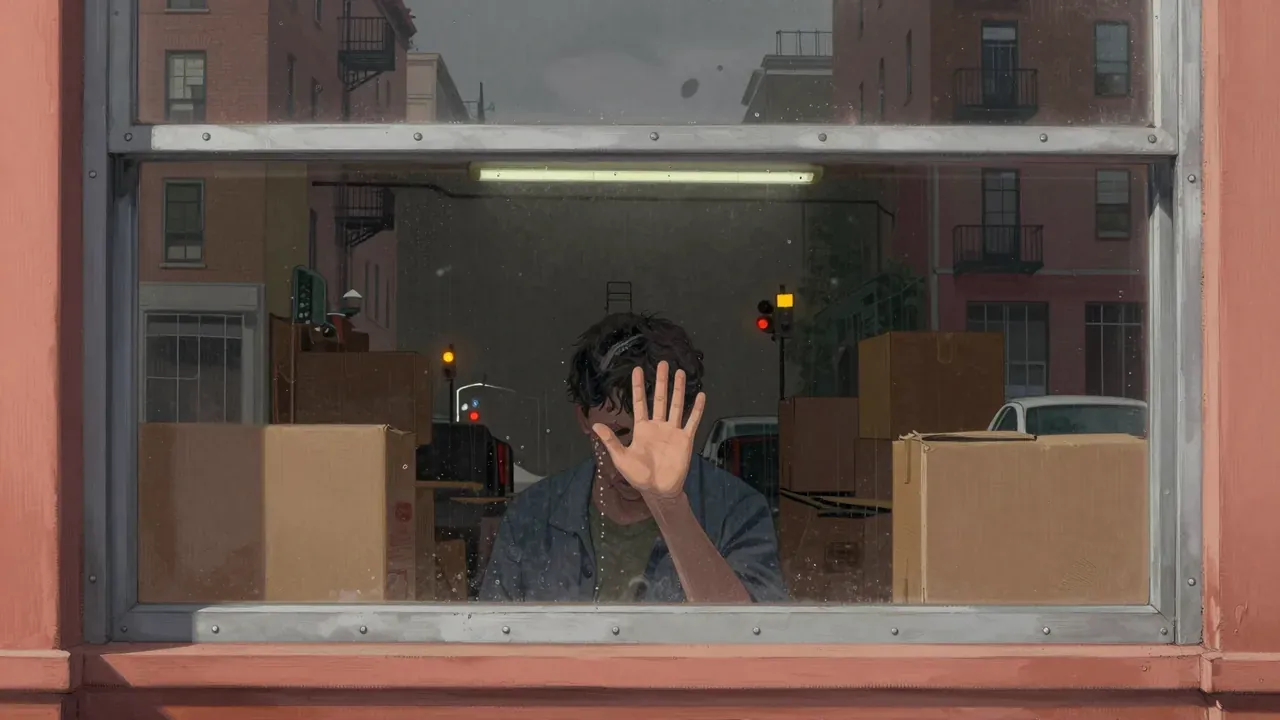
The arrival of the boy
Prince of Broadway is a low-budget American drama from 2008, written and directed by Sean Baker, that follows Lucky — a street vendor in New York City who sells counterfeit designer goods — after his ex-girlfriend reappears with their young son. It is trying to do something modest but precise: to hold steady on a man whose competence at survival has left him emotionally unprepared for parenthood, and to render that disjunction without recourse to melodrama or uplift. The film avoids the biographical sweep of social realism and the schematic rigour of issue-based indie drama; instead it works within the tight margins of daily transaction — cash exchanged, space negotiated, attention diverted — to ask how responsibility settles, if it settles at all. Its scale is deliberately narrow: one borough, one season, one fractured family unit, one economy operating just outside legality. There is no voiceover, no flashbacks, no explanatory dialogue. What it attempts is not revelation but registration — of habit, evasion, and the quiet weight of a child’s presence in a life built on mobility and impermanence. (159 words)
The weight of stillness
The story unfolds in episodic, unemphatic units: Lucky haggles with buyers, evades police, shares cramped apartments, and slowly adjusts to having his son around. Adu carries the role with minimal inflection — his performance is grounded in physical economy and withheld reaction, never signalling internal change before it arrives. Baker shoots on digital video with available light and natural sound, favouring medium shots and shallow focus that keep Lucky’s face half-obscured or partially turned away. Editing is unhurried but never slack; scenes end just before resolution, trusting the viewer to register what lingers — a glance held too long, a silence that outlasts the argument. Production design is functional rather than expressive: peeling walls, fluorescent hum, the clutter of resale goods stacked in hallways. There are no score cues, no stylised colour grading, no symbolic objects. The craft serves restraint: every choice defers interpretation, insisting instead on the texture of lived time — the wait between transactions, the fatigue in a shoulder slump, the way a child’s shoe sits abandoned on a linoleum floor. (158 words)
The rhythm of adjustment
What lands is the cumulative pressure of small adjustments — Lucky’s shift from treating the boy as a logistical problem to noticing his preferences, his rhythms, his unspoken fears. A sequence where he teaches the child to count money, then pauses mid-explanation to watch him trace letters on a shop window, lands because it refuses to name the feeling. The film’s refusal to moralise Lucky’s past — his hustling, his absences, his emotional reticence — gives his tentative steps forward more weight than any redemption arc could. The city itself lands as a character: not as backdrop but as constant counterpoint — traffic noise bleeding into domestic moments, sirens undercutting quiet conversations, the sheer density of human motion making solitude feel like effort. Even minor figures — a fellow vendor, a landlord, a social worker — register as fully inhabited, not plot devices. Their dialogue is terse, specific, often transactional, yet never dismissive of interiority. The film trusts that consistency of tone and precision of detail will generate empathy without exposition, and it does: the audience’s investment grows not through dramatic turns but through the slow accrual of witnessed behaviour. (157 words)
Where the frame holds too long
What does not land is the structural thinness of the second act, where narrative momentum stalls for nearly twenty minutes without sufficient compensatory texture. The film’s commitment to understatement begins to read as underdevelopment: certain relationships — particularly with the boy’s mother — remain opaque not by design but by omission, leaving motivations unanchored. A subplot involving a rival vendor feels tacked on, its tension dissolving without consequence or thematic return. The budgetary constraints show most plainly here: repeated locations, limited supporting cast, and a lack of visual or sonic variation begin to erode the very realism the film depends on. Some scenes linger not with intention but inertia — a pause that should breathe instead drags, a shot that should observe instead waits. This is not a failure of sincerity but of calibration: the film mistakes absence of emphasis for depth of implication. Where Baker’s later work uses austerity as a formal strategy, here it occasionally reads as provisional — as though the script stopped short of the revisions needed to make silence speak as loudly as speech. (156 words)
The grammar of survival
The themes that matter are parenthood as uninvited recalibration, economic precarity as a condition of perception, and dignity as something asserted in gesture rather than declared in speech. The film treats class not as backdrop but as grammar — shaping syntax, pacing, even the duration of eye contact. Lucky’s relationship to authenticity — selling fakes while seeking real connection — is never stated but permeates every transaction he makes, whether with customers, authorities, or his son. Time is another theme: not chronological but embodied — the exhaustion in Lucky’s gait, the impatience in his hands, the way childhood stretches and compresses depending on who is holding the clock. There is also a quiet interrogation of American individualism: the myth that self-reliance is virtuous, not just adaptive — and how that myth collapses when care becomes non-negotiable. These ideas are not argued but embedded: in the way Lucky folds a child’s clothes with unfamiliar care, in how he checks door locks twice now, in the single shot where he watches his son sleep and does not move for ninety seconds. The film’s moral centre is not virtue but vigilance — the sustained attention required to stay present in a world built to distract. (159 words)
Who this film is for
This film is for viewers who value behavioural precision over plot propulsion, who find resonance in the unsaid, and who trust that a character’s growth can be measured in posture shifts and revised routines rather than speeches or climaxes. It suits those familiar with New York’s lower-income neighbourhoods, or with the rhythms of informal economies — not as exotic subject matter but as lived terrain. It is not for viewers who require narrative closure, psychological exposition, or tonal consistency across acts. Those expecting the formal rigour of Baker’s later films — or the social sweep of comparable indies like Half Nelson or Frozen River — may find its looseness frustrating, not deliberate. A viewer who values thematic clarity over atmospheric accumulation would likely leave unconvinced. What would change the verdict? A tighter second act, or a more defined point of view on the mother’s agency — both would sharpen the film’s central question: not whether Lucky can become a father, but whether the conditions around him allow fatherhood to be anything other than endurance. (159 words)
What remains after the credits
Yes, it is worth your evening — but only if you approach it as a study in restraint, not as a story with a destination. Its value lies in its fidelity to a particular kind of marginal existence: economically precarious, socially unremarked, emotionally guarded — rendered without condescension or embellishment. It rewards patience, not passive viewing; it asks you to notice what changes in Lucky’s hands, not what he says. That said, its 100-minute runtime tests that patience unevenly: the middle stretch sags, and the ending arrives not with resolution but with quiet suspension — which some will read as honesty, others as evasion. Viewers who demand clear stakes or earned catharsis will feel short-changed. But for those willing to sit with ambiguity — to accept that care can begin before understanding, and that responsibility can settle before belief — the film offers something rare: a portrait of becoming that refuses to name the thing being become. It is not great, but it is honest — and in this register, honesty is the highest standard. (159 words)