The look of it
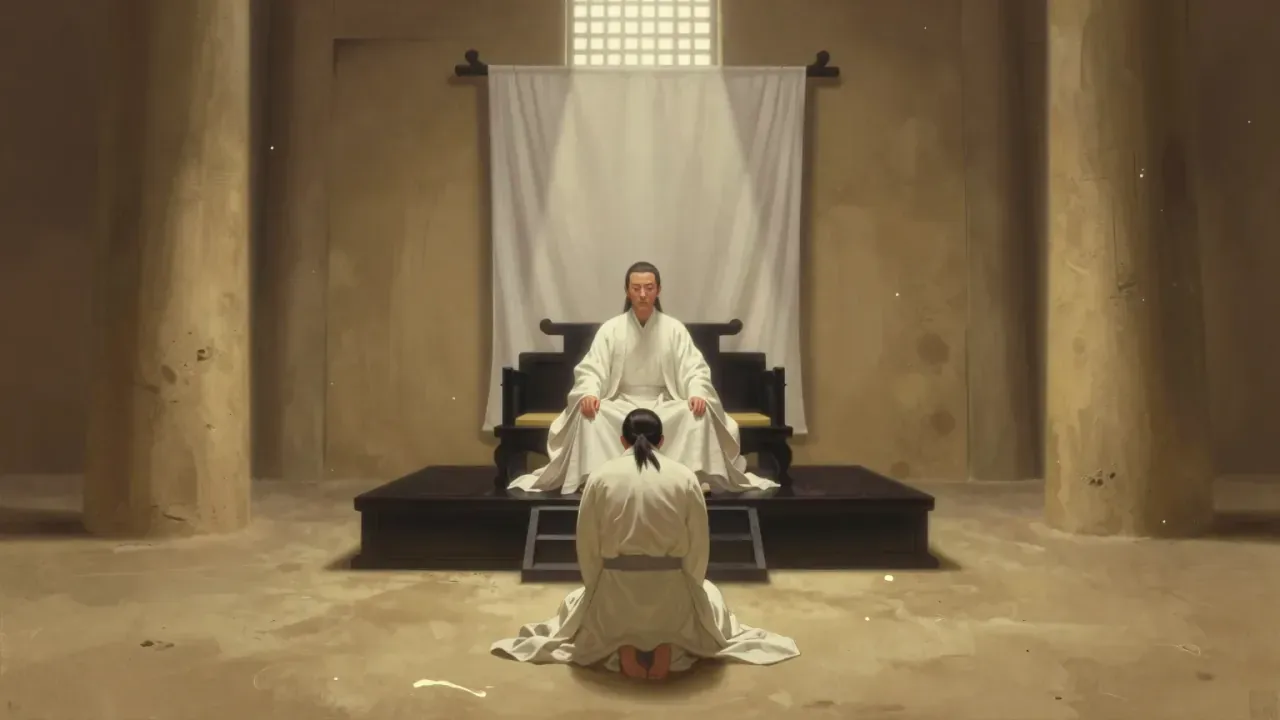
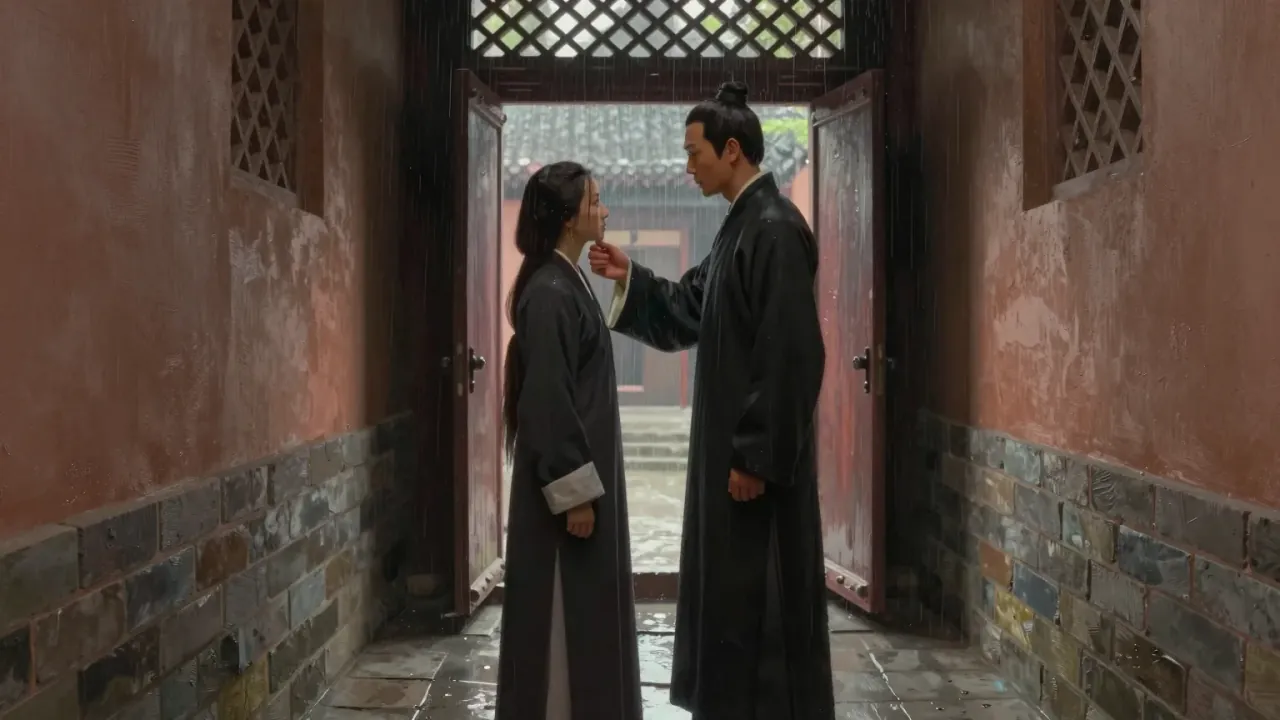
Shadow is a wuxia film set in a fictionalised Three Kingdoms-era China, adapted from Zhu Sujin’s play Jingzhou of the Three Kingdoms. Zhang Yimou directs and co-writes; Zhao Xiaoding handles cinematography. The film attempts a sustained visual experiment: rendering its world as close as possible to monochrome ink painting — not through digital desaturation but by shooting on real rainy days, controlling colour physically via costumes, sets, and weather. It seeks to subordinate narrative momentum to tonal cohesion, using restraint in palette, movement, and dialogue to evoke classical scroll aesthetics. Its ambition lies less in reimagining wuxia convention than in re-rooting it in Chinese pictorial tradition — treating combat, court intrigue, and identity as brushstrokes within a single, controlled wash. This is not stylisation as ornament but as structural principle: every frame must serve the ink-wash logic, even when that logic demands stillness over spectacle, silence over exposition, repetition over revelation. The film’s opening title sequence — slow pans across rain-slicked stone, ink-dark banners stirring in damp air — establishes this as a condition, not a choice.
The weight of it
The story follows Jingzhou, a decoy trained to impersonate the wounded general Ziyu, whose body and reputation he must sustain while plotting to retake Jing Prefecture from the rival Kingdom of Yan. Deng Chao plays both men, distinguishing them through posture, vocal register, and micro-gestures rather than makeup or editing tricks; Ryan Zheng appears as Yang Ping, son of the enemy general. Zhao Xiaoding’s camera moves with deliberate slowness, often framing characters in tight symmetry or shallow depth, letting rain blur edges and soften focus. Fight choreography privileges rhythm and geometry over speed: the metal umbrella weapon is treated as an extension of breath and balance, its parries and thrusts calibrated to yin-yang theory. Dialogue is sparse and functional; motivation is implied through gesture — Xiaoai’s silent adjustment of Jingzhou’s collar, Ziyu’s clenched jaw during training, Pei Liang’s finger tracing the rim of a teacup before issuing a death sentence. The production design avoids historical literalism: walls are matte grey, banners hang limp and untextured, armour is simplified into curved planes of brushed steel.
The movement of it
What lands most decisively is the film’s visual architecture. The ink-wash aesthetic holds without strain across all 116 minutes: rain is never incidental but compositional, light never dramatic but atmospheric, costume never decorative but chromatic anchor. Zhao Xiaoding’s control over exposure and contrast yields sequences — such as the duel on the floating platform at dawn, where mist dissolves the boundary between water and sky — that feel less like cinema than moving scrolls. Deng Chao’s dual performance works because it refuses duality: his Jingzhou is not ‘weaker’ than Ziyu but differently weighted — quieter in the shoulders, slower in the blink, more attentive to surfaces. The umbrella combat lands as both philosophy and physicality: its feminine, yielding logic counters Yang Cang’s rigid guandao technique not through force but redirection, making each clash legible as idea before action. Even the political subtext — the hollowness of royal authority, the expendability of shadows — emerges not through speech but through staging: Pei Liang seated high and isolated, Jingzhou always framed just slightly off-centre, Xiaoai’s gaze fixed on thresholds rather than faces.
The feeling of it
What does not land is the emotional weight of the central triangle. Jingzhou’s devotion to Xiaoai and his yearning for autonomy remain schematic rather than felt; their night together before the duel lacks texture — no shared history, no tactile detail beyond a single glance exchanged across a doorway. The film’s refusal to explain motivation extends too far: we are told Jingzhou was taken as a child and trained, but never shown what that training cost him beyond a scar. Pei Liang’s cruelty feels ritualistic rather than rooted — his decision to accept Yang Ping’s insult as concubinage reads as plot necessity, not psychological plausibility. The final feast scene pivots on revelations that arrive without groundwork: that Pei Liang knew Jingzhou was a shadow, that he ordered the assassins, that Ziyu survived — none of these are seeded earlier, so their impact is structural, not emotional. The film’s austerity becomes a barrier: when characters withhold expression, the audience has no access point. Some viewers will find this discipline bracing; others will find it withholding — a difference of taste, not craft.
The power of it
The themes that matter are substitution, visibility, and the violence of representation. Jingzhou is not merely a double but a vessel: his body bears Ziyu’s wounds, wears Ziyu’s rank, speaks Ziyu’s lines — yet his own name is erased from record and memory. The ink-wash aesthetic literalises this: figures emerge from and recede into grey, defined only by contrast, never by intrinsic hue. Power resides not in personhood but in position — Pei Liang rules because he occupies the throne, not because he commands loyalty; Ziyu schemes because he controls the narrative of his own survival. The rain is thematic as well as visual: it obscures, equalises, erases — washing away distinction between truth and likeness, ruler and stand-in, victor and victim. Even the banner — the symbol of sovereignty — is toppled not by a hero but by convicts, then replaced not by a new emblem but by a man wearing another man’s face. The film asks what remains when identity is stripped to function, and answers: only the shape left behind in the wet paper.
The patience of it
This is for viewers who value composition over catharsis, who find tension in stillness, who read frames as arguments. It rewards patience with cumulative precision — the third viewing reveals how lighting shifts between court scenes signal shifting allegiances, how costume textures change subtly as Jingzhou gains agency. It is not for those who need narrative propulsion, psychological exposition, or moral clarity: the film offers no heroes, no villains, only roles, rotations, and replacements. A viewer who expects wuxia to deliver kinetic release or romantic resolution will leave unsatisfied. Those who prefer historical fidelity over aesthetic abstraction may object to the anachronistic minimalism. But the verdict does not hinge on preference alone: if the ink-wash conceit were abandoned mid-film — say, through a sudden burst of colour or exposition — the structure would collapse. That coherence is the film’s achievement, and its limit.
The worth of it
Yes, it is worth your evening — provided you watch it as a study in restraint, not as a story to be solved. Its 116 minutes unfold without hurry, asking for attention to grain, gesture, and negative space. It repays close viewing: the way rain collects on an umbrella’s rim before falling, the shift in Xiaoai’s hand position when she picks up a dagger, the exact moment Jingzhou stops mirroring Ziyu’s walk and begins walking as himself. Those who find beauty in limitation — in the discipline of black ink on rice paper, in the economy of a single note held until it frays — will find it rich. Others may find its pace glacial, its silences opaque, its ending unresolved rather than ambiguous. A viewer who values thematic density over emotional payoff will argue it succeeds; one who measures film by empathy or momentum will judge it austere to the point of coldness. Nothing in the film changes that divide — it neither invites nor resists either reading.