The look of it
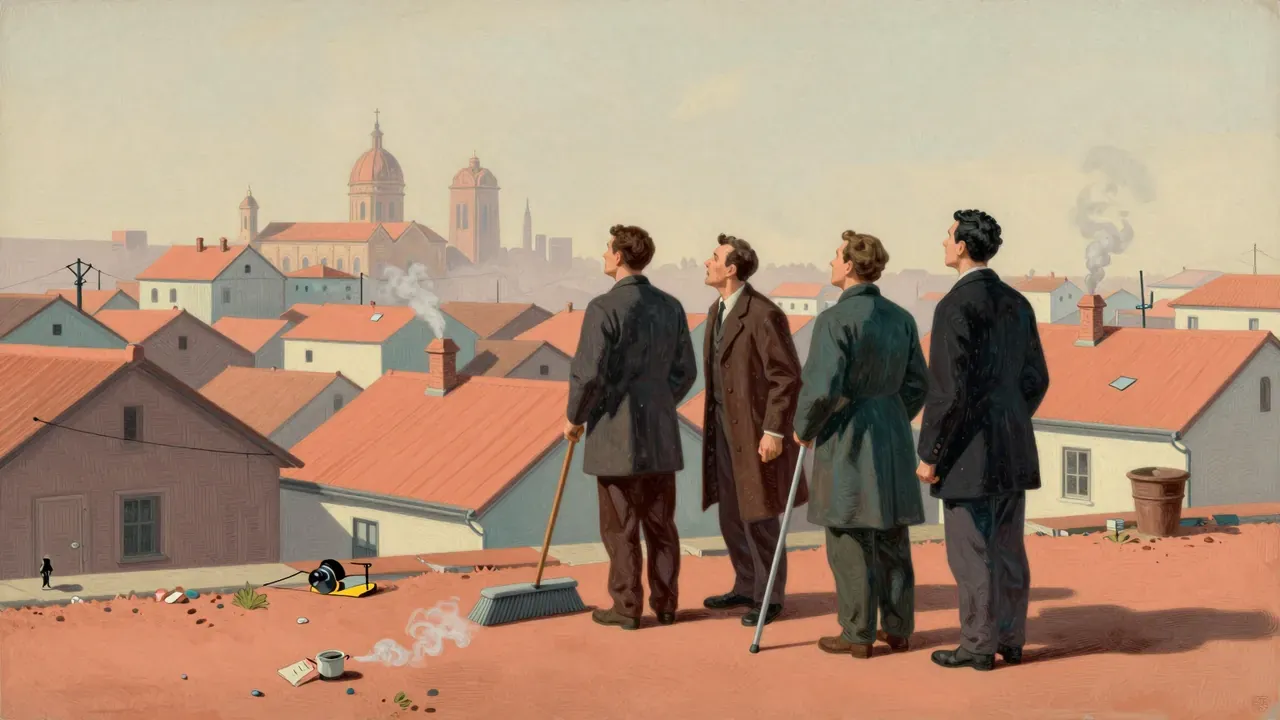
Miracle in Milan is a cinematic fairy tale made in post-war Italy, using the tools of neo-realism — non-professional actors, location shooting on a Milanese wasteland near Lambrate station — to frame a story that deliberately departs from documentary gravity. Vittorio De Sica intended it as an assertion: that dignity and joy persist even under material destitution, and that collective imagination can become a form of resistance. It adapts Cesare Zavattini’s 1943 novel Totò il Buono not as social reportage but as fable, threading fantasy into the fabric of everyday struggle. The film does not ask whether miracles are possible in reality, but whether they are necessary in spirit — whether belief in them, however briefly sustained, alters how people treat one another. Its project is neither escapism nor satire alone, but a calibrated suspension: realism held just long enough for wonder to enter without breaking the frame. It treats poverty not as a condition to be solved on screen, but as a ground from which other kinds of wealth — warmth, solidarity, play — might visibly grow. (158 words)
The way it moves
The story follows Totò from cabbage-patch infancy to leadership of a self-built shantytown, its structure shaped by gentle escalation rather than conflict-driven plotting. Francesco Golisano, a non-professional actor, carries the role with unforced openness; Emma Gramatica as Lolotta gives quiet gravity to the film’s moral centre. G.R. Aldo’s cinematography favours low angles and shallow focus, keeping faces prominent against the rough textures of scrap-wood huts and open sky. Ned Mann’s special effects — wirework, matte shots, simple optical tricks — are deliberately unpolished, reinforcing the handmade quality of the world. Alessandro Cicognini’s score uses light woodwind motifs and folk-like repetition, never swelling into grandeur. Eraldo Da Roma’s editing sustains rhythm through duration: scenes breathe, pauses hold, celebrations unfold in real time. The script by Cecchi d’Amico, Chiari, Franci and Zavattini avoids exposition, trusting gesture and ensemble interaction to convey shifts in mood and power. Even the oil discovery is treated with bemused understatement, not narrative fanfare. (159 words)
What holds the air
What lands is the film’s unwavering tonal consistency: a warmth that never curdles into sentimentality, a whimsy that never floats free of consequence. The shantytown’s evolution — from scattered huts to named streets and communal square — feels earned because it is shown as labour, not magic. Totò’s leadership emerges not through speechifying but through small acts of inclusion: sharing fire, listening, deferring to others’ ideas. The angels, the dove, the flying broomsticks — all land because they arrive only after the community has already built something real together. The finale’s flight over the Duomo works not as spectacle but as logical culmination: if shared hope can make a home from rubble, why not lift off? The film’s humour — Mobbi’s awkward sincerity, Rappi’s petty betrayal, the residents’ literal-mindedness about oil — lands precisely because it springs from character, not setup. There is no punchline that does not also reveal a truth about how people negotiate power, scarcity or kindness. (157 words)
Where the thread frays
What does not land is the late shift in agency: once Totò receives the dove, the film’s internal logic loosens. Wishes multiply without hierarchy or consequence, diluting the earlier emphasis on mutual effort. Edvige’s request for shoes — tender and grounded — is followed immediately by the Sun, a leap that risks making desire itself seem arbitrary rather than revealing. The angels’ reappearance feels less like mythic necessity and more like narrative convenience, especially as their intervention supplants the community’s own resilience. Some performances falter under the weight of allegory: Paolo Stoppa’s Mobbi remains broadly drawn, his conversion too swift to carry full weight, and Brambi barely registers beyond caricature. The American special effects, though charmingly rudimentary, occasionally jar — the dove’s flight lacks the physical presence of the human-scale action around it. The film’s refusal to name systemic forces — land law, municipal neglect, class violence — means its critique of capitalism stays at the level of individual greed, not structure. That choice serves the fable, but it leaves certain tensions unresolved, not transcended. (156 words)
What it believes in
The themes that matter are not poverty versus wealth, but attention versus indifference; reciprocity versus extraction; collective memory versus official history. The film treats sunlight, wind and water not as resources but as shared sensations — things felt equally by saint and squatter. It proposes that dignity resides not in ownership but in the right to shape one’s immediate environment, to name streets, plant gardens, dig wells. The oil discovery functions less as plot device than as test: when value is imposed from outside, does it corrupt the community’s internal economy of care? Totò’s final flight is not escape but reorientation — towards a place where greeting someone is not ritual but promise. The film’s quietest theme is temporality: winter lingers, but so does warmth; evictions happen, but so do returns. It refuses the neo-realist imperative to end in despair or reform, choosing instead a horizon where ‘good morning’ is both greeting and covenant — fragile, conditional, and entirely human. (154 words)
Who it meets
This film is for viewers who trust slowness, who find emotional precision in understatement, and who accept that political feeling can live inside a lullaby. It suits those familiar with Italian neo-realism but also those new to it — its fable structure offers entry without prerequisite knowledge. It is not for viewers who require clear antagonists, escalating stakes or psychological realism; Mobbi’s ambiguity may frustrate those seeking moral clarity. Nor is it for those who read fantasy as evasion: the film’s magic arrives only after bricks have been laid and fires lit. Some will find its gentleness insufficient against the weight of post-war Italy’s actual conditions — a view held by critics who preferred the sharper edges of Rossellini or early Visconti. A viewer who values narrative propulsion over cumulative mood, or who expects satire to name names and assign blame, will likely disengage before the maypole rises. What would change the verdict? A tighter integration of the miraculous with the communal — had the dove emerged from shared action, not solitary grace, the ending might feel less like departure and more like continuation. (159 words)
Where it lands
Yes, it is worth your evening — not as diversion, but as recalibration. Its 100 minutes move at the pace of shared breath, asking you to notice how light falls on a child’s face, how laughter spreads across a courtyard, how a handkerchief waved on a pole becomes a signal before it becomes a flag. It earns its lightness by first showing the weight it lifts. You will not leave with answers about housing policy or capital, but with a clearer sense of what a community looks like before it is named, and how joy functions as infrastructure. Those who watch for plot efficiency may find it slack; those who watch for texture will find it dense. It rewards attention to craft — Aldo’s grain, Cicognini’s flute trills, Da Roma’s unhurried cuts — not as decoration but as argument. Its restoration in 2019 confirms its durability: this is not nostalgia, but a working model. If your evening is measured in revelations, this film offers few. If it is measured in resonance, it offers many. Its worth lies not in what it solves, but in how thoroughly it reimagines the terms of belonging. (158 words)