The look of it
Patriotism is a thirty-minute silent black-and-white short film, shot in 1965 and released in Japan in April 1966. It adapts Yukio Mishima’s 1960 short story of the same name, dramatising the final hours of Lieutenant Shinji Takeyama and his wife Reiko following the February 1936 Ni Ni Roku Incident. The film does not seek to historicise or interrogate the coup but to ritualise its aftermath — to stage fidelity, love, and death as indivisible acts. Mishima co-directs with Masaki Dōmoto, but the film bears his authorial imprint at every level: he wrote it, stars in it, and conceived its Noh-inflected visual grammar. Its aim is not narrative exposition but formal consecration — to compress ideology, eros, and mortality into a fixed, static, unblinking frame. It treats suicide not as collapse but culmination; not as protest but punctuation. The film’s silence, intertitles, and compositional rigour all serve this singular purpose: to make devotion visible, legible, and absolute. It is less a dramatisation than a liturgy rendered in celluloid. (142 words)
The way it tells
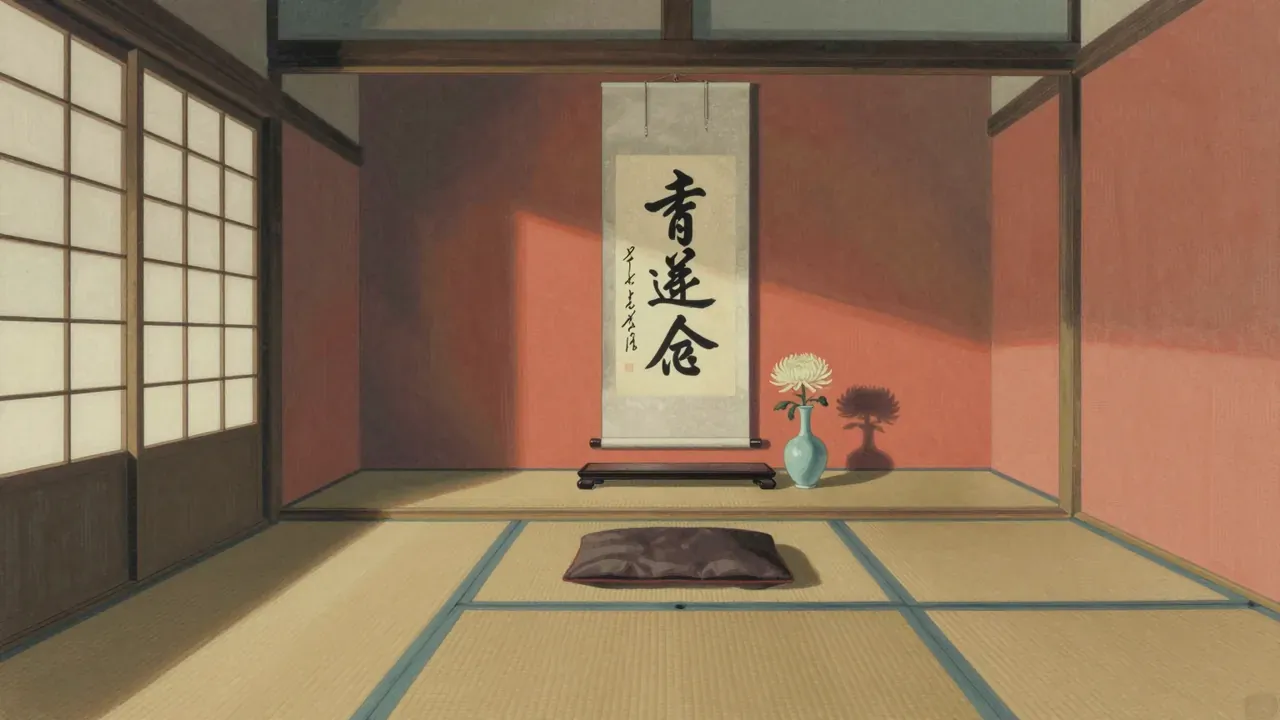
The story unfolds across five chapters in a single room, anchored by a hanging scroll inscribed with the phrase ‘wholehearted sincerity’. Mishima plays Takeyama with restrained physicality, his eyes often obscured by shadow or framing; Yoshiko Tsuruoka as Reiko moves with quiet deliberation, her face held in long-held close-ups that avoid sentimentality. Kimio Watanabe’s cinematography uses extreme contrast — deep blacks, stark whites — to heighten the Noh-like austerity, while blood appears with shocking, almost clinical intensity. The editing is deliberate and sparse, favouring static wide shots and lingering close-ups of hands, lips, fabric, and skin. Sound is absent except for Richard Wagner’s score, heard only in screenings with musical accompaniment — though the film itself contains no diegetic sound. Intertitles supply historical context and internal monologue, functioning like Noh chorus narration. The lovemaking sequence avoids eroticism in favour of abstraction: fragmented torsos, pressed palms, mouths on necks, all filmed with surgical focus. There are no cuts during the hara-kiri — only duration, stillness, and consequence. (158 words)
What holds
What lands is the film’s unwavering tonal consistency — its refusal to flinch, explain, or soften. The intertitles do not interpret; they locate. The static camera does not judge; it witnesses. The contrast between Reiko’s white kimono and the black void behind her is not symbolic shorthand but structural fact — the frame itself enacts the binary she inhabits: life/death, loyalty/betrayal, self/empire. The lovemaking sequence works not as sensuality but as surrender — the bodies become vessels for ritual, their intimacy stripped of psychology and offered as pure form. Mishima’s performance gains weight from its restraint: he conveys resolve not through gesture but through posture, breath, and the slow turning of the head. The final image — the couple reclined, limbs entwined, faces serene — lands because it follows logically from every prior composition, every withheld glance, every measured pause. Nothing here feels imposed; everything feels inevitable, earned by the film’s own internal logic. The austerity never reads as emptiness — it reads as discipline made visible. (153 words)
Where it tightens
What does not land is any attempt to read the film as social critique or political argument. Its historical framing is too thin, its context too selectively presented, to sustain readings about militarism’s death or postwar disillusionment — those are extrapolations, not engagements. The intertitles name the Ni Ni Roku Incident but do not define it; the film assumes knowledge it does not provide. Similarly, the Wagner score — while thematically resonant — remains external: it was not composed for the film, and its insertion feels associative rather than integrated. The abstraction of the lovemaking sequence risks alienating without clarifying — its power depends on accepting that flesh is syntax, not subject, and some viewers will find that leap unsupported. The film’s refusal to dramatise doubt, hesitation, or contradiction leaves no space for ambiguity — which makes it potent as rite, but narrow as drama. Its rigour becomes a limit: there is no room for irony, hesitation, or counterpoint, and so no friction against which meaning might spark. Those who require psychological realism or historical scaffolding will find the film opaque, not austere. (157 words)
What it means
The themes that matter are devotion as form, love as obligation, and death as completion. Patriotism treats loyalty not as allegiance to an institution but as fidelity to a condition — to one’s word, one’s spouse, one’s lineage, one’s end. The samurai code is not invoked as history but as grammar: a set of constraints that make action legible. The film’s preoccupation is not with why the coup failed, but with what remains when duty and desire converge beyond resolution. Ritual here is not superstition but architecture — the hara-kiri, the kiss, the lipstick application, the scroll — all are structures that hold meaning in place. Mishima’s later suicide shadows the film, but the work itself does not foreshadow; it rehearses. It asks what happens when ethics and aesthetics collapse into a single act — when to live well means to die precisely, and to love fully means to choose the same hour. The film’s nationalism is not chauvinist but ceremonial: the emperor is never shown, the state never named — only the private enactment of public principle. This is not propaganda; it is incantation. (149 words)
Who it meets
This film is for viewers who accept that form can carry moral weight, who find power in stillness and precision, and who approach cinema as contemplative practice rather than entertainment. It rewards attention to texture, framing, and rhythm over plot or character arc. It is not for those who require narrative momentum, psychological motivation, or contextual exposition — its silences are not invitations to interpretation but boundaries. Anyone expecting historical analysis, political commentary, or emotional catharsis will be frustrated. Those who reject ritual as inherently authoritarian, or who find Mishima’s worldview ethically untenable, may still engage formally but will likely resist its affective pull. A change in verdict would follow if the film admitted doubt — a hesitation, a glance away, a moment where the scroll’s inscription flickered under uncertain light. But it does not. Its conviction is total, and its audience must meet it on those terms. (144 words)
What it costs
Yes, it is worth your evening — but only if you arrive prepared to sit with it, not through it. Thirty minutes is brief, yet the film’s density demands slowness: each shot holds weight, each pause accumulates meaning. It repays rewatching not for revelation but for calibration — noticing how light falls on Reiko’s collarbone, how the sword’s edge catches the same highlight as the scroll’s calligraphy, how breath sounds (in musical screenings) sync with pulse. It is not pleasurable in any conventional sense, nor is it designed to be. Its value lies in its singularity: few films commit so utterly to a single proposition — that love, loyalty, and death are not sequential but simultaneous. Those who dismiss it as fascist kitsch or narcissistic mythmaking miss its formal rigour; those who treat it as pure allegory ignore its visceral tactility. Worthwhile not because it entertains, but because it insists — quietly, fiercely, without compromise — on the gravity of choice. (147 words)