The look of it
Rumble Fish is a stylised teen drama that treats adolescence as mythic territory, not social reportage. It adapts S. E. Hinton’s 1975 novel with fidelity to its interior logic rather than its surface realism — a choice reinforced by Francis Ford Coppola’s decision to shoot in stark, high-contrast black and white, using oblique angles, painted shadows, and handheld camerawork to destabilise the viewer’s sense of place and time. The film does not aim to document Tulsa youth culture in 1982; it constructs a self-contained symbolic world where time is cyclical, memory is unreliable, and identity is performed through gesture, posture, and silence. Its noir inflections are not genre pastiche but structural: light and shadow function as moral grammar, and the city’s deserted edges become psychological landscapes. Coppola frames the story — a younger brother’s longing for his enigmatic, withdrawn elder sibling — as a fable about imitation, inheritance, and the impossibility of living up to an ideal that exists only in retrospect. The film’s ambition lies in making mood and rhythm carry narrative weight, treating the teenage condition as something elemental, not anecdotal. (158 words)
The rhythm of it
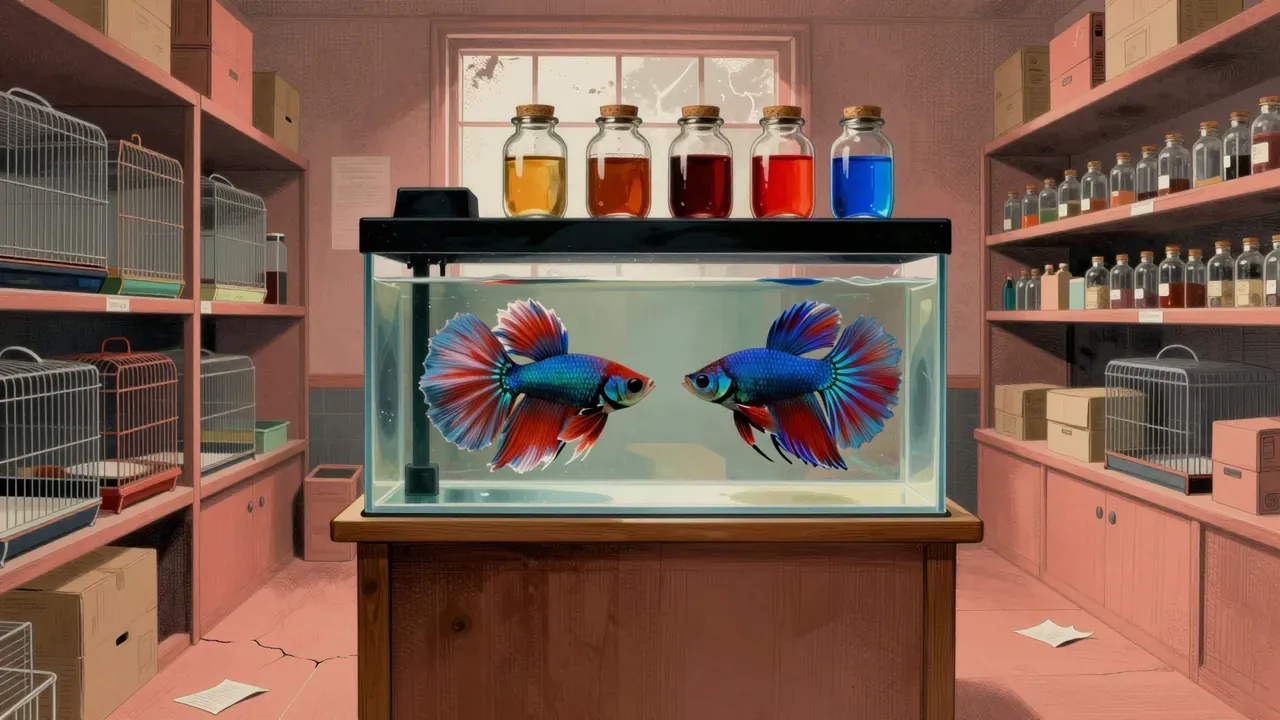
The story follows Rusty James (Matt Dillon), a restless, directionless teenager who idolises his older brother, the Motorcycle Boy (Mickey Rourke), a figure already receding into legend. Their relationship anchors a series of encounters — with friends, rivals, parents, and strangers — all filtered through Rusty James’s limited comprehension and growing disorientation. Dillon performs with physical precision: his slouch, his hesitation before speech, his flinching at sudden noise all register anxiety without exposition. Rourke’s stillness is more deliberate — a studied detachment drawn from Camus and German Expressionist portraiture, not method acting. Stephen H. Burum’s cinematography avoids naturalism entirely: walls are pre-shadowed, skies are time-lapsed, reflections are distorted, and colour appears only once, in a single, carefully constructed shot of fish in a tank. Stewart Copeland’s percussive score uses street recordings from Tulsa, processed via Musync, to bind sound to movement and urgency. Barry Malkin’s editing sustains a staccato rhythm, cutting on motion or silence rather than dialogue. The choreographed fight scene — designed by Michael Smuin — treats violence as ballet, not brutality. Every craft decision serves the film’s central conceit: that perception, not plot, is the engine. (159 words)
What holds it together
What lands most decisively is the film’s tonal consistency — its refusal to soften, explain, or reassure. The black-and-white palette does not evoke nostalgia but estrangement; the smoke-filled interiors do not suggest atmosphere but obstruction. Rusty James’s voiceover, sparse and uninflected, works because it never interprets — it merely reports sensation, leaving gaps for the viewer to inhabit. The recurring motif of the Siamese fighting fish operates as both literal prop and structural metaphor: beautiful, trapped, driven to self-destruction by instinct and reflection. The Motorcycle Boy’s final walk across the bridge feels inevitable not because of narrative cause but because the film has spent ninety minutes building a world governed by fatalistic symmetry. Even minor performances land with quiet exactness: Diane Lane’s Patty is neither romantic interest nor foil but a presence calibrated to Rusty James’s emotional bandwidth; Dennis Hopper’s father is less a character than a sonic and visual irritant — a grating bass note in the score. The film’s coherence is its strongest argument: every frame, every cut, every percussive hit reinforces the same proposition — that adolescence is less a stage than a state of permanent, low-grade crisis. (157 words)
Where it pulls away
What does not land is the film’s insistence on abstraction when emotional specificity is required. The Motorcycle Boy’s philosophical pronouncements — about time, freedom, and the futility of repetition — remain opaque not because they are profound but because they lack grounding in behaviour or consequence. His charisma is performative, not earned; his authority rests on costume and posture, not revelation. The film’s refusal to clarify motivation or history leaves some relationships undernourished: Rusty James’s bond with his father, for instance, registers as texture rather than tension. The experimental techniques — time-lapse skies, rear-projected colour inserts, abrupt cuts to static — accumulate without deepening meaning; they impress but rarely illuminate. Some sequences, particularly the dreamlike floating body mould scene, feel like technical exercises rather than narrative necessity. The score, while inventive, occasionally overwhelms rather than underscores: Copeland’s rhythms dominate scenes where silence or ambient sound would better serve Rusty James’s dissociation. And though the film’s dedication to Coppola’s brother August adds biographical weight, it remains external to the text — a footnote, not a key. The film’s rigour is admirable, but its austerity sometimes mistakes distance for depth. (156 words)
What it keeps returning to
The themes that matter are time, imitation, and the architecture of myth. Time is not linear here but recursive: characters repeat gestures, echo lines, retrace steps, and the film’s structure mirrors this — opening and closing on near-identical shots of rusted metal and moving water. Imitation is the central act of adolescence in this world: Rusty James copies his brother’s walk, his cigarette-hold, his silence, yet cannot replicate the inner certainty that makes those gestures meaningful. The Motorcycle Boy himself is already imitating — Camus, Napoleon, film noir antiheroes — suggesting that authenticity is always second-hand. Myth-making is the film’s quiet engine: the gang members speak of the Motorcycle Boy in hushed, contradictory terms; Rusty James reconstructs him from fragments, turning him into a symbol he can neither understand nor escape. Family is presented not as refuge but as echo chamber — voices overlapping, memories conflicting, parental figures absent or incoherent. There is no redemption arc, no growth, no resolution: only the slow realisation that some ideals exist only to be approached, never inhabited. The film treats adolescence not as a phase to outgrow but as a condition of perpetual becoming — and unbecoming. (159 words)
Who walks with it
This film is for viewers who value formal discipline over narrative clarity, who find resonance in mood over exposition, and who accept that a film may ask questions without offering answers. It rewards attention to composition, rhythm, and silence — not just what is said but how long a shot holds, how a shadow falls, how a drumbeat syncs with a footstep. It is not for those who require psychological realism, causal plotting, or character arcs with clear turning points. Anyone expecting a companion piece to The Outsiders will be confounded: Rumble Fish rejects that film’s warmth and accessibility in favour of austerity and ambiguity. Those who dislike non-linear storytelling, minimal dialogue, or scores that treat music as texture rather than commentary should pass. A viewer who finds German Expressionism or French New Wave techniques alienating will likely find the film cold. But someone open to cinema as sensory architecture — willing to sit with unease, to read light as language — will find it richly sustained. Its demands are precise, not arbitrary. (158 words)
What it leaves behind
Yes, it is worth your evening — provided you watch it on a screen large enough to register its contrasts, with sound that carries Copeland’s layered percussion, and without expectation of conventional payoff. Its ninety-one minutes move with the weight of inevitability, not haste, and its power accumulates slowly, like rust on metal. It is not entertainment in the transactional sense, but it is deeply felt and rigorously made — a rare case where stylistic extremity serves emotional truth rather than masks its absence. Those who dismiss it as pretentious are not wrong about its difficulty, but they mistake difficulty for emptiness. A different verdict would follow if the film were less consistent in its vision — if it wavered in tone, diluted its imagery, or softened its ending. But it does none of those things. Its integrity is its justification. To watch it is to enter a world built on its own rules, and to leave it is to carry its rhythms — the ticking, the rain, the slow turn of a head — long after the credits fade. (159 words)