The look of it
The Last Picture Show is a black-and-white coming-of-age drama set in a fading Texas oil town between November 1951 and October 1952. It adapts Larry McMurtry’s semi-autobiographical novel with fidelity to its emotional texture rather than its plot density, aiming not to chronicle adolescence but to register its quiet erosion — the slow withdrawal of certainty, warmth, and possibility from a place already half-empty. Peter Bogdanovich does not seek myth or satire; he treats Anarene as a real, breathing entity whose decline is registered through shuttered storefronts, unspoken grief, and the hollow echo of a single projector bulb flickering out. The film avoids exposition, period signposting, or narrative propulsion: it lingers where others would pivot, holds silence where others would score, and refuses to resolve what the characters themselves do not understand. Its ambition is modest in scope but exacting in execution: to make time feel thin, memory feel tactile, and loss feel ambient — not dramatic, but atmospheric, like dust settling after a door closes. It is less about what happens than what remains unspoken in the space between glances, gestures, and absences. (158 words)
The weight of silence
The story unfolds across twelve months in episodic, unemphatic increments, anchored by Sonny Crawford and Duane Jackson’s drifting friendship and their parallel, failed attempts at intimacy. Performances are restrained to the point of near-invisibility: Timothy Bottoms registers hesitation in the dip of a shoulder, Jeff Bridges conveys frustration in the way he grips a steering wheel, Cloris Leachman lets a tear fall without blinking, Ben Johnson speaks fewer than fifty lines yet fills every frame he occupies. Robert L. Surtees’ cinematography is deliberately flat and desaturated, using deep focus and static compositions that refuse to flatter or dramatise — faces are often half in shadow, interiors lit only by practical sources, exteriors bleached by Texan light. Editing by Donn Cambern and Bogdanovich favours duration over rhythm: scenes end before resolution, cuts land on empty chairs or distant horizons. Hank Williams’ music appears only diegetically — on radios, jukeboxes, car speakers — never as underscore, reinforcing the film’s refusal to interpret feeling for the viewer. Every craft choice serves the same principle: to withhold, not reveal; to observe, not explain. (159 words)
What sticks
What lands is the cumulative weight of small withdrawals: the closing of the Royal Theatre, Sam the Lion’s death, Ruth Popper’s quiet resignation, Jacy’s brittle performance of adulthood. These are not climaxes but quiet terminations — each one narrowing the world a little more. The film’s restraint makes its moments of vulnerability land with physical force: Sonny weeping silently in hospital, Duane’s fist shattering glass instead of dialogue, Lois Farrow’s confession about Sam spoken while driving, her voice steady but her knuckles white on the wheel. The black-and-white photography does not romanticise poverty or nostalgia; it clarifies texture — the grain of wood, the stubble on a jaw, the fraying edge of a café countercloth. Even minor characters register as fully inhabited: Eileen Brennan’s waitress Genevieve has three lines and two gestures, yet her weary competence feels lived-in. The film trusts the audience to infer motive, history, consequence — and rewards that trust with emotional precision rare in American cinema of the period. Nothing feels staged or symbolic; everything feels witnessed. That consistency of tone and attention is the film’s most durable achievement. (157 words)
Where it blinks
What does not land is the structural looseness around Jacy Farrow. Cybill Shepherd’s performance is technically assured, but the script gives her no interior logic beyond reaction — she shifts allegiance between Duane, Bobby, Abilene, and Sonny without psychological scaffolding, making her seem less like a person than a vector for male desire and disappointment. Her arc resolves not through growth but erasure: she departs for Dallas off-screen, her motivations unresolved, her presence reduced to a rumour in the final minutes. The subplot involving Billy, the mentally disabled boy, risks condescension despite good intentions; his function as moral barometer — swept streets, silent witness, object of pity — sits uneasily beside the film’s otherwise unsentimental gaze. Some viewers may also find the pacing unremittingly deliberate: long takes, minimal scoring, and sparse dialogue demand sustained attention without offering conventional narrative payoffs. The film assumes familiarity with mid-century Texan social codes — the weight of class, the unspoken rules of courtship, the quiet authority of older men — and offers no glossary. Those expecting thematic clarity or character arcs will leave unsatisfied. (156 words)
What it’s really about
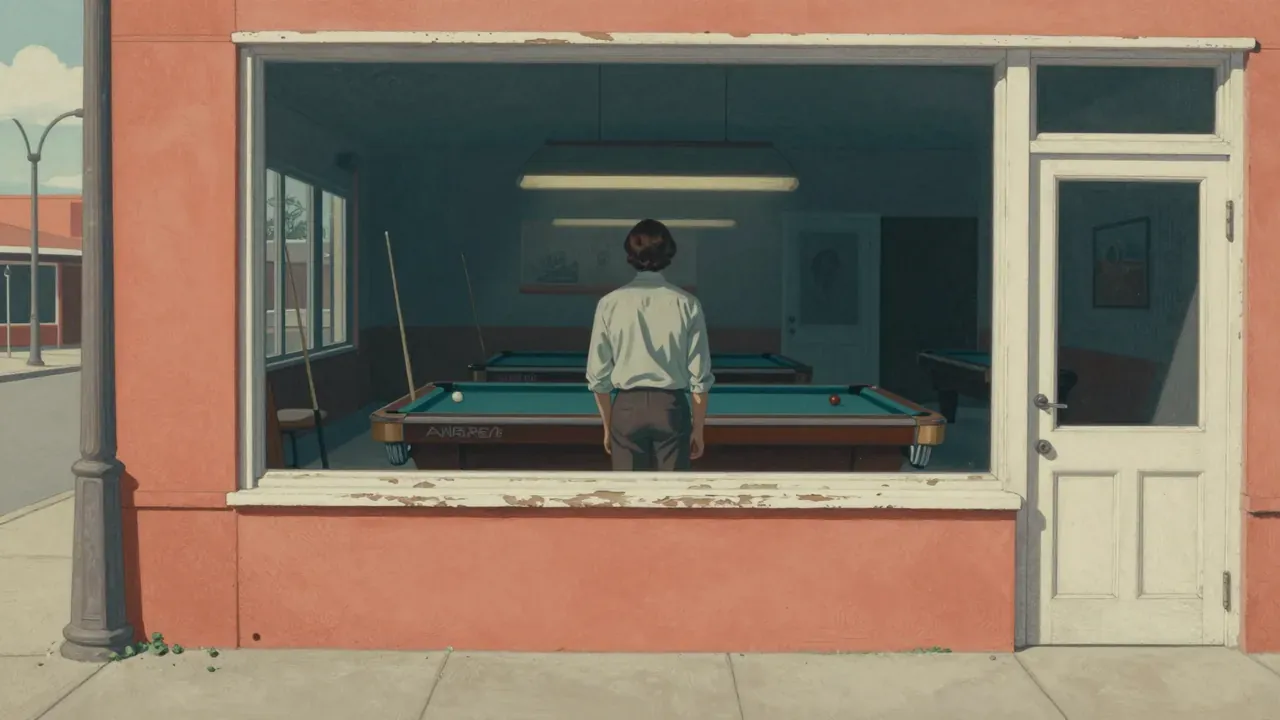
The themes that matter are not generational conflict or sexual awakening but the slow dissolution of communal infrastructure — not just the picture show, but the pool hall, the café, the coach’s authority, even the shared assumption that tomorrow will resemble today. It is a film about entropy in small places: how institutions fade before people do, how silence accumulates where conversation used to be, how grief becomes habitual rather than acute. Ageing is treated not as decline but as attrition — Sam the Lion’s death is not tragic but inevitable, like the theatre’s last reel snapping. Class is rendered through gesture: Gene Farrow’s polished shoes versus Duane’s grease-stained jeans, Ruth’s careful enunciation versus Sonny’s mumbled replies. There is no political analysis, no critique of oil culture or segregation — though both are present — only the lived fact of their weight. The film’s deepest concern is with continuity: who inherits what, who remembers whom, and what survives when no one is left to name it. Memory here is not sentimental; it is architectural, built into boarded windows and abandoned lots. (154 words)
Who it’s for
This film is for viewers who value atmosphere over exposition, stillness over momentum, and emotional implication over declaration. It suits those accustomed to European post-war realism or Japanese domestic dramas — films where a glance carries more freight than a monologue. It is not for viewers who require narrative propulsion, clear moral framing, or psychological exposition. Those who expect adolescent protagonists to ‘learn something’ or undergo transformation will find Sonny and Duane frustratingly inert. Fans of Bogdanovich’s later, more polished work — particularly Texasville — may be startled by the raw, unvarnished texture of this debut. Anyone seeking period authenticity as spectacle — costumes, cars, slang — will be disappointed: the film treats 1951–52 as a lived reality, not a museum exhibit. Its power depends on patience and tolerance for ambiguity. Without those, it reads as inert rather than intentional. A viewer who values tight plotting or cathartic resolution should look elsewhere. (158 words)
Is it worth your evening?
Yes, it is worth your evening — provided you watch it as the film intends: not as a story to be followed, but as a space to inhabit. Its 118 minutes pass slowly, but never emptily; every pause has weight, every silence resonance. It repays attention not with rewards but with recognition — the kind that arrives days later, unbidden, when you notice how a street corner looks like Anarene, or how someone’s posture echoes Ruth Popper’s quiet surrender. Those who dislike it tend to cite its lack of forward motion or its refusal to judge its characters — a fair objection, but one that mistakes the film’s method for its failure. Change the verdict? Only if you reframe what cinema is for: if you believe film must explain, instruct, or entertain, then this falls short. If you accept it as an act of sustained observation — patient, precise, unsentimental — then it remains unmatched in American film. It earns its length, its silence, its black-and-white. (159 words)