The look of it
French Cancan is a 1955 musical film written and directed by Jean Renoir, marking his return to France after twelve years of exile. It sets out to reconstruct the birth of the Moulin Rouge in late-1880s Paris—not as historical record, but as a living tableau of popular spectacle, ambition, and artistic reinvention. Renoir treats the cancan not as dance alone but as social catalyst: a vernacular energy that upends hierarchy, disrupts propriety, and forces commerce, class, and desire into uneasy alignment. The film’s aim is neither satire nor nostalgia, but celebration with texture—of laundresses and bankers, belly dancers and princes, all orbiting the same volatile centre: the stage. Its colour cinematography, art direction, and choreographic framing are calibrated to evoke Impressionist painting, particularly Degas, though without mimicking brushstrokes. Renoir does not dramatise the cancan’s origins so much as animate its conditions: precarious financing, jealous lovers, untrained bodies, and the sheer logistical chaos of building a theatre from rubble. It is a film about how culture gets made—not by decree, but by collision.
The shape of the story
The story follows Henri Danglard, played by Jean Gabin, as he pivots from failing nightclub owner to impresario of the new Moulin Rouge. His arc is less psychological than procedural: decisions flow from opportunity, debt, and temperament rather than inner revelation. Françoise Arnoul’s Nini carries quiet agency—her refusal to dance unless on her own terms is the film’s only real moral hinge—but her performance stays grounded, never sentimentalised. Michel Piccoli’s Baron Walter and Albert Rémy’s Paulo register as types, not caricatures; their motivations are clear, their gestures economical. Michel Kelber’s cinematography keeps light soft and movement fluid, avoiding sharp focus or dramatic contrast. Max Douy’s sets at Joinville Studios render Montmartre as legible stage space, not documentary realism—painted backdrops meet practical props with deliberate artifice. Georges Van Parys’s score supplies rhythm and charm without insisting on emotion; songs function as punctuation, not exposition. Renoir’s direction favours long takes during rehearsals and crowd scenes, letting bodies find their own cadence rather than imposing choreographic precision.
Where it breathes
What lands most firmly is the film’s sense of collective momentum—the way people gather, argue, rehearse, and finally erupt into shared rhythm. The rehearsal sequences, especially Nini’s early lessons with Madame Guibole, have a tactile authenticity: awkward limbs, hesitant timing, the physical cost of learning. The construction site scenes feel lived-in, not staged: dust, timber, shouted instructions, and the sudden violence of Danglard’s injury carry weight because they interrupt the flow rather than punctuate it. Édith Piaf’s cameo is brief but resonant—not for star power, but for the way her voice cuts through ambient noise like a blade through cloth. The final cancan, though unrehearsed, works because Renoir refuses to cut away: we see the audience’s reaction, the performers’ nerves, the backstage scramble—and then the dance itself, unvarnished, exuberant, slightly ragged. This is not perfection achieved, but possibility realised. The film’s warmth comes not from sentimentality but from its tolerance for mess: financial panic, romantic misfires, and last-minute substitutions all belong to the same ecosystem as applause and confetti.
Where it slips
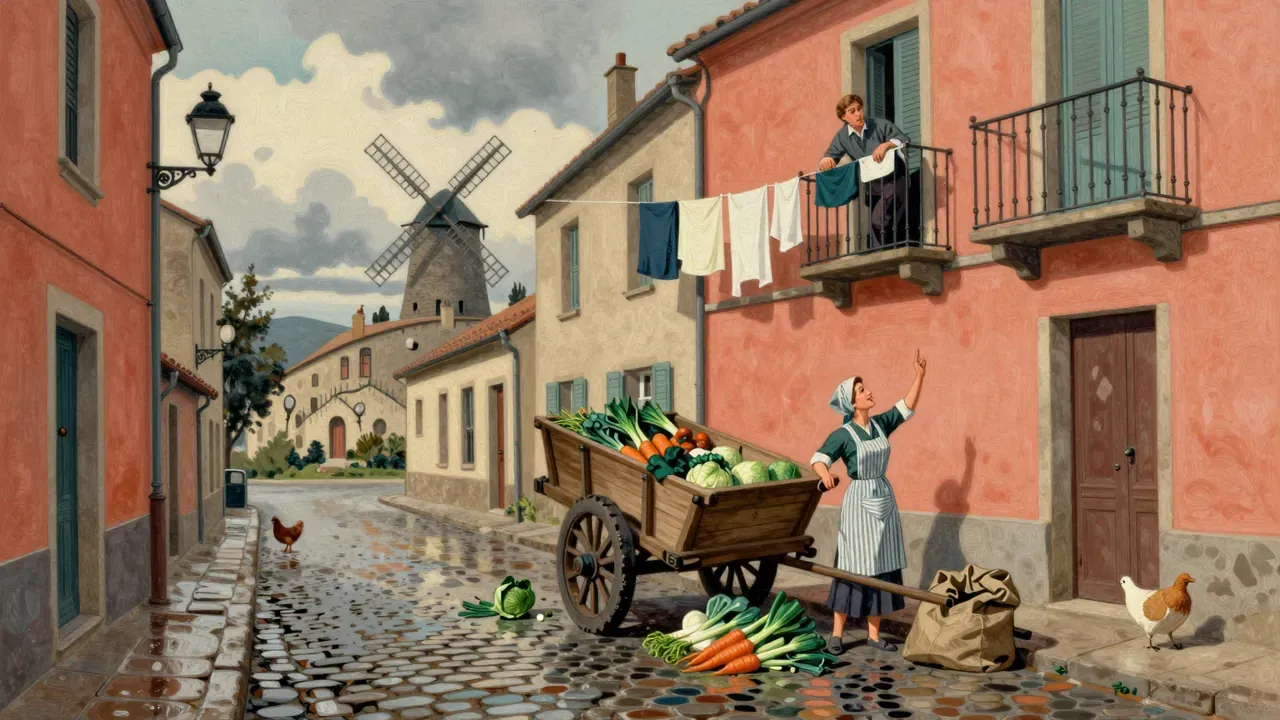
What does not land is the film’s handling of consequence. Alexandre’s suicide attempt arrives without sufficient groundwork—his timidity and infatuation are established, but his emotional rupture feels abrupt, not inevitable. Lola’s pivot from manipulator to remorseful ally lacks transition; her apology scene registers as narrative convenience rather than earned shift. The music, while pleasant, rarely deepens character or situation: Van Parys’s melodies are serviceable but unmemorable, and the lyrics (where audible) do little more than name emotions already visible on screen. Some set pieces strain under their own symbolism—the vegetable carts on Rue Lepic, for instance, read as decorative rather than atmospheric, their artificiality drawing attention to craft rather than enhancing immersion. Truffaut praised the Degas-like quality of the dance classes, but Chardère’s objection holds: when the visual reference becomes a checklist—‘post-impressionist lighting’, ‘compositional echoes of The Ballet Class’—it risks flattening the human scale of the action. The film’s affection for its world never quite overcomes its occasional detachment from the stakes within it.
What it remembers
The themes that matter are those Renoir returns to across his career: the tension between individual desire and communal form, the labour behind spectacle, and the provisional nature of success. French Cancan treats theatre not as illusion but as infrastructure—built, funded, staffed, and constantly renegotiated. Ambition here is neither heroic nor corrupting, but logistical: Danglard’s drive is less about fame than about solving problems—finding dancers, placating creditors, managing egos. Class operates not as barrier but as porous boundary: laundresses become stars, bankers become patrons, princes become spectators. Gender is handled with quiet consistency: women initiate change (Nini chooses to dance; Lola buys the property), but their leverage remains contingent on male capital or approval. The film’s deepest concern is time—how cultural forms emerge, endure, or vanish. The cancan is presented not as novelty but as reclamation: an old dance revived because it fits the moment’s energy better than anything new. Renoir suggests that what lasts is not originality, but adaptability—that art survives not by purity, but by willingness to be remade, again and again, by different hands.
Who it meets
This film rewards viewers who value craft over catharsis, process over plot, and atmosphere over argument. It suits those familiar with Renoir’s later work—particularly The Golden Coach—or with French cinema of the 1950s, where pacing and tone often prioritise observation over escalation. It will frustrate viewers expecting tight cause-and-effect storytelling, psychological depth, or musical numbers that advance character. Those drawn to biographical accuracy or historical rigour will find its liberties with fact unmooring; those seeking emotional crescendos may find its resolutions muted. A viewer who values Truffaut’s praise for its colour or Ebert’s inclusion in his Great Movies list may still leave unmoved if they respond more strongly to narrative propulsion than to compositional grace. Change the emphasis from painterly staging to tighter dramatic structure, and the verdict shifts: this is not a film whose merits depend on consensus, but on alignment with its particular rhythm—slow, deliberate, and attentive to the edges of the frame.
How it stays
Yes, it is worth your evening—if you are prepared to watch it as Renoir intended: not as a story to be followed, but as a world to be inhabited. Its 100 minutes unfold with unhurried confidence, trusting that the pleasure lies in watching paint dry on a set wall, hearing a single violin tune up before rehearsal, or noticing how light falls across a dancer’s shoulder mid-pirouette. It is not for those who require clear stakes, rapid development, or thematic closure. Someone who found Rules of the Game emotionally distant or The River too languid may find French Cancan similarly elusive. But for those who accept that some films are built to be lingered in rather than consumed, this remains singular: a late-career affirmation of Renoir’s belief that cinema’s highest function is to hold space—not for meaning, but for presence. Its worth does not diminish with age; it accumulates, like pigment on canvas.