The look of it
EO is a Polish-Italian co-production directed by Jerzy Skolimowski, conceived as a structural and ethical echo of Robert Bresson’s Au hasard Balthazar — not a remake, but a deliberate re-anchoring of that film’s moral geometry in contemporary Europe. It follows a donkey named EO across fragmented episodes: circus performer, stable labourer, forest wanderer, stadium interloper, slaughterhouse inmate. The film does not anthropomorphise him; it refuses interior monologue, voiceover, or expressive close-ups that imply human cognition. Instead, it sustains a fixed, non-judgemental gaze — one that treats the donkey’s body, movement, and duration as primary narrative material. Its ambition is formal and philosophical: to hold space for non-human subjectivity without recourse to sentiment or allegory, while mapping indifference, cruelty, care and chance across national borders, class lines and institutional systems. It asks whether attention itself — sustained, unflinching, unexplained — can constitute ethics when language and agency are withdrawn.
The weight of it
The story unfolds episodically, with no central human protagonist and no conventional dramatic arc. Kasandra, Vito, Mateo and the Countess appear only as passing nodes in EO’s trajectory; their dialogue is sparse, functional, often elliptical. Sandra Drzymalska gives Kasandra quiet gravity, Lorenzo Zurzolo’s Vito speaks with weary candour, Isabelle Huppert’s Countess is all clipped reserve — but none dominate the frame. Michał Dymek’s cinematography favours medium distances, shallow focus, and long takes that follow EO’s gait or rest on his stillness. Paweł Mykietyn’s score is percussive and dissonant, avoiding melody in favour of rhythmic pulse and metallic resonance. Agnieszka Glińska’s editing avoids continuity logic: cuts land on duration, not causality. The six donkeys — Ettore, Hola, Marietta, Mela, Rocco, Tako — are never asked to ‘perform’; their physical presence, breathing, blinking and weight anchor every scene. There is no scorecard of emotion, no cue for empathy — only observation, calibrated and unblinking.
The silence in it
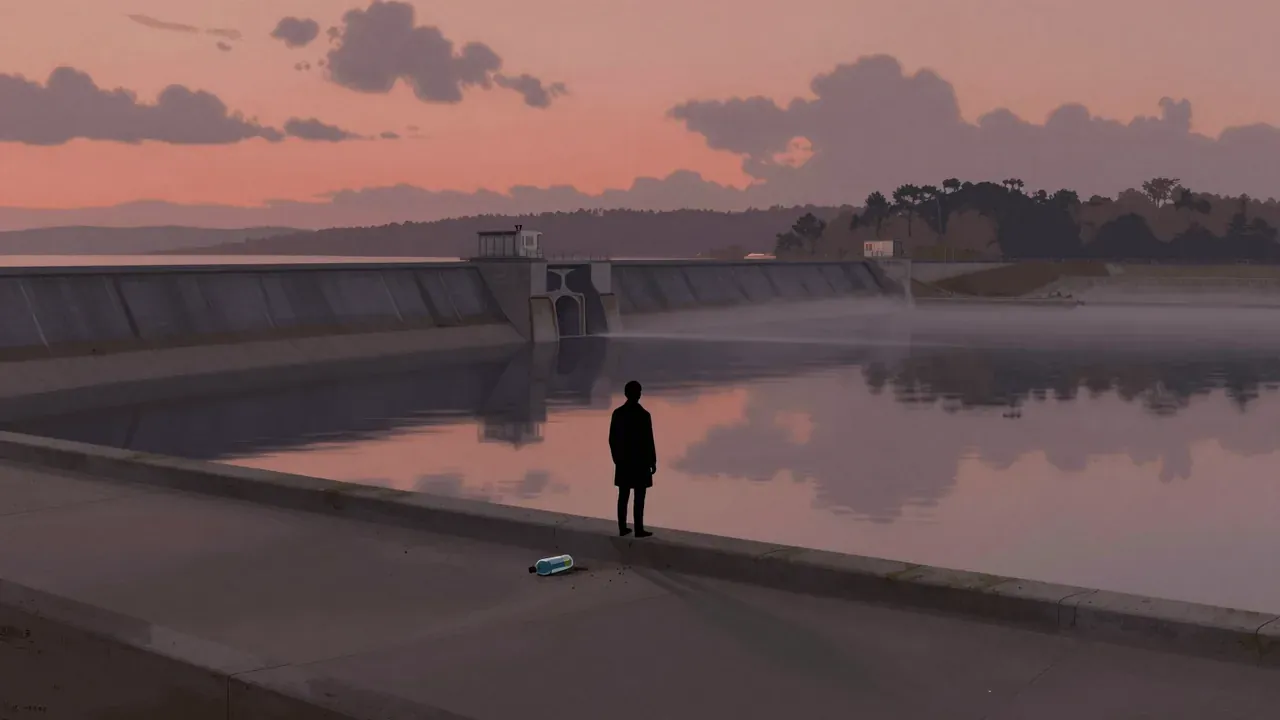
What lands is the film’s unwavering commitment to its central proposition: that a donkey’s experience of time, space and violence is legible without translation. The sequence in the dark forest — EO walking among fallen trees, hearing distant gunshots, pausing beside a dying wolf — achieves a rare kind of gravity because it refuses to name what is happening as metaphor. The shot of EO watching tropical fish through a shop window is not whimsical; it registers as sensory displacement, a moment of arrested perception that carries its own weight. The final stretch — the dam, the cattle line, the black screen followed by the sound of the captive bolt pistol — lands not as shock but as grim, inevitable punctuation. These moments work because they are anchored in concrete detail: the texture of rope on skin, the clatter of hooves on cobblestone, the way light falls on a muzzle at dawn. The film’s restraint becomes its authority: it does not plead, explain or soften. It simply places the viewer alongside EO, then holds that position until the frame ends.
The gaps in it
What does not land is the film’s occasional drift into schematic repetition. The motif of humans speaking directly to EO — Kasandra offering a carrot muffin, Vito confessing he’s eaten donkey meat — risks flattening into thematic shorthand rather than deepening character or relationship. These exchanges lack the lived specificity of the donkey’s physical world: they feel like notes in a margin, not part of the text. The soccer match sequence, though visually precise, sits uneasily between satire and accident; its function remains ambiguous, and its aftermath — the bar ransacking, EO’s near-fatal beating — feels abruptly brutal without sufficient groundwork in social texture or spatial logic. Similarly, the fur factory episode arrives without establishing the factory’s scale, rhythm or hierarchy; EO’s kick reads less as rebellion than as narrative rupture. These passages do not fail because they are implausible, but because they lack the same granular attention given to EO’s walk through the forest or his pause at the dam — moments where cause, effect and consequence remain physically traceable.
The structure of it
The themes that matter are not abstracted ideals but embodied conditions: exhaustion, surveillance, displacement, instrumentalisation and the quiet persistence of non-human life within human systems. EO moves through infrastructures — transport trucks, stables, slaughterhouses, dams — not as metaphors for capitalism or ecological collapse, but as literal spaces where bodies are moved, measured, used and discarded. The film treats bureaucracy (the missing manifest), ritual (the priest’s journey), labour (the fox-killing line) and leisure (the football match) as equally indifferent forces shaping EO’s path. Class appears not in dialogue but in contrast: Kasandra’s worn circus costume versus the Countess’s estate gate; the homeless woman fleeing Mateo’s offer versus the janitor questioning why EO is being saved. Mortality is not dramatised but distributed — in the wolf, the foxes, the captive bolt’s report — each instance refusing hierarchy. What matters most is the film’s refusal to separate ethics from attention: how long you watch, how closely you listen, whether you register the difference between a hoof striking stone and one sinking into mud.
The audience for it
This film is for viewers who accept that meaning may reside in duration, not revelation; who find tension in stillness, and coherence in accumulation rather than causality. It suits those accustomed to Bresson, Tarr or early Akerman — viewers who do not require narrative reassurance or emotional signposting. It is not for those who need clear motivation, psychological explanation or redemptive closure. Anyone expecting a fable with a moral, or an animal story with anthropomorphic warmth, will find it alienating. Those who rely on conventional pacing or character arcs may read its 86 minutes as withholding rather than disciplined. A viewer who values clarity over ambiguity, catharsis over contemplation, or empathy as feeling rather than sustained attention will likely reject it. That said, the film’s rigour is not dogmatic: its power lies in its patience, not its austerity. To dismiss it as cold is to miss how precisely it measures warmth — in Kasandra’s hand on EO’s neck, in the janitor’s quiet question at the hospital.
The time in it
Yes, it is worth your evening — provided you arrive prepared to watch, not decode. Its value lies in the cumulative weight of its attention: the way Dymek holds a shot just past comfort, the way Mykietyn’s score resists resolution, the way Glińska lets silence sit for three seconds longer than expected. It is not ‘enjoyable’ in the usual sense, but it is rigorously, uncompromisingly present — a rare thing in contemporary cinema. Those who leave unsatisfied are not wrong; they are simply responding to a different contract. The film assumes you will meet it on its terms: no exposition, no guidance, no reward beyond the act of witnessing. It would change its verdict if it softened its gaze — if it gave EO a name beyond ‘EO’, or let him blink on cue, or cut away before the bolt pistol fires. But it does not. And because it does not, it earns its duration. Ninety minutes spent this way is time accounted for, not passed.