The look of it
Days of Heaven is a period drama set in the Texas Panhandle in 1916, following Bill (Richard Gere), Abby (Brooke Adams), and her younger brother (Linda Manz) as they migrate from Chicago to work the wheat harvest for a wealthy, ailing farmer (Sam Shepard). It is trying to tell a story not through exposition or psychological realism, but through image, rhythm, and atmosphere — a visual poem about transience, labour, and moral ambiguity. Terrence Malick’s script is spare, almost skeletal; dialogue is minimal, plot turns are understated, and motivation is implied rather than explained. The film leans on painterly composition, natural light, and associative editing to evoke mood over meaning. Its ambition is not narrative clarity but sensory immersion: to make the viewer feel the heat of the fields, the weight of silence between characters, the fragility of a life built on deception. It treats the American frontier not as mythic terrain but as lived, sun-bleached reality — where beauty and brutality coexist without comment. This is not a film that argues; it observes, lingers, and withdraws.
How it speaks
The story unfolds in episodic, lyrical fragments: arrival at the farm, the harvest, the sham marriage, the locust swarm, the fire. Performances are muted and physical — Gere moves with guarded economy, Adams holds herself in quiet reserve, Shepard conveys vulnerability beneath stoicism, and Manz’s narration — improvised, unpolished, delivered in a flat, streetwise cadence — becomes the film’s emotional anchor and structural spine. Néstor Almendros’ cinematography dominates: shot almost entirely in magic hour, with soft backlighting, deep focus, and long takes that treat landscape as character. Haskell Wexler contributed additional photography, though Almendros shaped the look. Ennio Morricone’s score is sparse and melancholic, punctuated by Leo Kottke’s acoustic guitar; it underscores feeling without dictating it. Billy Weber’s editing is deliberate and unhurried, often holding on empty fields or distant figures. Patricia Norris’ costumes use worn fabrics to avoid artifice; Jack Fisk’s sets — especially the fully realised mansion — ground the film in tactile authenticity. There is no conventional dramatic arc; instead, cause and effect are absorbed into texture.
What stays with you
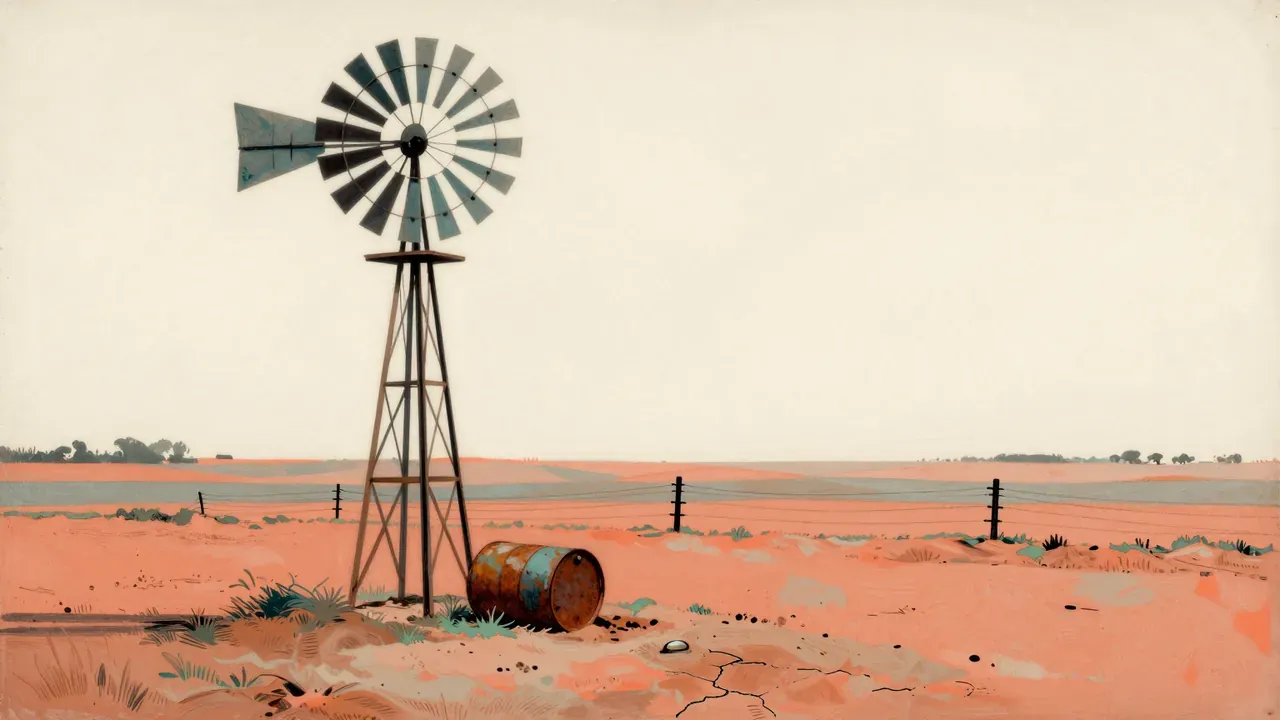
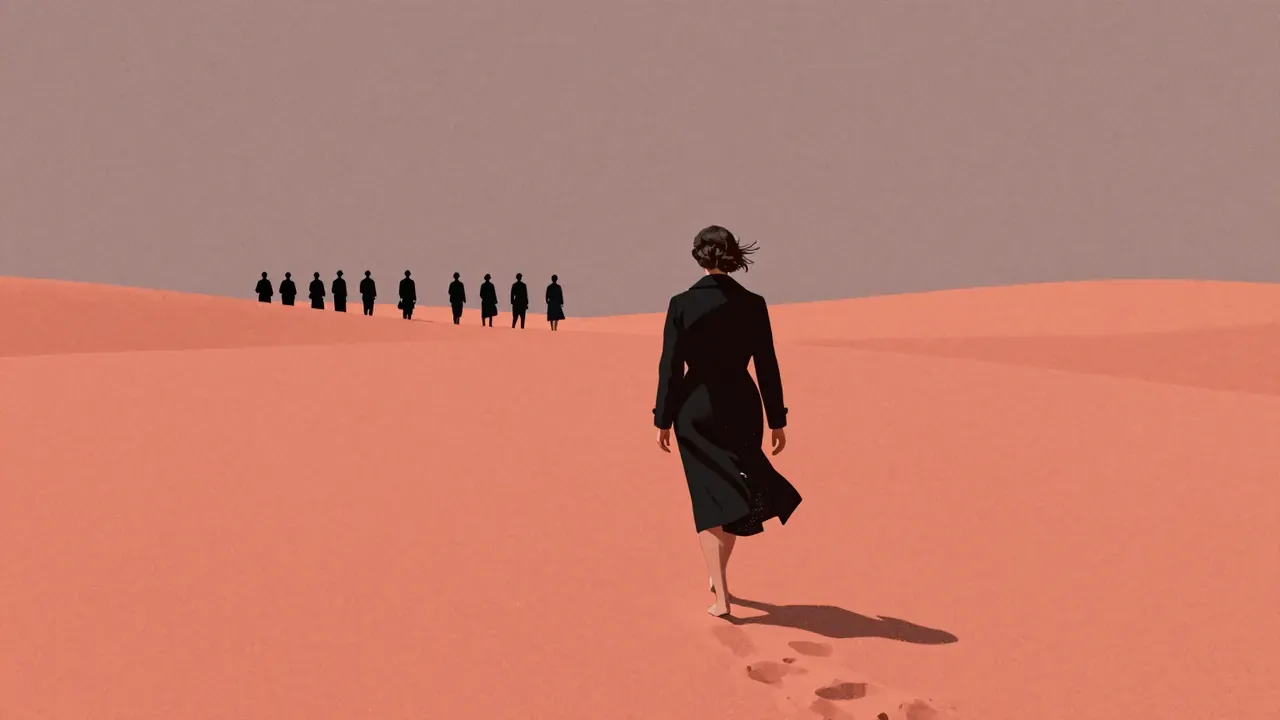
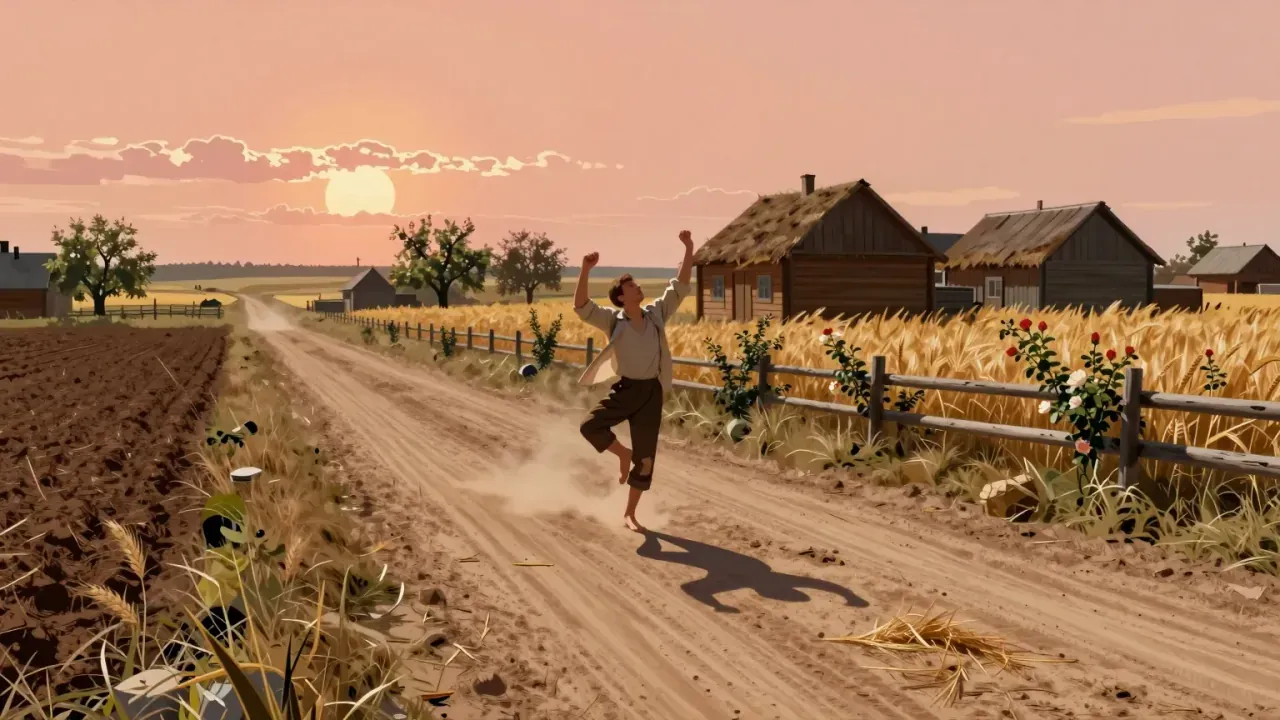
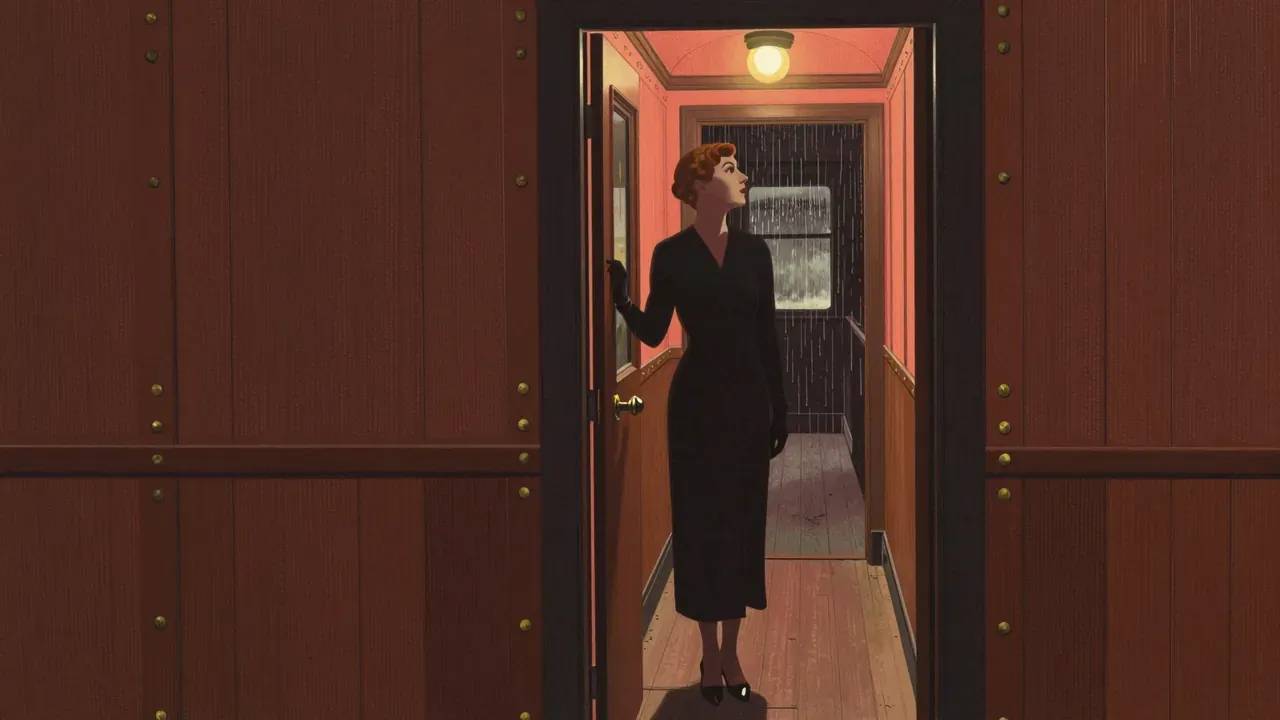
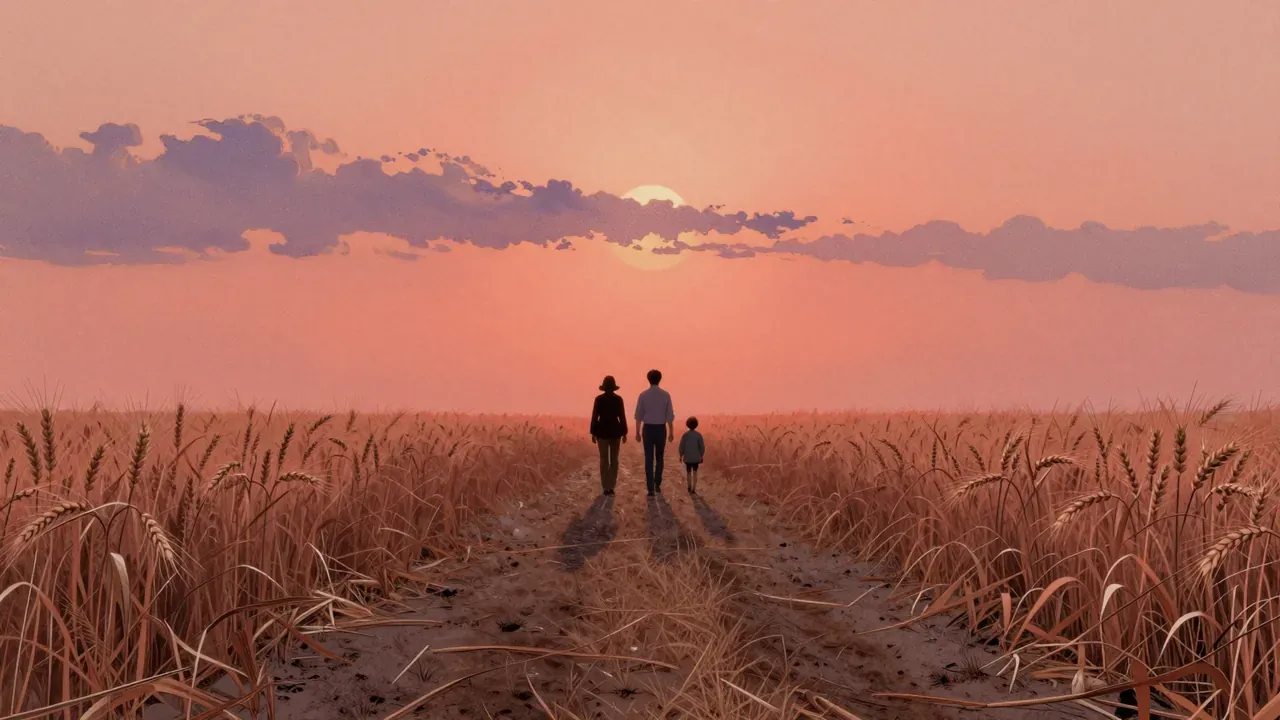
What lands most decisively is the film’s visual language. The wheat fields shimmer with golden-hour light; silhouettes against dusk feel monumental yet intimate; interiors glow with warm, low-key naturalism. These images do not illustrate the story — they are the story’s emotional grammar. Manz’s narration works because it is unscripted and unassuming: her voice carries the weight of lived experience, not literary polish, and its contradictions — childish phrasing alongside bleak observation — deepen the film’s sense of moral uncertainty. The locust sequence remains startling: peanut shells falling backward, reversed to mimic ascent, then live insects swarming close-up, all shot in near-darkness — a feat of practical ingenuity that feels both biblical and biological. The sound design, too, lands: wind, rustling grain, distant machinery, and silence are given equal weight. Even the film’s pacing — slow, repetitive, cyclical — serves its themes: time measured in seasons, not scenes; consequence deferred, then sudden. This is cinema that trusts the eye and ear before the intellect, and that trust is repaid.
Where it slips
What does not land is narrative cohesion for viewers expecting causal logic or psychological resolution. The central deception — Abby’s marriage to the farmer — is introduced without sufficient grounding in motive or consequence; Bill’s passivity reads as underwritten, not enigmatic. Some performances suffer from Malick’s direction: Gere and Adams rarely meet each other’s eyes, and their chemistry remains abstract, never embodied. The film’s refusal to clarify moral stakes — whether the farmer is kind or cruel, whether Bill is calculating or desperate — risks indifference rather than ambiguity. Certain transitions feel arbitrary, particularly in the final third, where the fire arrives without clear escalation. The absence of traditional scoring cues or dramatic music means emotional signposts are sparse; what reads as restraint to some may register as distance to others. And while the magic-hour aesthetic is breathtaking, its consistency begins to flatten contrast — after ninety minutes, the light itself can feel monotonous, its beauty unvarying, its purpose unchallenged. The film offers no counterpoint to its own lyricism.
What it’s really about
The themes that matter are those embedded in the material world: the precariousness of labour in an industrialising America, the illusion of upward mobility, and the quiet violence of class. Wheat is both sustenance and commodity; the harvest is communal effort and exploitable resource. The farmer’s wealth is inherited, his illness literal and metaphorical decay; Bill and Abby’s scheme is less greed than survival instinct — a bid for stability in a system offering none. Time is treated as geological: seasons turn, crops grow and burn, people arrive and vanish. Mortality is ambient — in the farmer’s frailty, the locusts’ destruction, the fire’s inevitability. There is no redemption arc, no reckoning beyond consequence: actions ripple outward, then fade. The film also explores perception — how light shapes truth, how silence amplifies doubt, how a child’s voice interprets adult choices without judgment. It is not a film about good and evil, but about scale: human lives against sky, against field, against time. Its ethics are ecological, not individual — concerned with balance, erosion, and what endures after the harvest ends.
Who it’s for
This film is for viewers who value image over exposition, patience over propulsion, and atmosphere over argument — those who find resonance in stillness, who watch films as one might study a painting or listen to a string quartet. It rewards attention to texture, light, and rhythm more than plot mechanics. It is not for viewers who require clear motivation, narrative closure, or sustained character development; those seeking psychological realism or moral clarity will find it withholding. Anyone put off by long takes, minimal dialogue, or unresolved tension should look elsewhere. It is also not for those expecting historical realism: the Alberta locations contradict the Texas setting, and the film’s painterly stylisation overrides documentary fidelity. A viewer who values strong performance-driven storytelling — say, of the kind found in contemporary American indie drama — may find Days of Heaven emotionally remote. What would change the verdict? A tighter edit, or a more grounded central relationship — but that would sacrifice the very qualities the film intends to foreground.
Is it worth your evening
Yes, it is worth your evening — but only if you approach it as an immersive sensory experience, not a story to be solved. Its ninety-five minutes unfold like a series of tableaux vivants: beautiful, deliberate, self-contained. You will not leave with answers, but with impressions — the colour of dust at dusk, the sound of wind in dry stalks, the weight of a glance withheld. It demands surrender to its pace and logic, and repays that surrender with moments of rare visual poetry. Those who resist will feel adrift; those who yield will find it haunting. It is not a film to consume, but to inhabit — briefly, quietly, and with full attention. Its power lies in what it refuses: explanation, emphasis, urgency. That refusal is its integrity. To ask whether it ‘holds up’ is to misunderstand its aim — it was never built to last as narrative, but to linger as sensation. And on that measure, it endures.