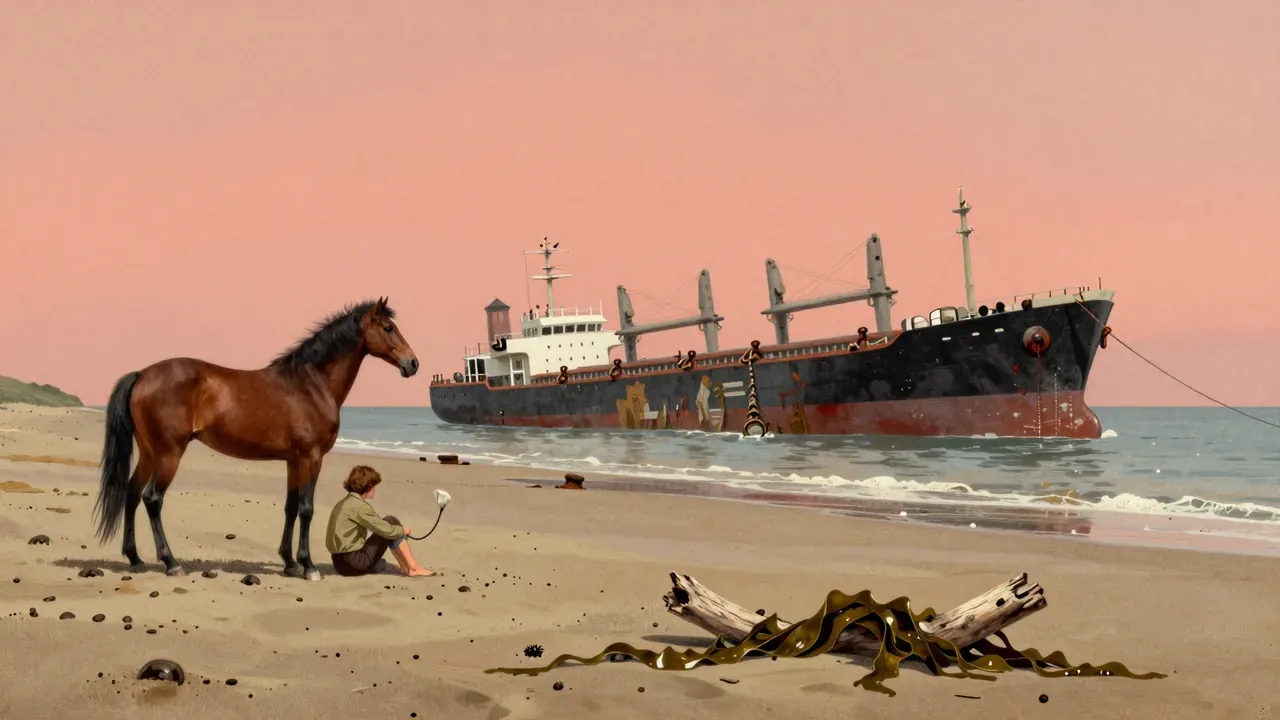
The look of it
White Mane is a 47-minute French short film from 1953, conceived and directed by Albert Lamorisse as a fable for children, though not confined by that label. It attempts to hold two things in tension: the physical reality of the Camargue marshes — their water, wind, mud, and wild horses — and a mythic register in which human and animal agency converge without explanation or mediation. The film does not dramatise social realism or psychological development; it offers instead a ritualised encounter between boy and stallion, framed by narration and sustained by visual rhythm rather than dialogue or exposition. Its ambition is not to instruct but to imprint: to fix in memory the image of a white horse rising from water, of a boy clinging to its back not as master but as witness, and of flight as both literal and symbolic resolution. It works within strict formal limits — no studio sets, no scripted performances beyond the narrator’s voice, no musical score that underscores emotion — relying instead on location, timing, and restraint to generate awe. That austerity is deliberate, not economical.
The shape of the story
The story follows Folco, a boy living with his fisherman grandfather in the Petite Camargue, as he observes then pursues the wild white stallion Crin Blanc. There are no character arcs in the conventional sense: Folco does not mature, the ranchers do not change, and White Mane remains unbroken even in submission. Performances are minimal and non-professional — Alain Emery, who plays Folco, was a local boy with no prior acting experience — and this absence of theatricality serves the film’s tone. Edmond Séchan’s cinematography keeps the camera low and steady, often at water level, letting the horses’ movement dictate pace and framing. Maurice Le Roux’s music is sparse, entering only at key transitions, never guiding feeling. The narration — delivered in French by Jean-Pierre Grenier and later in English by Frank Silvera and Les Marshak — functions less as exposition than as incantation, smoothing over gaps in logic while deepening the fable’s gravity. Nothing feels staged, yet everything feels composed: each shot is held just long enough to register weight, not duration.
What stays with you
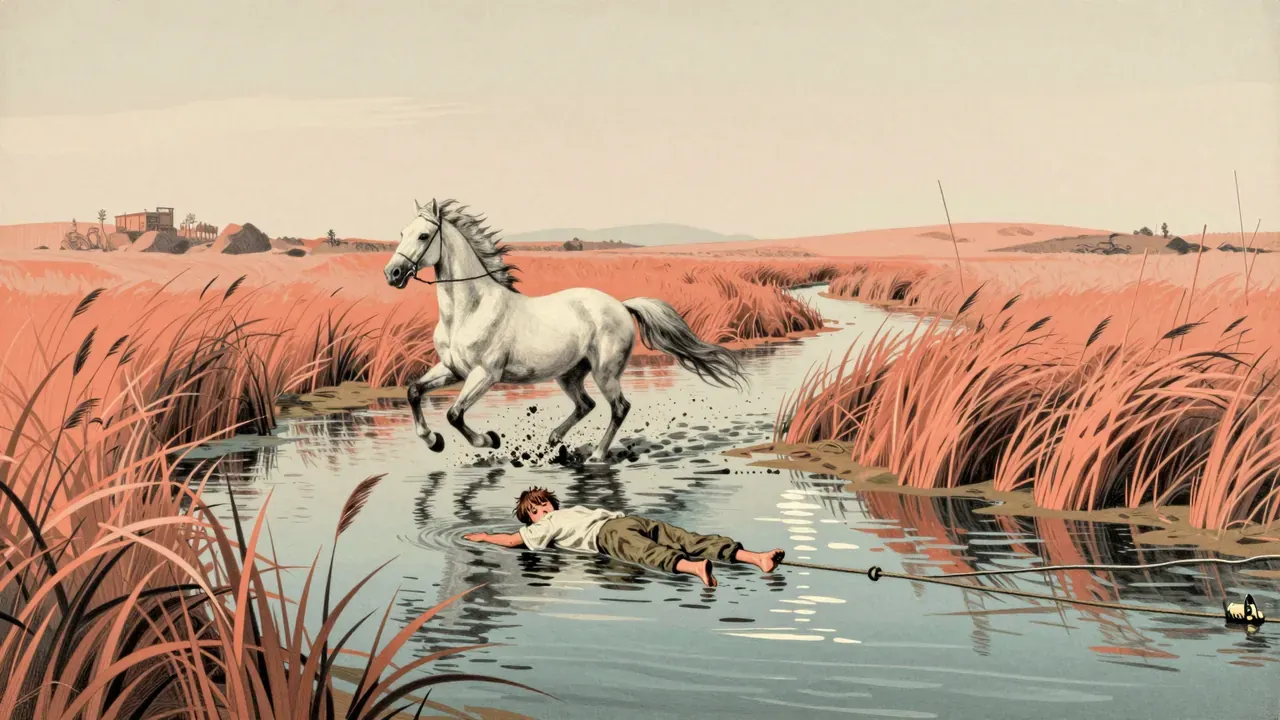
What lands most firmly is the film’s physical presence — the texture of wet reeds, the sound of hooves sinking into silt, the way light falls across the flank of a horse mid-gallop through shallow water. These are not decorative details but structural elements: the marsh is not backdrop but participant, shaping every action and limiting every choice. The sequence where Folco is dragged unconscious behind White Mane before the horse stops — not out of compassion but exhaustion, or perhaps recognition — avoids sentimentality by refusing to name motive. Similarly, the final ride into the sea carries no triumphalism; it is an act of mutual withdrawal, not victory. The film’s moral economy is simple but not simplistic: loyalty is shown, not declared; freedom is asserted, not explained. Its power lies in what it omits — no backstory for the ranchers, no psychology for the boy, no taxonomy for the horse — trusting the viewer to feel the stakes without being told them. This silence gives the images room to resonate beyond their frame.
What it leaves out
What does not land is any attempt to read the film as social allegory or psychological parable without evidence in the text. The ranchers are functional, not symbolic; they exist to set boundaries, not to represent authority or exploitation. Their fire-raising is practical, not punitive, and their pursuit ends not with confrontation but with stillness — they watch, then withdraw. The narration’s closing line about ‘a wonderful place where men and horses live as friends, always’ risks sentiment if taken literally, but the film itself undercuts it: White Mane returns to his herd after the sea, and Folco remains on the shore. There is no utopia depicted, only a momentary alignment. Some viewers may find the pacing too unhurried, the repetitions too insistent — the same gallop, the same water crossing, the same wide shot of the marsh at dawn — but this is not inertia; it is insistence. The film refuses to accelerate toward meaning, and that refusal will frustrate anyone expecting narrative payoff or thematic closure. It offers atmosphere, not argument.
What it’s really about
The themes that matter are endurance, reciprocity, and the limits of domestication — not as concepts but as embodied conditions. White Mane is not tamed; he is met. Folco does not conquer the horse but survives its resistance, and the horse in turn accepts the boy not as rider but as companion in motion. The Camargue itself is the third figure: a landscape that permits neither control nor permanence, where survival depends on adaptation, not mastery. There is no anthropomorphism — the horse’s behaviour follows equine logic, not human projection — yet the film insists on a shared field of perception: both boy and horse watch the same horizon, respond to the same wind, retreat from the same fire. This is not mysticism but ecology: a vision of relationship grounded in proximity, risk, and mutual consequence. The film’s quiet radicalism lies in its refusal to subordinate the non-human to narrative utility. The horse is not a symbol. It is a presence — stubborn, unpredictable, real — and the film treats it as such.
Who it’s for
This film is for viewers who value sustained attention over exposition, who find emotional resonance in landscape and movement rather than dialogue or plot, and who accept that a child’s perspective need not be simplified to be profound. It suits those familiar with mid-century European short filmmaking — particularly Lamorisse’s own The Red Balloon — or with documentary traditions that privilege observation over intervention. It is not for viewers who require clear cause-and-effect, psychological motivation, or narrative resolution. Those expecting a conventional children’s story — with lessons, growth, or moral clarity — will find it withholding. Nor does it serve as historical document: though filmed on location with local people, it makes no claim to ethnographic accuracy. Its power is poetic, not pedagogical. A viewer who dislikes ambiguity, resists slow pacing, or expects characters to explain themselves will leave unsatisfied — not because the film fails, but because it operates by different terms.
Is it worth your time?
Yes, it is worth your evening — not as diversion but as recalibration. Forty-seven minutes is enough time to settle into its rhythm, to notice how the light shifts across water between shots, to feel the weight of silence after the music stops. It rewards patience without demanding it, and its brevity means it asks for little but gives much in return: a reminder that awe does not require scale, that intimacy can exist between species without translation, and that some endings are not conclusions but continuations elsewhere. Those who dismiss it as ‘just a children’s film’ misunderstand its architecture; those who call it ‘timeless’ overlook how precisely it belongs to its moment — 1953, post-war France, the rise of location-based poetic realism. Its value lies in its singularity: no other film looks or moves like this. To skip it is not to miss a story, but to miss a way of seeing.