The shape of it
Happiness is a 1998 American ensemble film written and directed by Todd Solondz, structured as a series of interlocking domestic narratives centred on the Jordan sisters and their orbit. It does not aim to entertain, console or resolve; rather, it holds steady on discomfort — moral, emotional, sexual — without flinching or framing. Its project is diagnostic: to map how loneliness, repression, and unexamined desire circulate through middle-class American life, often manifesting in acts that violate law, ethics or basic empathy. The film treats pedophilia, obscene phone calls, marital indifference, suicidal despair and coercive sex not as aberrations but as logical, if extreme, outcomes of systems that privilege appearance over honesty, performance over feeling. It refuses satire’s safety net — there are no villains marked for ridicule, no heroes offering redemption. Instead, it sustains a tone of flat, uninflected observation, as if the camera were a clinical instrument calibrated to register affect without judgment. That stance is its method and its provocation: to ask what remains when all consolations — faith, family, success, even self-knowledge — are stripped away. (158 words)
The look of it
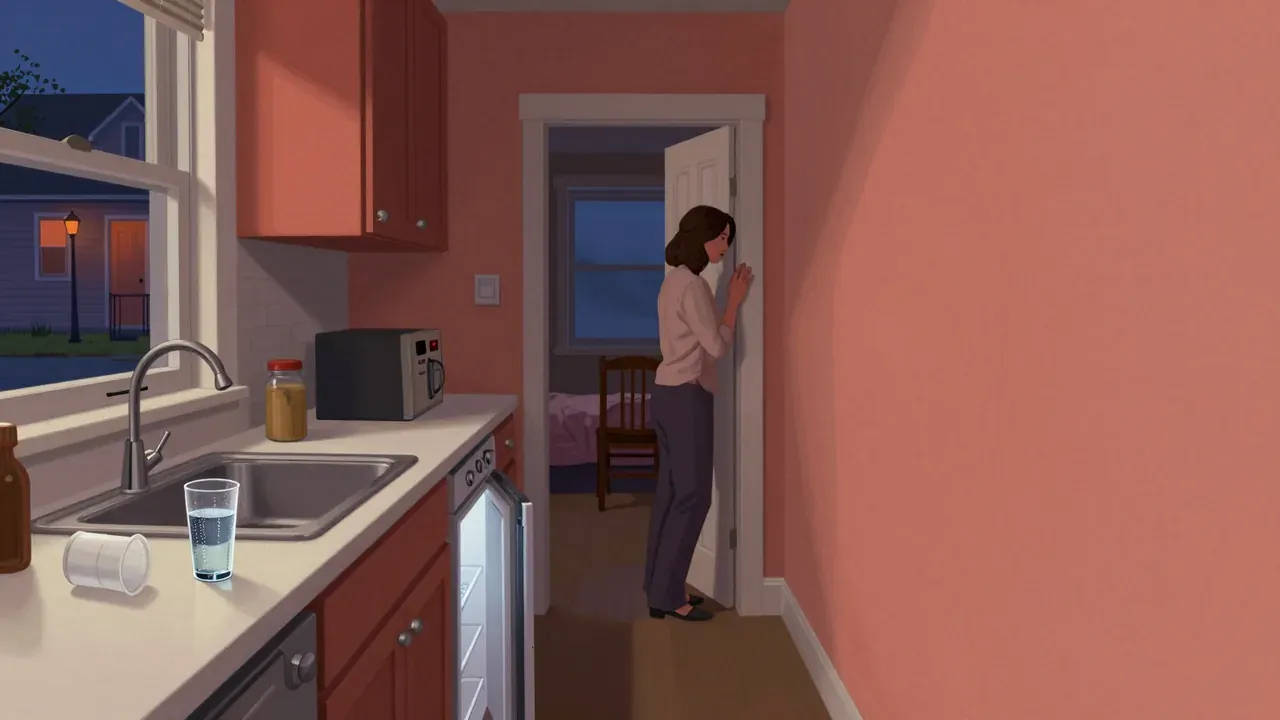
The film works through accumulation and contrast: overlapping storylines unfold with deliberate pacing, each held at the same emotional temperature — neither heightened nor softened. Maryse Alberti’s cinematography avoids flourish, favouring static frames and medium shots that keep characters contained within domestic spaces — kitchens, bedrooms, hallways — reinforcing claustrophobia without resorting to tight close-ups or jarring edits. Performances are uniformly restrained; Dylan Baker plays Bill Maplewood with quiet, matter-of-fact dread, while Philip Seymour Hoffman’s Allen delivers obscene monologues with the weary cadence of someone reading grocery lists. Jane Adams, Cynthia Stevenson and Lara Flynn Boyle anchor the sisters’ arcs not through transformation but through subtle shifts in posture, silence, or the timing of a blink. Robbie Kondor’s score is sparse and tonally ambiguous, underscoring scenes without guiding interpretation. Dialogue is written with surgical precision: every line serves dual functions — advancing plot while exposing subtext, revealing character while withholding motive. There is no music cue to signal irony, no cutaway to relieve tension. The craft insists on continuity of tone, making the viewer complicit in the act of sustained attention. (159 words)
The rhythm of it
What lands is the cumulative weight of moral unease made visible in ordinary detail: the way Trish adjusts her blouse after learning her husband raped two boys; the pause before Helen asks Allen, ‘Do you ever touch anyone?’; the offhand cruelty of Joy’s boss telling her she’s ‘not cut out for sales’. These moments land because they are rendered without emphasis — no swelling strings, no reaction shots lingered on — yet they reverberate precisely because they feel lived-in, not scripted. The film’s black comedy works not through punchlines but through dissonance: Billy’s proud announcement of his first orgasm follows immediately after his father’s tearful confession about masturbation preferences, and the juxtaposition lands with brutal, unforced logic. Even the music choices — Mozart’s ‘Soave sia il vento’ playing over Bill’s grooming of Johnny — land not as irony but as structural counterpoint, deepening the sense of life’s grotesque harmony. The ensemble cast earns its National Board of Review award not through showy turns but through shared commitment to a register where pathos and absurdity occupy the same breath. No single scene shocks more than the whole does, slowly, by refusing relief. (157 words)
The weight of it
What does not land is any suggestion of catharsis, growth or systemic critique — and that is by design, not failure. But the film’s refusal to distinguish between degrees of harm can flatten moral texture: Bill’s crimes sit alongside Allen’s impotence and Lenny’s emotional atrophy with equal visual and narrative weight, risking equivalence where hierarchy matters. Some viewers will find the treatment of pedophilia ethically untenable not because it is depicted, but because it is presented without contextualising framework — no social history, no psychological exposition, no institutional critique beyond the individual. The decision to surrender the NC-17 rating and release unrated also weakens the film’s own boundary-setting: it courts controversy while opting out of the formal accountability such a rating implies. A few subplots — particularly Kristina’s backstory — feel underdeveloped, functioning more as thematic punctuation than fully realised arcs. And though the final scene unites the family physically, its emotional stasis risks reading as resignation rather than revelation, especially when set against the earlier, sharper ruptures. None of this undermines Solondz’s control — but it does limit the film’s capacity to argue beyond its own premises. (156 words)
The language of it
The themes that matter are not listed but embedded: the hollowness of achievement culture, the violence of enforced normalcy, the ways language fails to contain desire or trauma, and the quiet desperation of people who have mistaken endurance for living. Class operates as atmosphere rather than subject — the Jordans’ upper-middle-class stability makes their dysfunctions more unsettling, not less. Sexuality appears not as identity or pleasure but as leakage: from Bill’s compulsions, Allen’s phone calls, Vlad’s coercion, Joy’s misreadings. Parenting is shown as transmission — of anxiety, expectation, silence — rather than nurture. The film treats happiness not as a state but as a word people use to mask absence, hence the title’s bitter irony. Even the Russian-language original (a detail confirmed by the fact sheet) feels thematically resonant: a film about miscommunication, alienation and inherited pain, spoken in a tongue that signals distance even when characters share a room. These are not abstract ideas but lived conditions, rendered through gesture, duration and omission — the time it takes for Trish to look away, the length of a silence before a lie is told, the space between what is said and what is meant. (155 words)
The audience for it
This film is for viewers who value formal rigour over comfort, who can sit with unresolved discomfort and find meaning in sustained ambiguity. It suits those familiar with Solondz’s earlier work, or with the ethical austerity of filmmakers like Chantal Akerman or early Lars von Trier. It is not for viewers seeking narrative resolution, emotional uplift or clear moral signposting — nor for those who require psychological realism to be legible through exposition or therapy-speak. Parents of young children may find Bill’s storyline intolerable not for its depiction but for its refusal to offer condemnation as catharsis. Some critics, including Roger Ebert, found it essential; others, like Quentin Crisp, dismissed it as misguided. A change in verdict would follow only if the film were re-edited to include explicit framing — sociological context, authorial commentary, or structural variation in tone — but that would contradict its central premise: that these lives are not exceptional, and therefore need no special handling. (159 words)
The time for it
Yes, it is worth your evening — but only if you approach it as one would a difficult medical report: with attention, patience and willingness to sit with findings that offer no cure. Its 134 minutes pass without hurry, demanding full presence rather than passive consumption. It rewards rewatching not for hidden clues but for noticing how small shifts in delivery or framing accumulate into meaning. Those who expect entertainment will leave exhausted; those who accept its terms will find it rigorously honest, formally precise and morally unflinching. Its power lies in what it refuses: explanation, absolution, distraction. That makes it rare, and necessary — but not universally accessible. Anyone who has ever mistaken routine for contentment, or politeness for connection, may recognise something here — not as diagnosis, but as mirror. To call it ‘worth it’ is not to endorse its world, but to acknowledge its fidelity to a strain of human experience most films avoid entirely. (159 words)