The shape of time
A Man Escaped is a French docudrama from 1956, directed and written by Robert Bresson, based on the wartime memoir of Resistance fighter André Devigny. It sets out to render an escape from Montluc prison in Lyon not as spectacle but as process: a sequence of small, repeated, physically constrained actions — tapping, listening, chiselling, knotting — each measured against time, sound, and risk. Bresson avoids dramatisation in the conventional sense; there are no flashbacks, no exposition of motive beyond necessity, no psychological interiority offered through dialogue or close-up. Instead, the film pursues what he called ‘a great purity’, using non-professional actors, pared-down framing, and a strict economy of means. Its aim is not to immerse but to distil: to isolate the mechanics of will under constraint, and to test whether cinema can register human agency without recourse to expression, explanation, or embellishment. The subject is not resistance as ideology but resistance as rhythm — breath, pulse, friction, silence. (142 words)
The grammar of confinement
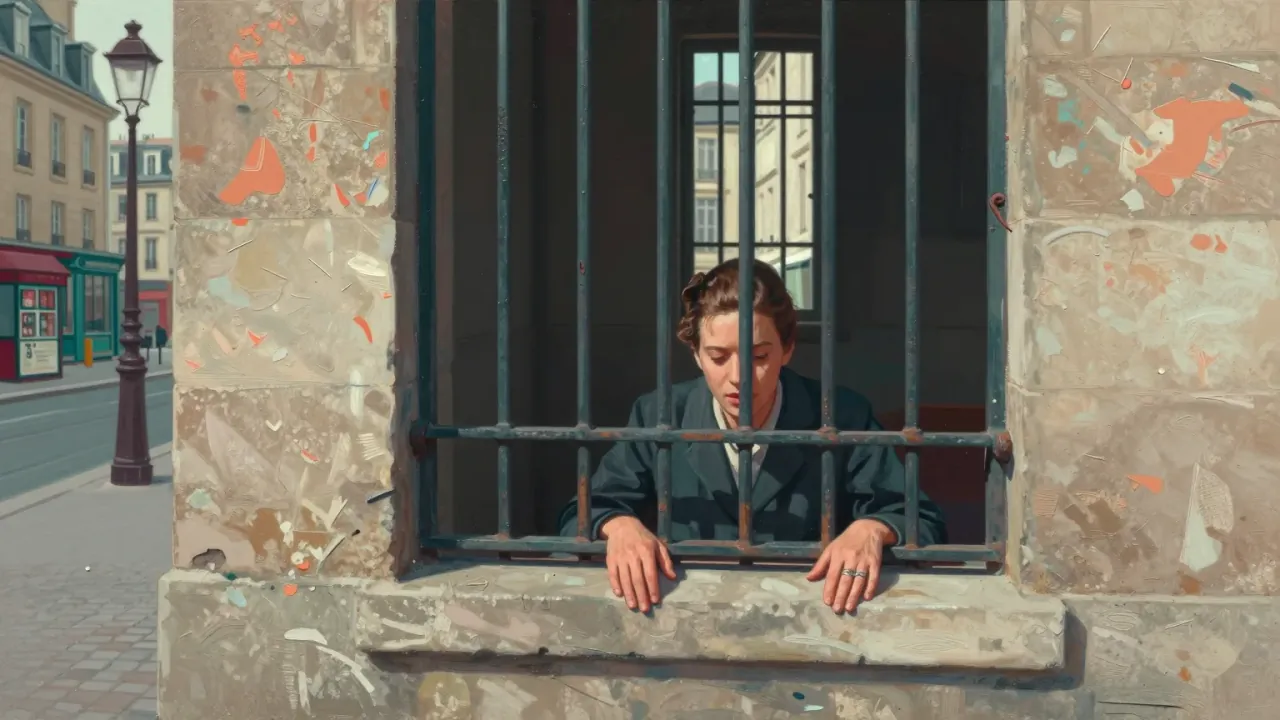
The story follows Fontaine, a captured Resistance member, over several weeks as he plans and executes his escape from Montluc. It unfolds in strict chronological order, with no digressions or emotional detours. Performances are deliberately uninflected: César Gattegno as Fontaine speaks little, moves with minimal emphasis, and registers tension only through posture and duration of gaze. Léonce-Henri Burel’s cinematography keeps the frame tight and low-contrast, favouring medium shots and static compositions that deny spatial relief or visual comfort. Sound is precisely calibrated — footsteps on stone, wood splintering, distant gunfire, the Kyrie from Mozart’s Great Mass used sparingly and without diegetic justification. Editing is functional, never rhetorical: cuts serve only to mark passage of time or shift of location, never to heighten emotion. Every element — lighting, pacing, performance, sound design — operates under self-imposed restriction, treating the prison not as setting but as formal condition. (153 words)
The weight of watching
What lands is the cumulative weight of attention. Fontaine’s labour — sharpening a spoon, counting shavings, testing rope knots — gains moral and physical gravity because it is shown without commentary or acceleration. The film’s refusal to editorialise makes the stakes feel earned, not assigned. When Fontaine and Jost cross the rope between walls, the hesitation is not dramatised but held in real time, and its resolution feels neither triumphant nor cathartic, only necessary. The use of non-professionals removes the expectation of ‘acting’, allowing gesture and routine to carry meaning: a hand wiping a face, fingers tracing a door joint, eyes tracking a guard’s patrol. Even the music — heard three times, always the same excerpt — functions not as emotional cue but as structural punctuation, marking intervals in the escape’s timeline. This rigour produces a rare kind of suspense: not about whether Fontaine will succeed, but whether the film’s own logic — its fidelity to physical cause and effect — will hold. That logic does hold, and the result is a sustained, quiet intensity. (158 words)
The architecture of omission
What does not land is any attempt to read the film as psychological portraiture or historical testimony. There is no exploration of Fontaine’s past, no depiction of Resistance networks beyond brief, functional exchanges, no reckoning with the moral ambiguity of wartime choices. Characters like Blanchet or Orsini appear and recede without development, their fates registered with the same neutral tone as a change in light. Some viewers may find the austerity alienating — the lack of exposition, the refusal to name motivations beyond survival, the absence of even a single subjective camera movement. The film offers no context for Montluc’s role in the Nazi occupation, no reflection on collaboration or reprisal, and no framing that situates Devigny’s experience within broader Resistance history. It is not indifferent to those things, but it declines to incorporate them. That omission is deliberate, not negligent; yet it leaves no room for viewers who require narrative scaffolding, emotional signposting, or historical anchoring. Those expecting a war film in the conventional sense will find its omissions absolute. (157 words)
The physics of will
The themes that matter are endurance as repetition, freedom as calibration, and agency as subtraction. Fontaine does not overcome the prison so much as exploit its gaps — in routine, in material, in attention — and the film treats those gaps not as flaws but as conditions of possibility. It explores how constraint shapes perception: sound becomes more precise than sight, touch more reliable than vision, silence more active than speech. The film also treats time not as narrative progression but as accumulated effort — fifteen days in one cell, then weeks of chiselling, then hours waiting on a roof — each interval marked not by plot but by physical consequence. There is no theme of heroism, only of persistence; no theme of faith, only of attention; no theme of hope, only of next-step necessity. Even the title’s biblical reference — ‘the wind bloweth where it listeth’ — is not invoked as mysticism but as metaphor for unpredictability: the train that masks noise, the guard who pauses, the moment when doubt gives way to motion. These are not abstract ideas but operational principles, rendered visible through action alone. (154 words)
The terms of entry
This film is for viewers who trust cinema to work without explanation, who value precision over persuasion, and who find tension in restraint rather than release. It suits those accustomed to Bresson’s methods — or to similar economies in Ozu, Dreyer, or early Tarkovsky — and those willing to meet a film on its own formal terms. It is not for viewers who rely on character psychology, narrative momentum, or emotional escalation to sustain engagement. Those who expect historical context, moral framing, or stylistic variation will find it withholding. A viewer who values expressive acting, dynamic editing, or immersive sound design may feel the film denies them tools they depend on. That verdict would not change if the film were longer, louder, or more explicit — its power lies precisely in its refusal. It asks for patience, not tolerance; attention, not sympathy. Its audience is narrow by design, not accident. (150 words)
The measure of return
Yes, it is worth your evening — but only if you approach it as a discipline, not a diversion. It demands full attention for its full hundred minutes, and repays that attention with a clarity few films achieve: every shot, sound, and pause serves the same purpose, and nothing is wasted. It is not relaxing, nor is it designed to be; its reward is the sensation of mental alignment — of seeing cause and effect, effort and outcome, rendered with unbroken consistency. Those who watch it expecting entertainment, catharsis, or insight into wartime France will leave dissatisfied. But those who watch it as a demonstration of cinematic form — of how much can be said with how little — will find it singular. Its value does not diminish with time; it accumulates. It is not a film to be enjoyed, but one to be absorbed, then remembered in fragments: a spoon’s edge, a rope’s twist, the space between two footsteps. (149 words)