What it is, and what it is trying to do
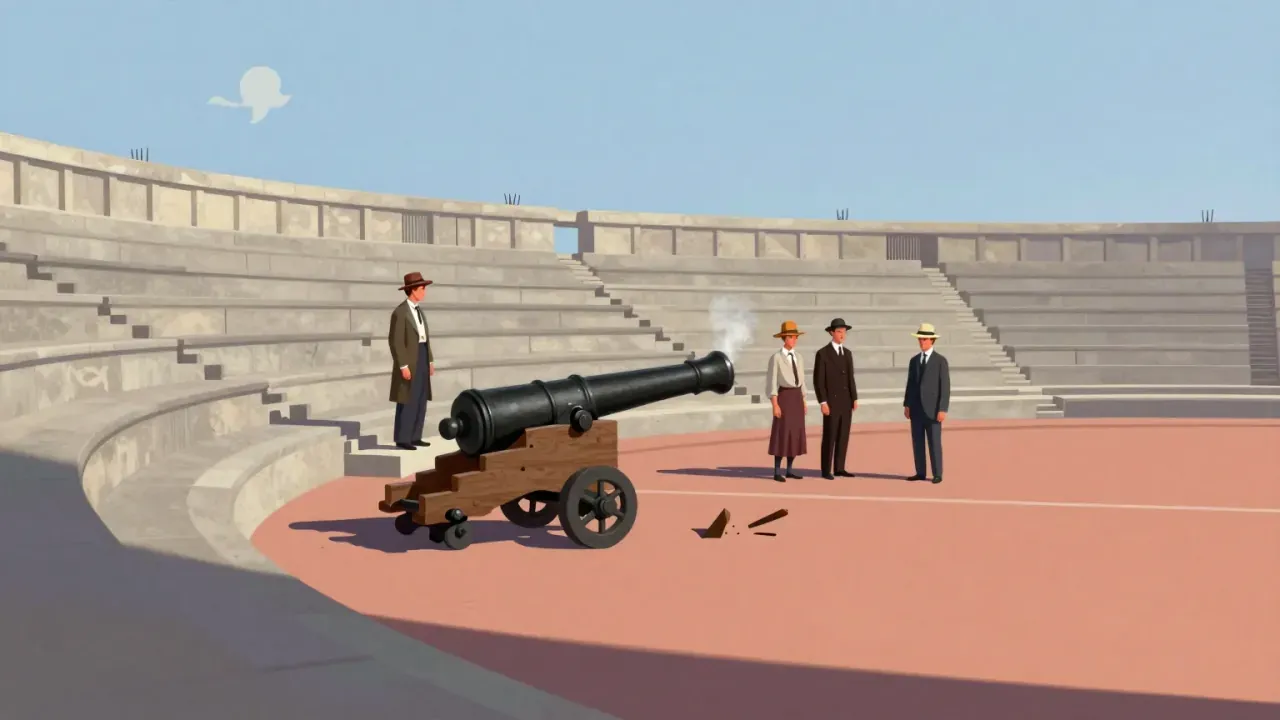
Entr’acte is a twenty-two-minute silent French film made in 1924 as a prologue and intermission piece for the Ballets Suédois production of Relâche. It does not tell a story, nor does it seek to illustrate or accompany the ballet’s narrative — it exists as an autonomous Dada intervention, designed to rupture expectation, destabilise causality, and treat the cinema screen as a site of playful sabotage. René Clair directs with deliberate anti-mimetic intent: time runs backward, gravity suspends, logic unravels. The film was conceived under the banner of ‘instantanéisme’, a collaborative Dada method that privileged spontaneity, collision, and the immediate juxtaposition of incongruous images over continuity or coherence. Its ambition is not to communicate but to disorient — to make the audience feel the mechanics of perception, the arbitrariness of sequence, the absurdity of cinematic convention itself. It treats film grammar as a set of rules to be broken, not followed; its syntax is nonsense, its punctuation is a cannon recoil. It is less a work of storytelling than a demonstration of what happens when editing, framing, and motion are liberated from meaning.
How it works
The film operates through rapid, unexplained cuts between rooftop vistas, slow-motion leaps, reversed actions, multiple exposures, and surreal transformations — an egg shot from a cannon becomes a pigeon; chess players vanish in a jet of water; mourners skip in slow motion behind a hearse pulled by a camel. Performances are deadpan and fragmentary: Erik Satie and Francis Picabia jump stiffly on a roof; Marcel Duchamp and Man Ray play chess without expression before being drenched; Jean Börlin appears as both hunter and magician, his costume shifts signalling no character arc but only a shift in visual register. Gordon Willis is not involved; the cinematography is by Georges Périnal, who tilts the frame, shoots dancers from below glass, and frames cityscapes at oblique angles. Editing is jagged and associative, not syntactic. Satie’s score — written separately as ‘Cinéma’ — attempts early synchronisation via repeat zones, though much of the Prologue plays unsynchronised. There is no dialogue, no intertitles beyond ‘Fin’, no exposition — only image, rhythm, and rupture.
What lands
What lands is the sheer physicality of the gags and the precision of their timing. The cannon recoil, the reverse jump, the pigeon emerging from the egg — these are not jokes with punchlines but mechanical surprises whose impact depends on the viewer’s familiarity with cinematic cause-and-effect. The slow-motion procession works because it literalises mourning as absurd exertion; the hearse detaching from the camel gains momentum like a runaway logic, escalating until the chase merges with bicycle races and rollercoasters. The final gag — a man poking through the ‘Fin’ card, then being kicked back through it as the title repairs itself — lands with perfect circularity: it acknowledges the film’s artifice while dissolving it. These moments succeed not by being clever but by being irreducible — they cannot be paraphrased, only witnessed. Their force comes from the clarity of the image, the economy of the cut, and the refusal to explain. They do not ask for interpretation; they demand attention to how the trick is done — and then, immediately, undo the trick.
What does not
What does not land is any sustained emotional or intellectual engagement beyond the initial jolt. The film’s commitment to fragmentation means it offers no accumulation, no development, no resonance beyond the frame. The cameo appearances — Duchamp, Satie, Man Ray — function as signatures rather than presences; their faces appear but do not cohere into commentary or personality. The chess scene, the boxing gloves over city squares, the balloon-headed dolls — all remain isolated motifs, never building toward irony, critique, or even consistent absurdity. Without a governing principle beyond ‘disruption’, repetition begins to feel arbitrary: the rooftop recurs too often, the slow motion loses its charge after the third use, the multiple exposures blur into visual noise. The film resists narrative but also resists pattern; its refusal of structure eventually reads less like liberation and more like exhaustion. It is not that it fails to mean — it refuses to mean — but that refusal, stretched across twenty-two minutes, starts to feel less like provocation and more like vacancy.
The themes that matter
The themes that matter are not stated but enacted: the instability of time, the illusion of causality, the fragility of authorial control. Entr’acte treats the filmstrip as a physical object — reversed, spliced, punctured — and thereby foregrounds the medium’s material basis. It questions whether meaning resides in sequence (editing), duration (slow motion), perspective (tilted frames), or presence (cameos). The recurring rooftop is not setting but stage — a neutral platform for arbitrary events, suggesting that context is imposed, not inherent. The transformation of egg to bird mocks biological and narrative teleology; the magician’s vanishing act parodies both theatrical illusion and cinematic erasure. Underlying it all is a Dada suspicion of language, including cinematic language: titles, continuity, motivation, closure — all are treated as conventions to be discarded. This is not nihilism but a rigorous testing of assumptions — what remains when you strip away story, psychology, and even consistent tone? Not emptiness, but a field of pure possibility, however fleeting.
Who should watch it, and who should not
It is for viewers who value formal invention over emotional payoff, who find pleasure in the mechanics of perception, and who approach film as a site of historical experiment rather than entertainment. It rewards patience with texture — the grain of the print, the weight of a pause, the shock of a reversed gesture. It is not for those who require narrative scaffolding, psychological consistency, or thematic resolution. Anyone expecting satire, social commentary, or even coherent surrealism will leave frustrated: Entr’acte has no target, no argument, no stance. Those who dislike silence, stillness, or ambiguity will find its pacing alienating. A viewer who values Satie’s music more than Clair’s images may prefer the Relâche score on its own. Someone who finds early avant-garde work historically significant but emotionally thin would agree with this verdict — but that disagreement rests on different priorities, not misreading. Change the frame from ‘art film’ to ‘historical document’, and its value shifts entirely.
Is it worth your evening
Yes, it is worth your evening — but only if you watch it once, on a screen large enough to see the grain, with no expectation of reward beyond the act of watching. Its brevity makes it manageable; its density demands attention, not absorption. To watch it twice is to risk diminishing returns — the gags lose their surprise, the repetitions become obvious, the absence of development begins to grate. It is worth your evening not as entertainment, nor as insight, but as a calibration: a reminder of how much cinema assumes, how little it needs to function, and how radically it can unsettle before sound, colour, or narrative became default. Anyone who has spent years watching films shaped by continuity editing or character arcs will feel the floor drop — briefly, vividly, and irrevocably. That sensation, fleeting as it is, justifies the time. It is not enriching, but it is clarifying — like wiping the lens clean before looking again.