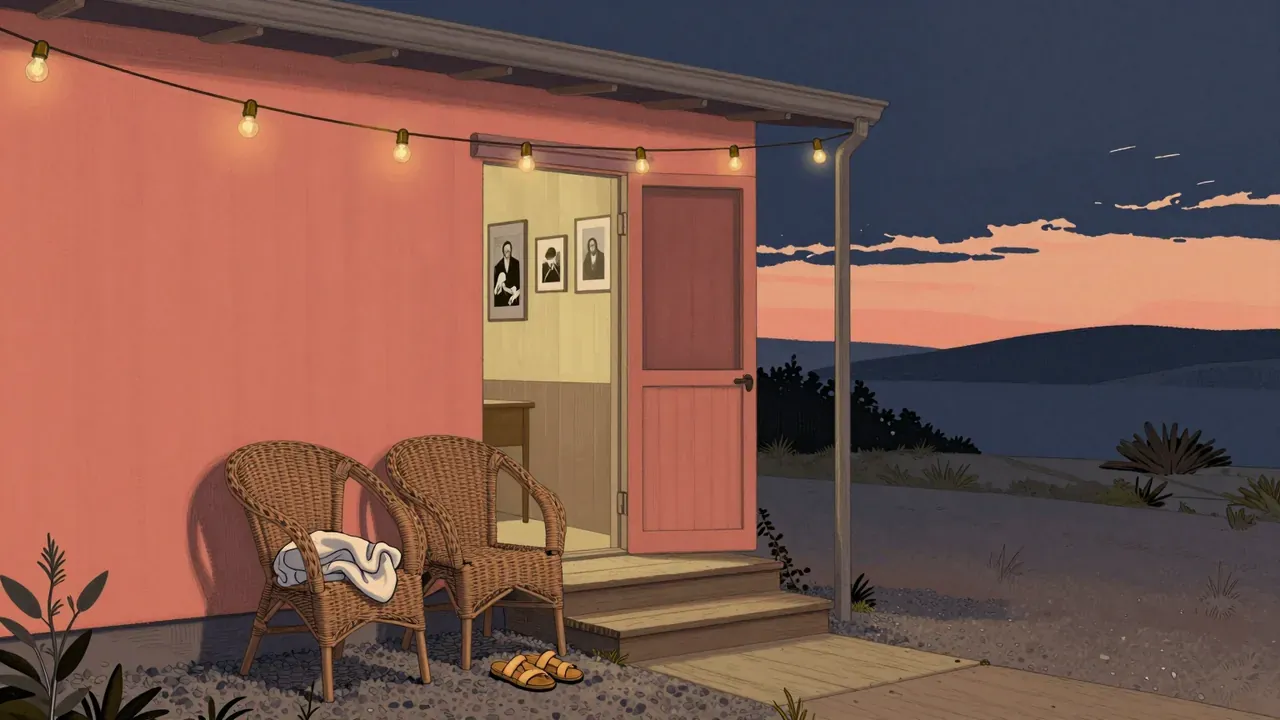
The shape of the marriage
L’Atalante is a French drama about a newly married couple, Juliette and Jean, who live aboard the barge L’Atalante as it travels the inland waterways of northern France. It attempts to hold together two registers at once: the grounded, tactile reality of working-class life on the water — ropes, damp wool, cat-hair on phonograph horns — and a lyrical, almost mythic sensibility about love, solitude, and the porous boundary between the domestic and the unknown. Jean Vigo does not treat the barge as setting but as character: its timbers groan, its deck tilts with the current, its cabin holds objects that seem gathered from dream logic rather than commerce. The film resists exposition or psychological explanation; instead, it builds meaning through accumulation — of gesture, texture, silence, and recurring motifs like floating debris, recorded sound, and the repeated image of hands gripping railings. Its ambition is modest in scope but radical in method: to find poetry not in escape from daily life, but in its unvarnished grain.
The look of it
The story follows Juliette’s restlessness after marriage, her brief flight to Paris, and Jean’s desperate search for her amid the city’s indifferent crowds. Michel Simon’s Père Jules — the barge’s eccentric, cat-collecting mate — anchors the film’s physical and emotional tone with a performance that balances grotesque detail and deep tenderness. Dita Parlo moves with quiet, watchful precision; Jean Dasté conveys Jean’s earnestness without sentimentality. Boris Kaufman’s cinematography favours low angles, shallow focus, and long takes that let scenes breathe — particularly in the cramped barge cabin, where light falls unevenly across faces and surfaces. Maurice Jaubert’s score avoids orchestral sweep, using folk motifs and sparse instrumentation to underscore mood rather than dictate it. Louis Chavance’s editing sustains rhythm without emphasis, cutting on movement or breath rather than narrative cue. The film’s craft is cumulative: no single shot declares itself, but the whole accrues weight through consistency of attention to how things feel, sound, and occupy space.
What sticks in the hand
What lands most firmly is the film’s fidelity to sensory experience: the chill of canal mist, the clink of bottles in Père Jules’ cabin, the way Juliette’s coat catches on a doorframe as she leaves. These details are not decorative but structural — they make the world legible and emotionally immediate. The sequence where Juliette wanders Paris at night, passing real unemployed men lined up outside a soup kitchen, lands with documentary gravity because it refuses dramatisation; the camera observes without commentary, trusting the viewer to register the contrast between her private grief and public destitution. Père Jules’ phonograph scene, with cats drawn magnetically to the horn, works not as whimsy but as a quiet assertion of shared, wordless attention — a moment where human and animal inhabit the same register of curiosity. Even the showman’s interpolated song feels earned, its irony softened by the sincerity of its delivery and the visible effort of the performers. Nothing here feels imposed; everything feels found, then held steady.
Where the current slows
What does not land is the film’s attempt to resolve its central relationship with conventional narrative closure. Juliette’s return to the barge arrives without psychological preparation — her change of heart is implied by proximity, not articulated. This may reflect Vigo’s distrust of interior monologue, but it leaves Jean’s arc underdeveloped: his jealousy, insecurity, and eventual reconciliation lack the textual support needed for full emotional purchase. The Gare d’Austerlitz robbery scene, though shot with urgency, suffers from thin motivation and unclear spatial logic — it functions more as a symbolic rupture than a coherent dramatic beat. Some of the improvisational passages, particularly those involving minor characters like the showman or the dockworkers, drift without anchoring context. And while the film’s resistance to exposition is part of its strength, it occasionally tips into opacity: the significance of certain objects — a compass, a pair of gloves, a broken clock — remains associative rather than legible, demanding more from the viewer than the film equips them to give.
What holds the boat together
The themes that matter are intimacy as labour, not feeling; the sea as both horizon and prison; and knowledge as embodied, not intellectual. The barge is neither idyll nor trap, but a site where love must be continually remade through shared tasks — hauling rope, lighting stoves, mending nets. Juliette’s departure is not rebellion against marriage but against confinement to a single version of herself; her return is not submission but re-orientation toward a different kind of belonging. Père Jules’ collection — shells, masks, gramophone records — suggests that identity is assembled from fragments gathered along the way, not inherited or fixed. The film treats memory not as recollection but as residue: the echo of a voice on wax, the scent of damp wool, the weight of a cat asleep in a speaker. There is no grand statement about class or politics, but a persistent attention to how economic reality shapes gesture — the way hands are calloused, how shoulders slump after long hours, how silence stretches when money is short.
Who steps aboard
It is for viewers who value atmosphere over exposition, who find emotional resonance in texture and duration rather than plot turns, and who accept that some questions — why Juliette leaves, why she returns — need not be answered to be felt. It is not for those who require clear motivation, linear cause-and-effect, or psychological explanation for every action. Those who expect period drama to clarify social context or historical positioning will find it withholding; those who rely on dialogue to carry meaning may struggle with its reliance on silence and gesture. A viewer accustomed to contemporary pacing or narrative signposting may find its rhythms opaque or inert. But for someone willing to sit with its slowness, its refusal to name what it shows, its reward is a rare kind of presence — not the illusion of reality, but the sensation of being inside it.
The weight of the evening
Yes, it is worth your evening — not as entertainment, but as an act of sustained attention. Its 89 minutes pass with the weight and pace of actual time: sometimes dense, sometimes suspended, never hurried. You will not leave with answers, but with impressions that linger — the glint of water on metal, the warmth of a shared blanket, the way light pools in a narrow cabin. It asks nothing of you but to notice, and repays that attention with a quiet, cumulative intensity. Those who find this unrewarding are not wrong; they may simply prefer films that organise experience rather than mirror it. A restoration of the original cut would clarify some narrative ambiguities, but the core achievement — its tactile fidelity and emotional restraint — remains intact in the version widely available. It is not a film to consume, but one to inhabit, briefly, and then carry away in fragments.