A show in a ring
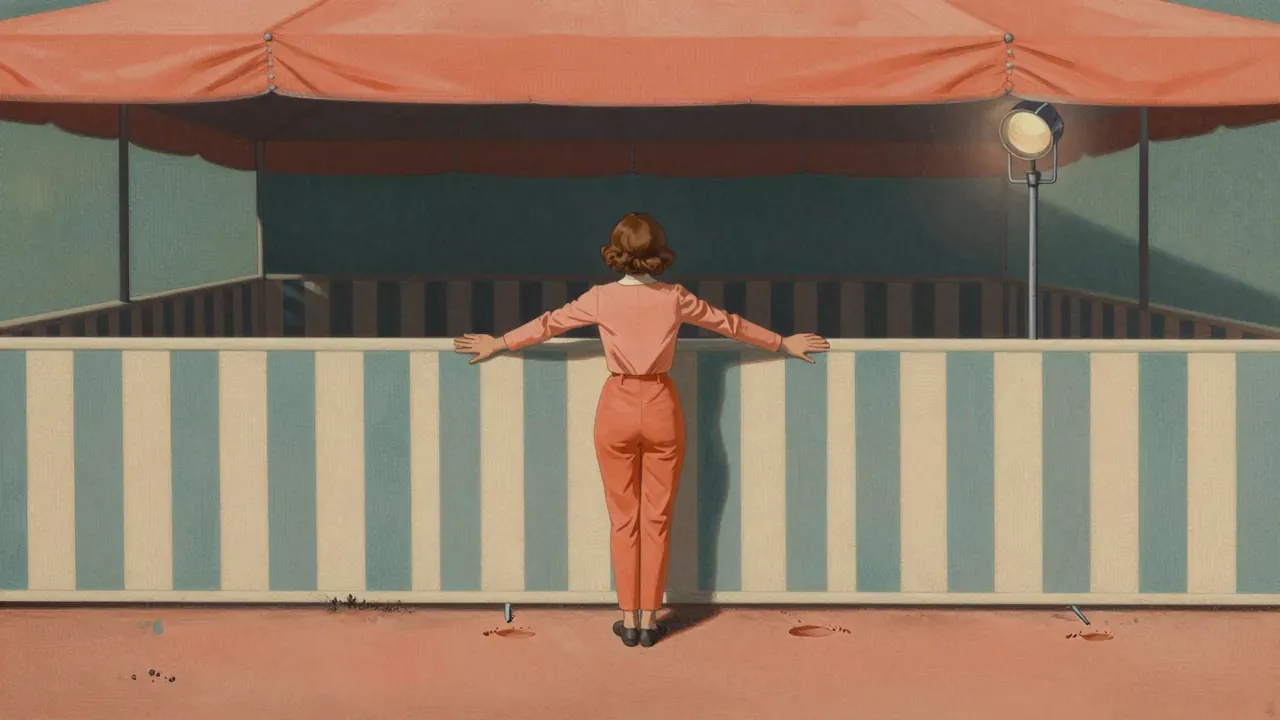
Parade is a television film made for Swedish broadcast, conceived by Jacques Tati as a live-in-the-studio clown revue rather than a narrative feature. It does not attempt to tell a story, develop character arcs or sustain dramatic stakes. Instead, it sets out to reassemble the grammar of silent-era physical comedy — pantomime, timing, spatial awareness, visual rhythm — within the constrained, intimate frame of a single circus ring in Stockholm Cirkus. Tati appears as Monsieur Loyal, a ringmaster who invites the audience into complicity, treating them less as spectators than co-performers in a deliberately unpolished, low-budget variety show. The film’s ambition lies in its refusal of cinematic scale: where PlayTime expanded into architecture and Trafic into automotive systems, Parade contracts into gesture, proximity and repetition. It is not a farewell statement in the manner of a valedictory symphony, but a return to first principles — the body in space, the pause before the fall, the shared glance across a room. Its purpose is functional, almost pedagogical: to demonstrate how laughter can be built from silence, misdirection and collective attention.
No plot, only parade
The film unfolds as a sequence of discrete acts — juggling, mime, animal tricks, musical stunts, magic illusions — linked only by Tati’s presence and his gentle, looping address to the audience. There is no plot, no subplot, no off-stage life implied for any performer. Michèle Brabo and Pia Colombo appear as supporting clowns and singers, their roles defined by function rather than psychology; Brabo’s mime routine relies on precise weight shifts and facial control, Colombo’s songs are delivered with theatrical clarity but minimal inflection. Gunnar Fischer’s cinematography avoids flourish: he keeps the lighting flat and even, the framing tight, the camera mostly static or panning slowly across the ring. The mix of video, 16mm and 35mm stock is visible in texture shifts — grain, scan lines, soft focus — but never deployed for effect. Charles Dumont’s music is light, repetitive, slightly dated, underscoring gags without amplifying them. Editing is rhythmic rather than syntactic: cuts land on beats, not revelations. Performance is calibrated to the room, not the screen — gestures are broad, pauses long, reactions delayed just enough to let the audience catch up. Nothing is hidden; everything is offered plainly, without irony or commentary.
The body in time
What lands is the consistency of Tati’s physical intelligence. His timing remains exact, his sense of scale unerring: when he steps into a too-small box, or misjudges the height of a ladder, the failure reads not as error but as intention made visible. The audience participation segments — a child handed a prop, an elderly man coaxed into a simple dance — work because they are unscripted in tone, not in structure: Tati creates safety through repetition and predictability, so even awkwardness feels choreographed. The juggling routine with three men and one ball builds momentum through incremental complication, not surprise. The mime sketch with the invisible wall holds attention not through virtuosity alone but through its insistence on shared perception — the wall exists because we agree it does. These moments do not rely on narrative payoff but on the quiet satisfaction of a system working as designed: body, space, time, attention, all aligned. They land because they ask nothing beyond presence, and reward it with clarity.
When the beat slows
What does not land is the film’s structural slackness when viewed outside its original broadcast context. Without the liveness of television — the sense that this is happening now, in real time, with no retakes — the repetitions begin to feel like padding rather than rhythm. The musical numbers, though cleanly performed, lack tonal variation; Dumont’s score offers little contrast between acts, and the absence of diegetic source (no band, no orchestra pit) makes them feel imposed rather than earned. Some gags overstay their welcome by five or six seconds — a dropped prop retrieved twice, a door opened and closed three times — not for comic escalation but because the shoot ran long or the tape rolled on. The video footage, while historically interesting, introduces a slight temporal disconnect: its immediacy clashes with the deliberate slowness of the 35mm sequences. And Tati’s monologues, delivered directly to camera in French, assume a familiarity with his persona that newer viewers may not possess — they read as warm but opaque, like overhearing half a conversation in a language you almost know.
The shape of the space
The themes that matter are containment, reciprocity and endurance. Parade is set entirely within the ring — a literal and metaphorical boundary — and every act tests its limits: bodies fold into boxes, ropes stretch taut, animals circle but never exit. Reciprocity runs through the film’s architecture: Tati addresses the audience, invites them in, acknowledges their laughter and hesitation, making spectatorship a two-way transaction rather than passive consumption. Endurance is both formal and biographical: the film’s modest runtime is filled with sustained takes, repeated actions, lingering glances — a refusal of cutaway or distraction. This is not the endurance of suffering but of attention, of maintaining focus on the small, the slow, the seemingly trivial. It is also Tati’s own endurance — made under financial duress, after the collapse of PlayTime’s ambitions, with borrowed equipment and a skeleton crew. The film does not speak of failure directly, but it embodies resilience without rhetoric: doing the work, in the space available, with the people at hand.
Who it meets halfway
It is worth watching for anyone interested in the mechanics of physical comedy, in Tati’s late-period thinking about performance and audience, or in the history of television as a site for cinematic experiment. It rewards patience, familiarity with silent-era conventions, and tolerance for anti-climax. It is not for viewers who require narrative propulsion, psychological depth, or stylistic innovation — those looking for PlayTime’s architectural wit or Mon Oncle’s satirical precision will find Parade thin by comparison. Roger Ebert’s assessment reflects a mainstream expectation of progression; others, like Time Out’s ‘eccentric slice’, accept its terms more readily. A change in context — seeing it projected in a small cinema with an engaged crowd, or as part of a Tati retrospective — would lift its weight considerably. Without that framing, its modesty risks reading as meagreness.
What remains after the curtain
Yes, it is worth your evening — but only if you approach it as a document of method, not a destination. It is ninety minutes spent inside Tati’s workshop, watching him rebuild a gag from scratch, test its balance, adjust its tempo, discard what doesn’t serve the rhythm. That has value, but it is specialised value: it assumes interest in craft over story, in process over product. Someone expecting a film might leave restless; someone watching for how a clown negotiates space, or how light falls on a striped costume under mixed stocks, will find it rich. Its worth depends not on universal appeal but on alignment — with temperament, with history, with the particular pleasure of seeing mastery operate under constraint. To call it minor is accurate; to dismiss it as negligible is to misunderstand what minor work can preserve.