The shape of time
Farewell My Concubine is a Chinese historical drama spanning fifty years, from the Republican era through the Cultural Revolution to the late 1970s. It follows two Peking opera performers — Cheng Dieyi and Duan Xiaolou — whose professional intimacy and personal entanglement unfold against successive political ruptures. The film attempts to hold individual fidelity — to art, to love, to self — in tension with collective coercion, using the rigid formalism of Peking opera as both aesthetic framework and metaphor for enforced identity. Its scope is not epic for spectacle’s sake but structural: each historical turning point tests whether performance can survive when the script is rewritten by force. The ambition is precise — not to survey modern Chinese history, but to trace how ideology colonises gesture, voice, and memory. It treats opera not as folklore but as embodied discipline, a grammar of survival that eventually fractures under pressure. The film’s central question is not what happens to the men, but what happens to meaning when repetition becomes compulsion and devotion becomes confession.
The body remembers
The story unfolds in three acts, anchored by the opera ‘Farewell My Concubine’, which Cheng Dieyi performs obsessively, blurring the line between role and reality. Leslie Cheung’s Cheng is physically and psychologically porous — his posture, vocal timbre, and gaze are calibrated to feminine refinement, then destabilised by decades of political demand. Zhang Fengyi’s Duan Xiaolou grounds the film in pragmatic masculinity, his gradual moral erosion rendered without flourish: a glance away, a delayed pause, a hand withdrawn. Gong Li’s Juxian enters as counterweight — worldly, resilient, then broken by the same system that consumes the men. Gu Changwei’s cinematography avoids grandeur; he keeps faces tightly framed in shallow focus, often lit from below or behind, so shadows pool in eye sockets and throat hollows. Zhao Jiping’s score uses erhu and pipa not for ornament but as leitmotif — recurring phrases warp slightly each time, like memory under duress. Pei Xiaonan’s editing sustains duration without indulgence: long takes hold breath, cuts land like accusations.
The weight of the fan
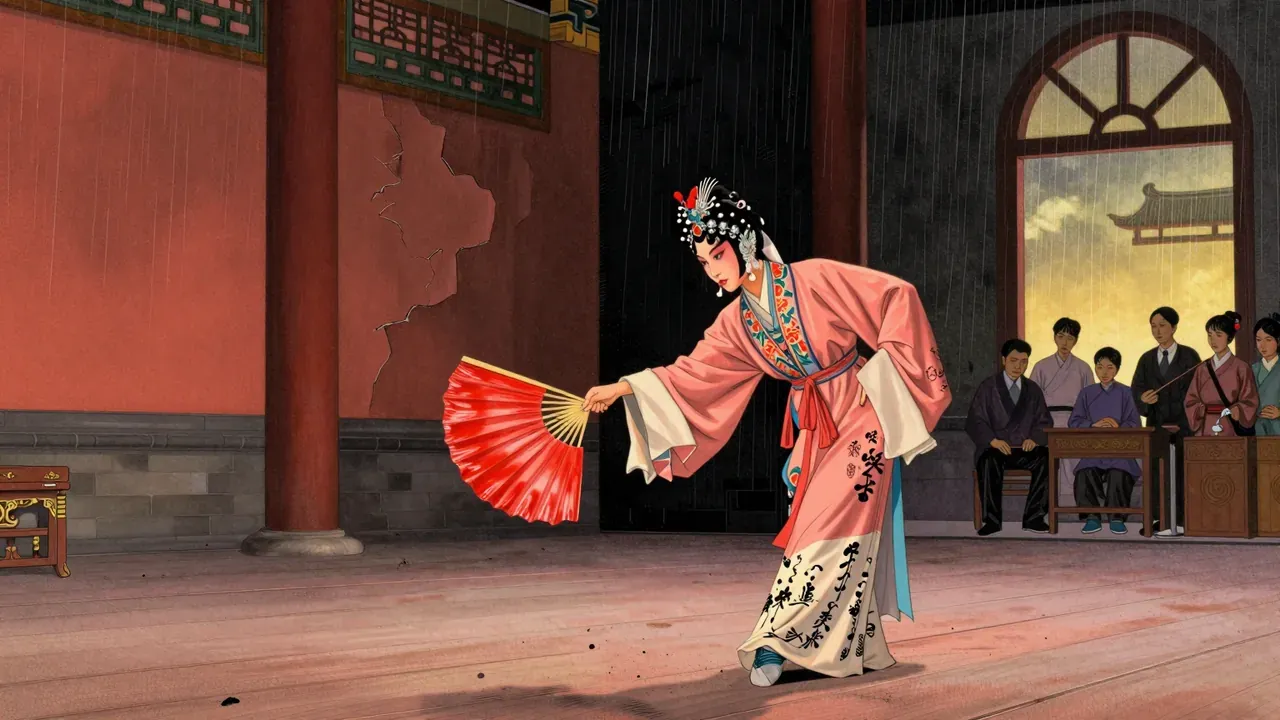
What lands most firmly is the film’s physical grammar — the way bodies remember training even when minds rebel. Cheng Dieyi’s hands never forget the fan’s arc, his neck the tilt required for the concubine’s final bow, long after he has been forced to denounce it. This bodily continuity gives the film its quiet authority: trauma here is not shouted but rehearsed, embedded in muscle and breath. The opera sequences do not function as interludes but as structural refrains — each performance marks time, measures change, and exposes what has been excised from the previous one. The 171-minute runtime feels necessary rather than indulgent because the film’s rhythm is cumulative, not episodic: small shifts in costume, lighting, or vocal register signal larger ruptures in social contract. Even minor roles — Ge You’s sardonic theatre manager, Ying Da’s opportunistic cadre — land with economy, their lines sparse but their presence weighted by implication. The Palme d’Or win reflects this precision: it is a film where every held silence, every unblinking stare, carries narrative freight.
The light changes
What does not land is the film’s treatment of political agency beyond the central trio. Characters outside the opera troupe often serve as ideological vectors rather than individuals — the Red Guards shout slogans without inflection, cadres issue orders without hesitation, and even Juxian’s political awakening arrives abruptly, without the same psychological scaffolding given to Cheng or Duan. The Cultural Revolution sequences risk flattening into tableau: massed figures in grey uniforms move in unison, their menace stylised rather than specific. There is little sense of dissenting thought within the system, no glimpse of bureaucratic friction or private doubt among enforcers. This simplification serves the film’s allegorical drive but weakens its historical texture. Some viewers may find the moral calculus too stark — Cheng’s purity versus Duan’s compromise — leaving little room for ambiguity in motivation or survival strategy. The film assumes fluency in Peking opera conventions, and while subtitles translate dialogue, they cannot convey the weight of gesture or vocal nuance lost in translation, creating a subtle barrier for audiences unfamiliar with the form.
The role takes hold
The themes that matter are not loyalty or betrayal in the abstract, but the violence of role enforcement — how art trains the body to obey, and how politics repurposes that obedience. Identity here is neither fixed nor fluid but rehearsed: Cheng’s lifelong identification with Yu Ji is not delusion but discipline, and its collapse is less psychological breakdown than systemic dismantling. The film interrogates authenticity not as truth-telling but as continuity — what persists when language is stripped, when names are revoked, when performance is weaponised. Time is another theme: not linear progression but layered recurrence, where 1930s rehearsals echo in 1960s struggle sessions, and the same fan appears in different hands across decades, its meaning inverted each time. Censorship operates not only from above but internally — Cheng polices himself before the state demands it. The opera house becomes a microcosm not of China alone but of any institution where ritual masks coercion, and where mastery of form becomes indistinguishable from surrender to form.
The stage holds
This film is for viewers who value sustained emotional architecture over plot propulsion — those willing to sit with discomfort, ambiguity, and unresolved grief. It rewards attention to gesture, silence, and repetition, and assumes some tolerance for slow-burn psychological erosion rather than dramatic catharsis. It is not for viewers seeking clear moral binaries, historical exposition, or narrative efficiency: the political context is implied, not explained, and character motivation often resides in what is withheld. Those expecting a conventional biographical arc or a critique of Maoism as ideology may find the film’s focus too intimate, too embodied. A viewer who values historical accuracy over symbolic resonance may object to the compression of decades into emblematic moments. What would change the verdict? A stronger through-line for Juxian’s interiority, or more granular depiction of dissent within the revolutionary apparatus — but that would shift the film from tragedy to chronicle, and it is not trying to be either.
The final bow
Yes, it is worth your evening — not as diversion but as immersion. Its 171 minutes ask for patience, but repay it with cumulative power: the final sequence lands with the weight of everything that precedes it, not because of surprise but because of inevitability earned note by note, gesture by gesture. It is not ‘entertaining’ in the colloquial sense, but it is rigorously alive — every frame calibrated, every performance restrained yet charged. Those who find its pace oppressive may prefer tighter historical dramas; those who distrust allegory may resist its symbolic density. But for viewers who accept that some truths are held in the throat, not spoken, and carried in the spine, not declared, Farewell My Concubine remains singular. Its endurance lies not in nostalgia but in its refusal to simplify the cost of remembering — or forgetting — who you were trained to be.