The look of it
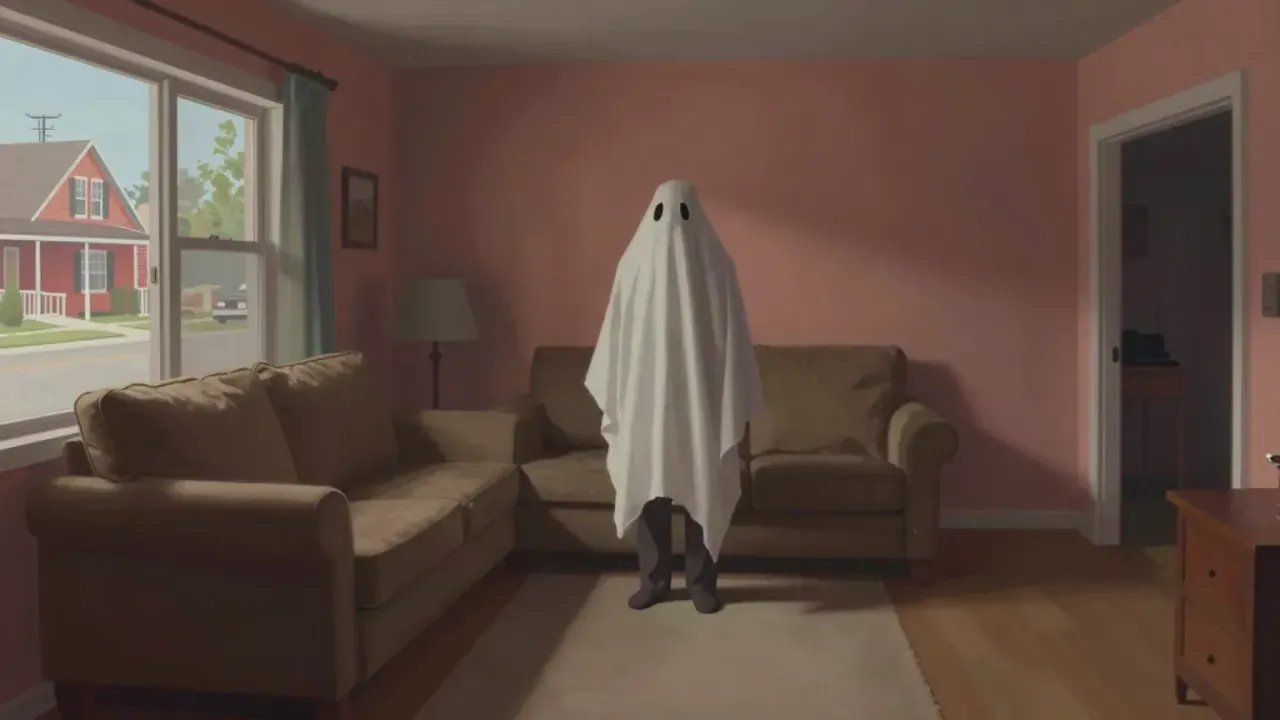
A Ghost Story is a formally rigorous, low-budget American melodrama about duration, memory and physical space. It uses the figure of a sheet-draped ghost — played by Casey Affleck — not as a vehicle for scares or exposition, but as a passive, fixed observer across time. The film’s ambition lies in its refusal to anthropomorphise grief: the ghost does not speak, reason, or evolve. Instead, it occupies rooms, watches people live and leave, and repeats fragments of its own past like a looped tape. David Lowery wrote, directed and edited the film, working from an idea rooted in personal attachment to domestic architecture and existential unease about deep time. Its 1.33:1 aspect ratio enforces visual containment; its silence between lines, its long takes, its refusal of narrative momentum — all are deliberate constraints meant to mirror the ghost’s immobility and the weight of unprocessed loss. It is not a supernatural thriller, nor a psychological study. It is a structural experiment in stillness, using genre scaffolding to hold a meditation on what persists when people do not.
The shape of time
The story unfolds almost entirely within one house — a real, soon-to-be-demolished structure chosen for its resemblance to Lowery’s first marital home. Andrew Droz Palermo’s cinematography keeps light sparse and directional, often holding on empty doorways or static corners for extended durations. Rooney Mara’s performance as M is grounded in quiet physicality: her grief manifests in posture, repetition, and small gestures — eating pie until she vomits, hiding a note, humming a tune. Affleck’s ghost is less a character than a compositional element: his movement is minimal, rigid, deliberately puppet-like, as the production notes confirm. Daniel Hart’s score is sparse and tonal, built around piano motifs that recur across centuries. Editing avoids conventional continuity; cuts often jump decades without transition, trusting the viewer to register change through wallpaper, furniture, or language. The film’s craft is unified: every decision — the sheet’s stiffness, the boxy frame, the absence of non-diegetic sound in key scenes — serves the central conceit of time as accumulation rather than progression.
What stays
What lands is the cumulative emotional weight of persistence. The ghost’s silent witnessing — of M’s sorrow, of the Spanish-speaking family’s warmth, of the partygoers’ nihilism — gains resonance not through plot but through repetition and contrast. The Virginia Woolf passage read aloud, the recurring piano melody, the note hidden and unpicked: these are anchors, not revelations. The film’s most effective moments are those where duration itself becomes expressive — the four-minute take of Mara eating pie, the slow pan across the derelict house before demolition, the final retrieval of the note after decades of scraping. These sequences do not ask for empathy so much as attunement: they reward patience with a kind of tactile memory, where the texture of plaster, the grain of wood, the hum of a refrigerator become carriers of feeling. The film’s restraint — its refusal to explain, underline or resolve — allows space for the viewer’s own associations with place, loss and impermanence to settle in.
Where it slips
What does not land is the film’s occasional drift into abstraction without sufficient grounding. The 19th-century flashback, while thematically coherent, arrives without tonal preparation and risks feeling like an illustrative footnote rather than an organic extension of the ghost’s experience. The flower-print ghost’s line — ‘I don’t think they’re coming’ — is poignant in isolation but underdeveloped as a counterpoint to C’s fixation; its brevity leaves little room for the audience to invest in its parallel arc. Some transitions between eras rely too heavily on visual shorthand — a change in wallpaper, a shift in clothing — without enough sonic or spatial continuity to sustain immersion. The film’s commitment to minimalism occasionally tips into austerity: a few scenes linger beyond their expressive yield, becoming exercises in endurance rather than meaning. Those who require narrative propulsion, psychological motivation or even basic exposition will find the film withholding to the point of opacity — not as a virtue, but as a limitation of its method.
What it’s really about
The themes that matter are not love or death in the abstract, but the materiality of memory: how buildings hold time, how objects accrue significance, how a single note hidden behind paint can outlast generations. The film treats space as palimpsest — walls layered with residue of lives lived, floors worn by footsteps no one remembers. It engages with deep time not cosmologically but domestically: the same piano appears in three centuries, played by different hands, sounding the same melody. Mortality is framed not as an end but as a shift in agency — from actor to witness, from subject to surface. The ghost’s sheet is both costume and metaphor: a barrier, a shroud, a screen onto which meaning is projected. The film also quietly interrogates authorship and legacy: C’s song outlives him, M’s note remains unread, the bulldozer erases the house but not the memory of it. These are not philosophical propositions argued in dialogue, but conditions enacted in composition, rhythm and duration.
Who it’s for
This film is for viewers who treat cinema as a medium of attention rather than information — those accustomed to the pacing of Tsai Ming-liang, the stillness of Béla Tarr, or the architectural focus of Chantal Akerman. It rewards rewatching, not for plot clarification but for noticing shifts in light, texture or off-screen sound. It is not for those who rely on narrative cause-and-effect, character arcs or verbal exposition to orient themselves. People who find ambiguity frustrating, or stillness boring, will likely disengage early. Those expecting horror, romance or even conventional drama will be misled by the title and cast. The verdict changes only if the viewer accepts that the film’s form is its argument — that duration, repetition and emptiness are not flaws but tools. Without that acceptance, it feels inert; with it, it hums.
Is it worth your evening
Yes, it is worth your evening — provided you approach it as you would a piece of chamber music or a long-exposure photograph: with intention, not distraction. Its ninety-two minutes pass slowly, but not emptily; every pause has weight, every cut carries implication. It does not offer catharsis or resolution, but it does offer a rare, sustained encounter with the physical reality of time’s passage — in plaster, in piano wire, in the slow decay of a house. Those who watch it on a phone, with notifications on, or while waiting for something to ‘happen’, will find it interminable. But those willing to sit with its silences, to notice how light falls on a floorboard across decades, will leave with a recalibrated sense of scale — of how small a life is, and how large its traces can be. It is not entertainment. It is a minor monument to the ordinary.