Beatles money behind a Mexican surrealist film
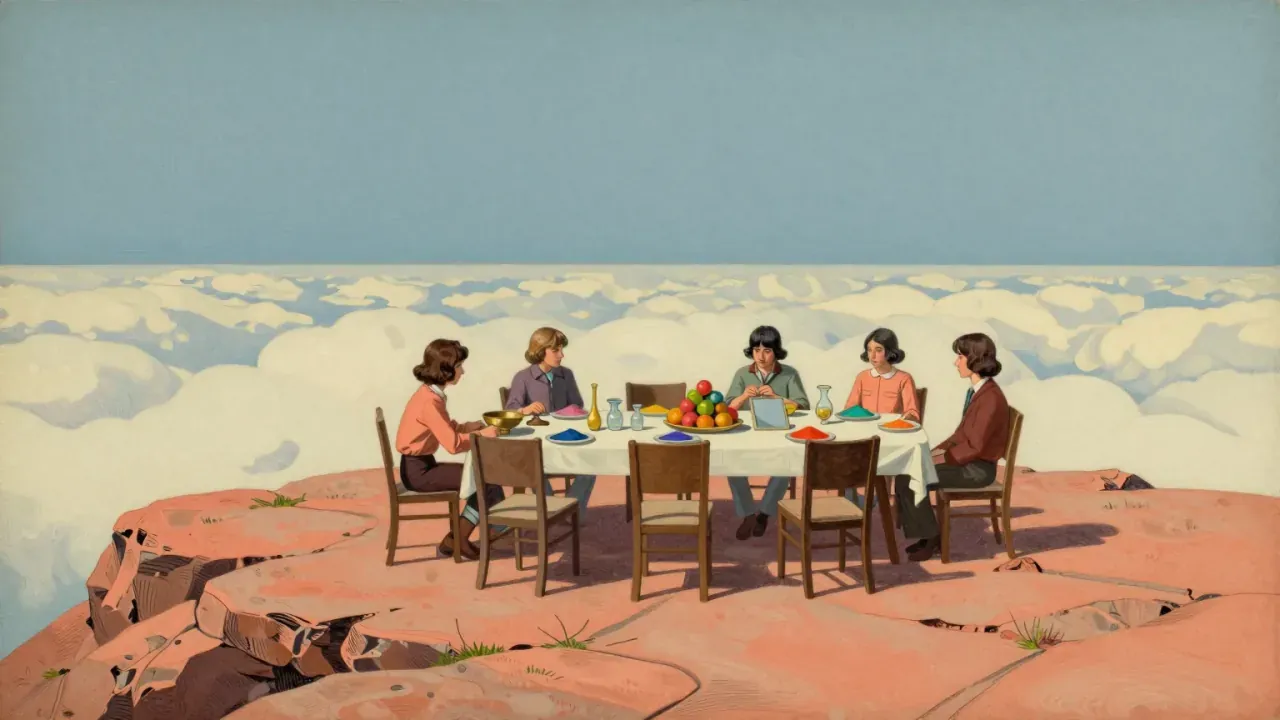
The Holy Mountain is Alejandro Jodorowsky’s 1973 surrealist film, his follow-up to the underground hit El Topo, following a nameless thief who resembles Christ as he abandons a life of petty scams to apprentice himself to an alchemist and join a group of seven wealthy, corrupt figures, each representing a planet, on a quest to steal the secret of immortality from the beings said to guard it atop a sacred mountain. Beatles manager Allen Klein financed the film through his company ABKCO after El Topo won admirers in John Lennon and George Harrison, and Lennon and Yoko Ono personally put up production money. Jodorowsky wrote, directed, edited, co-scored and starred in the film himself, drawing on tarot, alchemy, Kabbalah, Zen Buddhism and Latin American shamanic imagery rather than any single narrative source.
Three months of spiritual training before a single scene
Before filming began, Jodorowsky and his wife went a full week without sleep under the direction of a Japanese Zen master, while the film’s central cast spent three months undergoing spiritual exercises with Oscar Ichazo of the Arica Institute, a program blending Zen, Sufi and yoga practices with concepts drawn from the Kabbalah and the I Ching. The group then lived together in Jodorowsky’s home for a month before the shoot itself began, in early 1972, filmed sequentially and entirely on location in Mexico on a budget of $750,000. On Ichazo’s instruction, Jodorowsky took LSD as part of his own spiritual practice during the production, and he gave the cast psilocybin mushrooms while filming the film’s death-and-rebirth sequence.
A twist that dismantles its own mysticism
The film’s episodic structure, introducing each of the seven planetary figures through a self-contained set piece detailing their specific corruption, whether weapons manufacturing, child-targeted toy indoctrination or population control disguised as fiscal policy, gives it a satirical bite that the later, more purely mystical mountain-climbing sequence doesn’t quite match. Rafael Corkidi’s cinematography turns even the film’s most grotesque imagery, like the thief eating the face off his own wax Christ statue, into something closer to religious painting than shock value. The final twist, in which the immortals guarding the mountain’s summit are revealed as faceless dummies and the film abruptly shows its own camera and crew, is the rare ending that genuinely upends the journey the previous two hours built toward.
Symbolism arriving faster than it can be processed
The film’s density of symbolic reference, drawing simultaneously on tarot, Gurdjieffian psychology and Jodorowsky’s own invented Panic movement, occasionally outpaces its narrative clarity, and individual images, striking on their own, sometimes arrive faster than the film gives an audience time to process their connection to what came before. The extended sequence introducing the seven planetary characters, while its best-sustained stretch, runs long enough that the momentum built by the earlier city scenes with the thief and his companion dissipates before the mountain plot properly begins. A scene involving child nudity, later removed from release prints after the mother of one young performer threatened legal action, points to a production ethic that by any modern standard was reckless.
Seven portraits of what money does to people
Power and greed, distributed across seven deliberately exaggerated figures, function as the film’s real subject well before the mountain itself enters the story, each character offering a specific, satirical portrait of how wealth converts cruelty into a business model. Mortality, and the desire to escape it, is what finally unites the thief with his new companions, but the film’s ending refuses to grant that wish even symbolically, dismantling the very idea of transcendence by exposing its own artifice at the moment the goal seems within reach. Surrealism here is not decorative but argumentative, a way of making corruption, spiritual hunger and self-delusion visible all at once without needing a conventional plot to connect them.
Who should approach this one carefully
This suits viewers drawn to surrealist cinema built from religious and esoteric imagery rather than plot logic, anyone curious about the countercultural film scene Lennon and Klein helped fund in the early 1970s, and admirers of Jodorowsky’s specific, uncompromising visual sensibility. It is not suited to viewers wanting narrative coherence or restraint, since the film includes sustained nudity, animal cruelty during production, and imagery, including the removed child nudity scene, that a contemporary audience will likely find genuinely troubling regardless of its intent. Anyone approaching it expecting a straightforward mountain-quest narrative should also be prepared for the mountain itself to arrive quite late.
A cult reputation built on midnight screenings
Critical scores have settled comfortably positive, an 84 percent Tomatometer score, a 76 Metascore and an average rating of 7.2 out of 10, respectable numbers for a film this wilfully abrasive. At 114 minutes, its midnight-movie afterlife, including a sixteen-month run at New York’s Waverly Theatre, has done more to cement its reputation than its original festival release did. It is worth an evening specifically for viewers already curious about 1970s countercultural cinema at its most extreme, though it is a poor choice for anyone wanting a first exposure to arthouse film, given how far it pushes past ordinary narrative and taste.