The look of it
Dragon Gate Inn is a wuxia film set in mid-fifteenth-century Ming China, built around a single, sustained confrontation at a remote desert inn. King Hu wrote and directed it as a deliberate pivot from the studio-bound elegance of his earlier Come Drink with Me: here, space is sparse, authority is corrupt, and moral clarity rests not in imperial decree but in personal loyalty and martial discipline. The film aims to reconfigure the genre’s conventions—not by expanding spectacle or deepening psychology, but by tightening narrative geography, compressing motive into duty, and treating action as structural grammar rather than ornament. It does not seek historical verisimilitude, nor does it dwell on political exposition; instead, it uses the jinyiwei secret police and the eunuch Cao Shaoqin as functional antagonists—agents of systemic violence whose presence justifies the protagonists’ vigilance and cohesion. This is a film about containment: of people, of information, of movement—and how resistance takes shape within narrow margins. Its ambition is formal and tactical, not thematic or expansive. (158 words)
The sound of it
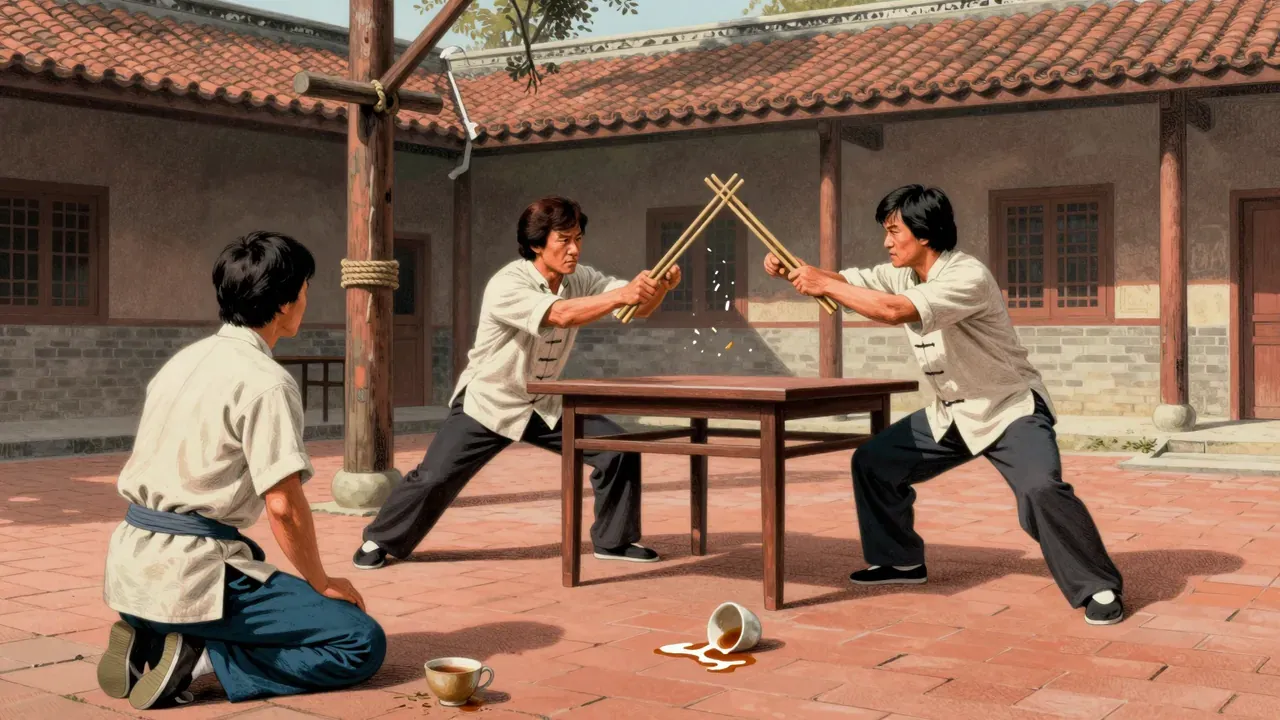
The story unfolds with minimal exposition: Yu Qian’s execution, his family’s exile, Wu Ning’s quiet resolve, and the arrival of three martial artists who join him at Dragon Gate Inn. Performances are restrained—Hsu Feng’s Zhu Hui moves with economical precision, Shih Chun’s Xiao Shaozi carries dry wit without broadening it into comedy, and Polly Shang-Kuan Ling-Feng’s Zhu Ji conveys gravity through stillness more than speech. Hua Hui-ying’s cinematography favours wide shots and shallow depth, keeping figures anchored in arid landscape and sun-baked architecture; interiors are lit with directional austerity, never softening edges. Chou Lan-Ping’s score avoids leitmotif in favour of rhythmic punctuation—drums and strings mark transitions, not emotions. Chen Hung-min’s editing sustains tension through duration and repetition: a glance held, a door creaked open twice, a sword drawn slowly across frame. Han Ying-chieh’s choreography treats combat as spatial negotiation—feints, parries, and retreats occupy real distance, with cuts that clarify consequence rather than conceal effort. There are no slow-motion flourishes, no wirework illusions; every strike lands with audible weight and visible recoil. (159 words)
The movement of it
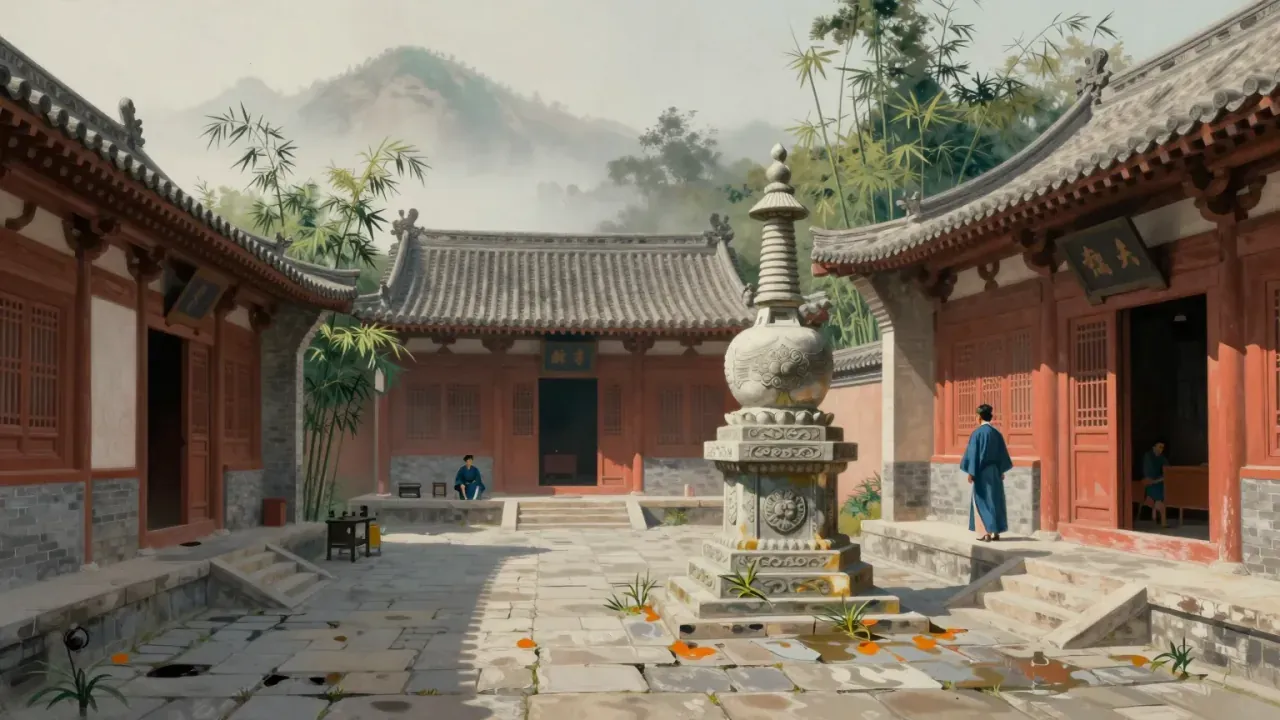
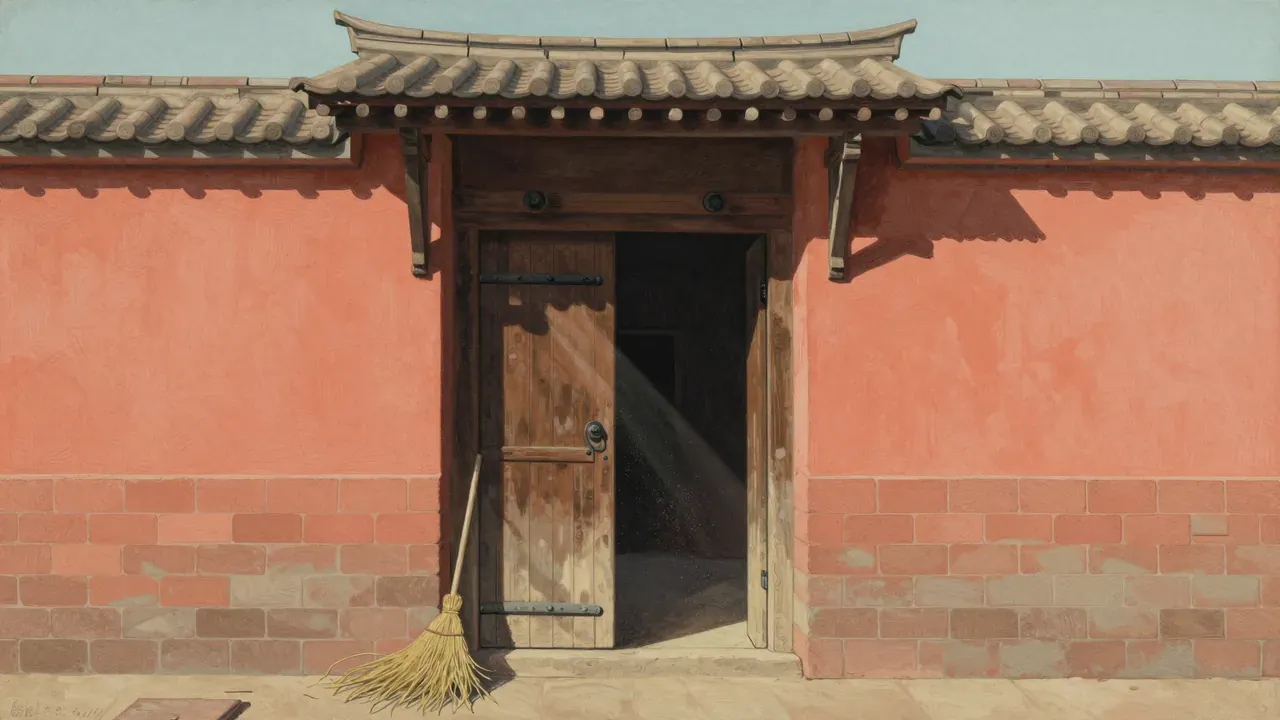
What lands most firmly is the film’s architectural control: the inn itself becomes a character defined by thresholds, corridors, courtyards, and rooftops—each zone governing what can happen, and when. The pacing never rushes, yet never stalls; scenes breathe but do not linger. The tension between stillness and sudden violence feels earned because it is preceded by precise staging—characters occupy fixed positions before shifting, and their movements obey the logic of the space. The ensemble’s cohesion reads as conviction, not convenience: these are people bound by shared history, not plot necessity. Hsu Feng’s physical command anchors the central trio, her swordplay neither flamboyant nor stoic but fluent—each motion serves the next. The film’s sense of scale is also persuasive: the desert is vast but unromanticised, the inn isolated but not mythologised. Even the eunuch Cao Shaoqin, though archetypal, registers as a threat because his power lies in delegation and surveillance, not monologue or spectacle. The final tree-leap sequence works not as transcendence but as culmination—a release of accumulated pressure, executed with exact timing and no embellishment. This is a film where form and function align without friction. (157 words)
The weight of it
What does not land is psychological complexity beyond the immediate stakes. Characters speak little, and what they say rarely reveals interiority—it serves exposition or tactical alignment. The Yu children remain passive charges, their survival symbolic rather than dramatised. The political context—Emperor Yingzong’s return, Yu Qian’s false treason charge—is sketched, not interrogated; the film assumes familiarity with Ming-era court intrigue, offering no foothold for viewers unfamiliar with its contours. There is no irony, no ambiguity in moral positioning: good and evil are cleanly assigned, and the film makes no attempt to complicate them. The absence of romantic subtext or generational friction flattens potential emotional registers. Some sequences—particularly early exchanges between Wu Ning and the siblings—feel functional rather than lived-in, their rapport established through gesture alone, which may read as reserve or as underdevelopment depending on expectation. The film’s rigour resists sentiment, but at times it also resists warmth. A viewer seeking moral doubt, historical texture, or interpersonal nuance will find the frame too tightly drawn. That is a choice, not a flaw—but it is a limit the film does not soften. (156 words)
The rule of it
The themes that matter are fidelity, jurisdiction, and the ethics of restraint. Fidelity here is not sentimental but operational: Wu Ning serves Yu Qian’s memory by protecting his kin; the martial artists serve Wu Ning’s cause not out of ideology but obligation. Jurisdiction is contested across scales—the jinyiwei claim authority over life and death by imperial proxy, while the inn’s walls assert a counter-jurisdiction governed by custom and competence. Restraint operates on multiple levels: in dialogue (few words, no speeches), in movement (no wasted gestures), in violence (strikes are decisive, not prolonged). The film treats power not as something wielded but as something enforced through proximity and persistence—Cao Shaoqin’s men patrol, observe, wait; their menace lies in patience, not rage. There is no redemption arc, no conversion, no tragic fall—only adherence or violation of code. The Ming dynasty setting matters less as history than as scaffolding: it provides a world where bureaucracy and martial skill coexist without irony, where loyalty is legible as action, not declaration. These are not universal themes dressed in period costume; they are period-specific propositions made concrete through behaviour. (155 words)
The demand of it
This film is for viewers who value compositional discipline over emotional exposition, and who find tension in geometry and timing rather than in backstory or motivation. It rewards attention to blocking, editing rhythm, and the physical grammar of fight choreography. It suits those already familiar with wuxia conventions—or those willing to learn them through observation, not explanation. It is not for viewers who require psychological realism, layered antagonists, or narrative digression. Those expecting the lush mise-en-scène of Li Han-hsiang or the existential drift of Tsai Ming-liang will find Dragon Gate Inn too lean, too literal. Its austerity may frustrate anyone accustomed to modern genre pacing or character-driven arcs. A viewer who values thematic ambiguity or moral complexity will leave unsatisfied—not because the film fails, but because it refuses that register entirely. Its rigour is its condition, not its compromise. (150 words)
The end of it
Yes, it is worth your evening—provided you watch it as a study in controlled escalation, not as a story about people. Its 111 minutes unfold with the inevitability of a well-calibrated mechanism: each scene tightens the coil, each cut releases a fraction of pressure. It repays repeat viewing not for hidden detail but for deeper perception of its architecture—the way light falls across a courtyard at dusk, how a sword’s edge catches the sun only once per sequence, how silence is used as punctuation rather than absence. Those who find pleasure in craft as argument—where framing asserts meaning, where editing enacts consequence—will find it rich. Anyone seeking immersion in character or historical texture may feel distanced. But that distance is intentional: Dragon Gate Inn does not invite empathy so much as calibration. It asks you to measure time, space, and force—not to feel alongside its characters, but to understand the rules by which they move. (151 words)