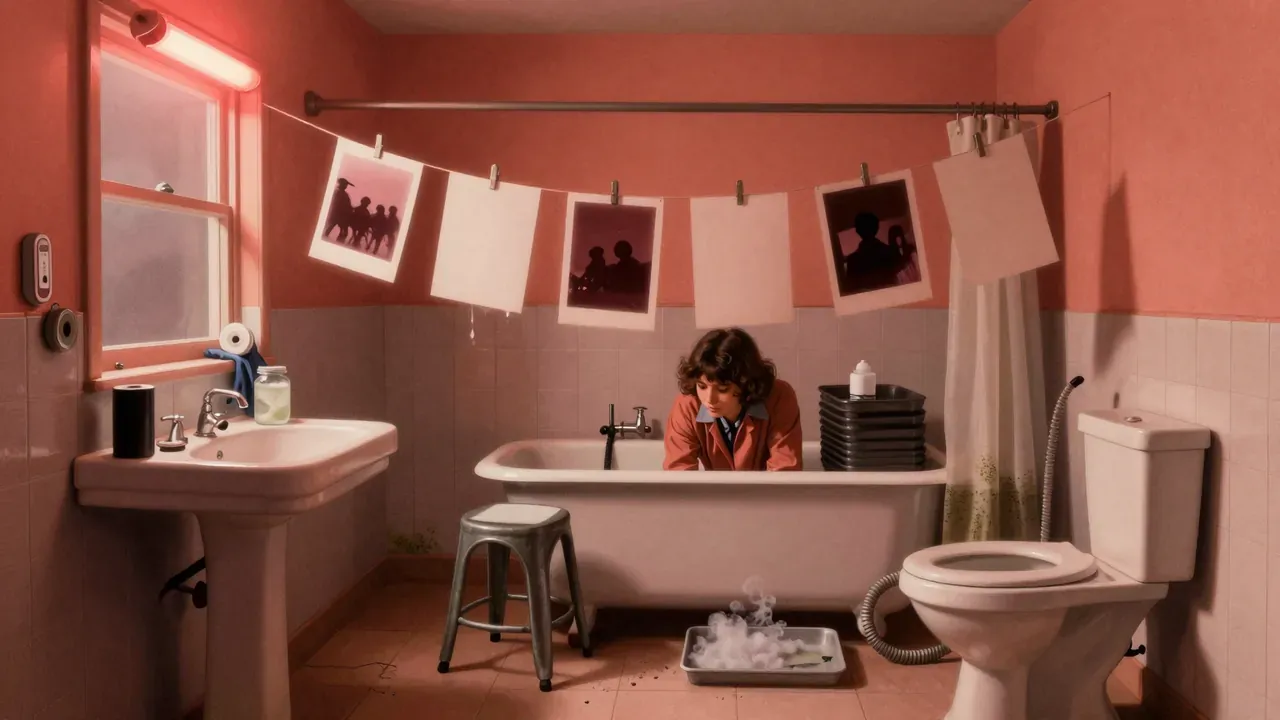
The moment Anne moves out
Girlfriends is a 1978 American comedy-drama about Susan Weinblatt, a Jewish photographer living on Manhattan’s Upper West Side, whose sense of self unravels when her roommate and best friend Anne moves out to marry. It is not a film about crisis in the conventional sense — there are no breakdowns, no betrayals, no plot turns that pivot on revelation or violence — but about the quiet erosion and reassembly of identity amid ordinary pressures: financial strain, creative doubt, romantic missteps, and the slow recalibration of friendship after life paths diverge. Claudia Weill, directing her first feature, works from Vicki Polon’s script with a documentary-trained eye for behavioural truth and social texture. The film treats its milieu — late-1970s New York, specifically its young, secular, urban Jewish intelligentsia — not as backdrop but as architecture: the rhythms of bar mitzvahs, gallery openings, tequila shots at 11 p.m., and conversations that loop between affection and accusation are all structural. Its ambition is modestly radical: to hold sustained attention on a woman’s interior life without recourse to melodrama or myth-making. Word count: 148
The look of it
The story unfolds episodically, following Susan across eighteen months as she navigates freelance photography, a crush on a rabbi, an ill-fated cohabitation with a hitchhiker, and the long lead-up to her first solo exhibition. Melanie Mayron carries the film with a performance that avoids both neurotic caricature and stoic idealisation; her Susan is watchful, wry, intermittently self-sabotaging, and never less than credible in her contradictions. Bob Balaban and Christopher Guest appear in supporting roles that ground the film’s tone — dry, precise, lightly ironic — without tipping into satire. Fred Murphy’s cinematography favours natural light and shallow focus, keeping interiors softly lit and exteriors unvarnished; Michael Small’s score is sparse, mostly piano-based, and never cues emotion. Editing is unhurried, often holding on reaction shots longer than expected, allowing silences to settle. The pacing reflects the production’s reality: shot over a year in fragments, it bears the rhythm of lived time rather than narrative urgency. Word count: 152
What stays with you
What lands is the fidelity to small emotional truths: the way Susan’s voice tightens when she lies about her gallery prospects, the physical awkwardness of her kiss with Rabbi Gold, the exhaustion in her face when she photographs yet another bar mitzvah, the specific weight of Anne’s absence in their shared apartment. The film’s strongest scenes are those built on subtext — Susan and Anne’s final confrontation in the countryside, where dialogue skirts around abortion, resentment, and fear of abandonment without naming them outright; or Susan’s meeting with the gallerist, where ambition and insecurity flicker across her face in equal measure. The Upper West Side feels inhabited, not curated: laundry hangs from fire escapes, apartments are cluttered but not stylised, conversations overlap and trail off. Even minor characters — Ceil the hitchhiker, Martin the husband, Eric the boyfriend — register as individuals rather than functions. The film’s warmth comes not from sentimentality but from its refusal to simplify motive or resolve tension too neatly. Word count: 156
Where it wanders
What does not land is the structural looseness that borders on drift. Several sequences — Susan’s brief entanglement with Ceil, her flirtation with Rabbi Gold — introduce threads that resolve without consequence or thematic return. The film’s episodic form works only so long before the connective tissue thins; by the final third, momentum relies more on character consistency than forward propulsion. Some performances feel under-rehearsed or under-directed: Jane Anderson as Anne occasionally slips into affectation, and Russell Horton’s Martin lacks the grounded presence needed to anchor his role as mediator. The script’s dialogue, while often sharp, sometimes leans on exposition that would have been better implied — particularly in scenes explaining Susan’s artistic ambitions or Anne’s marital dissatisfaction. There is also a slight tonal inconsistency between the film’s observational realism and its occasional leaps into near-farce, such as Susan’s scamming her way into a gallerist’s office. These moments don’t break faith with the film’s world, but they do momentarily unsettle its gravity. Word count: 154
What it’s really about
The themes that matter are loneliness as a condition rather than a symptom, friendship as a practice requiring continual renegotiation, and autonomy as something fragile, expensive, and often mistaken for isolation. The film treats creativity not as vocation but as labour — Susan shoots weddings because she must, not because she chooses to, and her ‘art’ emerges only after years of grinding technical work and rejection. It also examines how gendered expectations persist even among women who reject them: Susan’s insistence on keeping her own apartment is read as stubbornness by Eric, as selfishness by Anne, and as maturity by no one — including herself. Judaism appears not as doctrine but as cultural texture: food, humour, speech patterns, familial expectation — a context, not a subject. The film’s historical significance lies partly in its timing: made just before the Reagan era’s retrenchment, it captures a moment when urban independence felt possible, provisional, and deeply personal. Word count: 152
Who it’s for
It is for viewers who value behavioural precision over plot mechanics, who find resonance in pauses and glances, and who accept that a film can be about the space between decisions rather than the decisions themselves. It suits those familiar with or curious about 1970s New York, American Jewish urban life, or the aesthetics of low-budget 1970s independent cinema. It is not for viewers who require clear narrative arcs, defined stakes, or cathartic resolution — those who expect Susan’s gallery show to represent triumph, or her relationship with Anne to culminate in reconciliation, will leave unsatisfied. Those who dislike films where characters speak over each other, where endings resist closure, or where the camera lingers on empty rooms may find it listless. A viewer who values pace above psychological fidelity would likely disengage early. Word count: 150
Why it holds
Yes, it is worth your evening — not as escapism, but as calibration. It offers a rare portrait of female interiority that neither flatters nor pathologises, and its restraint feels deliberate, not deficient. Its value increases with attention: the second viewing reveals how much is withheld, how carefully performances modulate between irony and vulnerability, how the city itself functions as counterpoint. It is not for everyone — those who prefer tightly wound narratives or emotionally declarative performances will find it thin. But for those willing to sit with its quiet rhythms, it repays patience with cumulative emotional weight. Its 86-minute runtime is neither rushed nor padded; it occupies its duration honestly. To call it ‘small’ is accurate, but misleading — its scale is human, not diminutive. Word count: 149