The route it takes
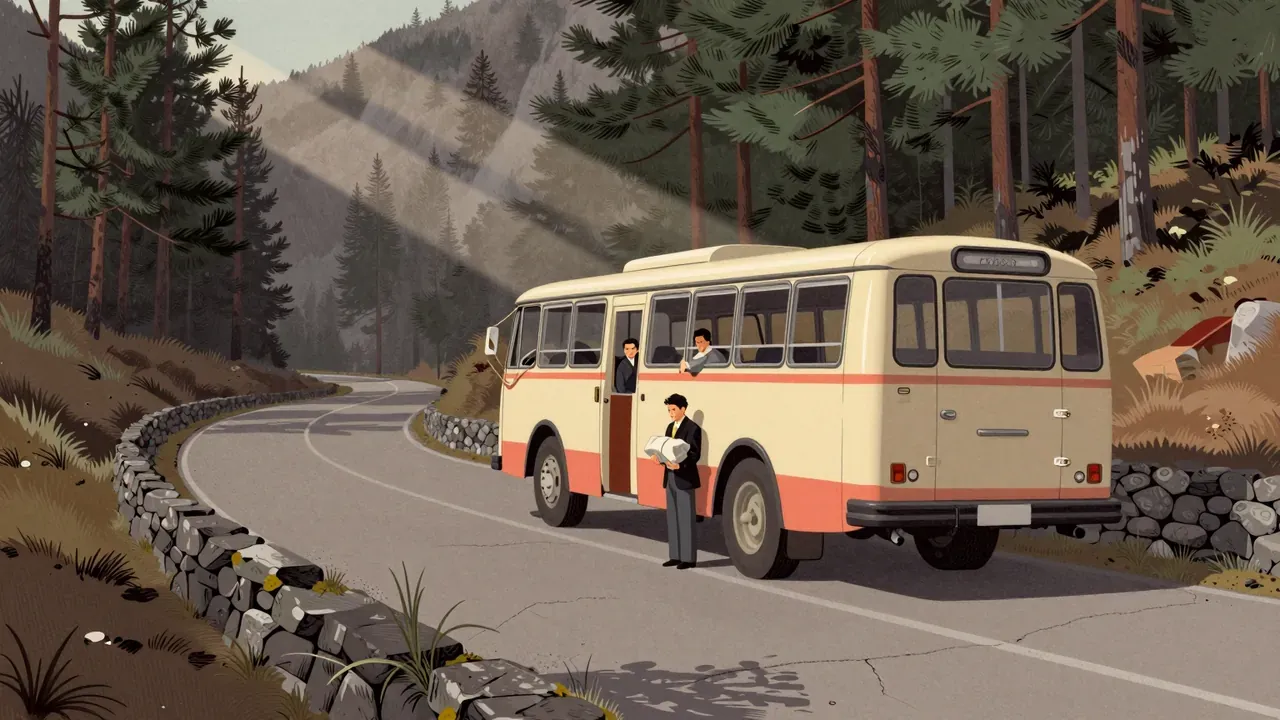
Mr. Thank You is a 1936 Japanese drama built around a bus journey from rural Izu to Tokyo, using movement through landscape and shifting human encounters as its structural principle. It does not aim for narrative density or psychological exposition but instead sustains a quiet observational rhythm, treating each passenger as a node in a wider social field shaped by poverty, migration, and unspoken obligation. The film adapts Yasunari Kawabata’s 1925 short story ‘Thank You’, expanding its narrow focus on a mother and daughter destined for sale into a broader cross-section of depression-era mobility — including a Korean woman arranging her father’s funeral and a returning Tokyo migrant’s daughter. Shimizu’s intention is neither satire nor polemic but a patient, almost ethnographic registration of how people carry their circumstances: in posture, silence, brief exchanges, and the physical fact of shared transport. It treats the bus not as a plot device but as a mobile public sphere — temporary, contingent, and morally porous.
The way people hold themselves
The story unfolds episodically, with little cause-and-effect propulsion: passengers board and alight; conversations begin and trail off; landscapes shift without commentary. Ken Uehara plays Mr. Thank You with minimal inflection — his gratitude is habitual, not performative — and Michiko Kuwano’s woman in the black collar registers grief and reserve in stillness rather than speech. Isamu Aoki’s cinematography favours medium distances and shallow focus, keeping faces legible but surroundings softly defined; light falls evenly, avoiding chiaroscuro or symbolic emphasis. Shimizu avoids studio sets: location shooting in Izu’s winding roads and roadside inns grounds the film in tangible topography. There are no musical cues, no dramatic scoring — only ambient sound and pauses long enough to register breath. Performances are understated to the point of withholding, consistent with Shomin-geki tradition, where class and constraint limit expressive range. The writing leaves gaps — motivations unstated, outcomes ambiguous — trusting the viewer to infer weight from gesture and context rather than exposition.
What stays after the engine stops
What lands is the cumulative texture of endurance: the way a mother’s hand rests on her daughter’s shoulder, the precise angle at which a Korean woman folds her hands while speaking of burial costs, the repeated tilt of the bus driver’s head as he thanks another vehicle. These moments accumulate not as emotional crescendos but as quiet confirmations of shared vulnerability. The film’s restraint becomes its moral grammar — refusing melodrama when depicting trafficking, refusing pity when showing labour migration. Its location work gives the journey physical credibility: steep gradients, narrow lanes, unpaved shoulders, the way sunlight hits pine trunks at mid-morning. Even minor characters register as fully inhabited — the bearded gentleman’s weary courtesy, the girl’s silent watchfulness — because their presence is anchored in space and duration, not function. The ending, in which Mr. Thank You marries the girl, lands not as romantic resolution but as a pragmatic, slightly hollow act of deflection — one more transaction in a system that offers few exits.
Where the frame won’t stretch
What does not land is the attempt to stretch Kawabata’s tightly focused original into a broader social panorama. The added characters — particularly the daughter of the man returned from Tokyo — lack the narrative or emotional weight to sustain their inclusion; their scenes feel illustrative rather than integrated, sketching types rather than deepening the film’s central concerns. The marriage resolution sits uneasily: it arrives without sufficient groundwork in mutual recognition or desire, functioning more as a narrative stopgap than an earned turn. Shimizu’s refusal to dramatise interiority works against itself in moments requiring moral clarity — the mother’s complicity, the girl’s ambivalence — leaving them flattened rather than enigmatic. The film’s evenness of tone occasionally blurs ethical distinctions: the Korean woman’s grief and the mother’s resignation occupy the same tonal register, diluting the specific violence of filial sale. Some viewers will find this ambiguity principled; others will read it as evasion.
The language of the road
The themes that matter are mobility as exposure, gratitude as social lubricant, and consent as a luxury withheld by circumstance. The bus is both vehicle and microstate — governed by unspoken rules, vulnerable to breakdown, dependent on cooperation from strangers. Mr. Thank You’s repeated ‘arigatō’ is less politeness than ritual maintenance: a verbal handrail on unstable ground. The film treats economic precarity not as backdrop but as architecture — shaping who travels, how far, with whom, and under what conditions. Colonialism enters obliquely, via the Korean woman’s marginal status and her need to negotiate funeral rites across linguistic and bureaucratic borders. Gender operates as constraint: women move only when chaperoned, sold, mourned, or married — agency limited to small refusals or quiet compliance. Time is measured not in clocks but in gradients climbed, stops made, fare collected. There is no utopian horizon — only the next bend in the road, the next passenger, the next unspoken bargain.
Who it is for, and who it isn’t
This film is for viewers who value sustained attention to behaviour over exposition, who find meaning in compositional balance and temporal rhythm, and who accept that social critique need not shout to be sharp. It rewards patience with texture, not payoff. It is not for those who require narrative momentum, psychological revelation, or moral signposting — viewers expecting clear villains, catharsis, or redemptive arcs will find it withholding, even evasive. Those familiar with 1930s Japanese cinema may recognise its affinities with contemporaneous Shomin-geki, but newcomers might mistake its stillness for inertia. A change in verdict would follow tighter integration of secondary characters or a more rigorously ambiguous ending — one that resists the marriage solution entirely. Without that, the film remains compelling but incomplete in its social vision.
Is it worth your evening
Yes, it is worth your evening — provided you approach it as a study in restraint, not a story with closure. Its seventy-six minutes pass without hurry, yet never slacken; every shot serves the film’s quiet insistence on presence over plot. It repays close watching: the way light shifts on a bus window, how a character’s hands move before they speak, the difference between a pause that signifies thought and one that signals exhaustion. Those who dislike films that refuse to explain themselves, or who expect historical context to be narrated rather than embodied, will leave unsatisfied. But for viewers attuned to the eloquence of the unemphatic — to what a glance or a road sign can imply about power, distance, or dignity — it remains singular. Its value lies not in what it resolves but in how precisely it holds open a moment of collective uncertainty, unresolved and real.