The look of it
Umberto D. is a neorealist film made in Rome in 1952, set among the crumbling tenements and municipal hospitals of post-war Italy. It follows Umberto Domenico Ferrari, a retired civil servant, as he tries to hold on to his room, his dignity, and his dog Flike amid mounting rent arrears, social indifference, and physical frailty. The film does not aim to dramatise crisis but to register its quiet accumulation: the weight of unpaid bills, the silence after a refused loan, the gap between a man’s self-perception and how others see him. It avoids exposition, symbolism, or narrative escalation. There are no villains, only structural pressures — a landlady needing money, a maid with uncertain paternity, a hospital system that admits and discharges without inquiry. Cesare Zavattini’s script treats poverty not as a condition to be overcome but as a persistent fact, observed without judgment and without recourse to uplift. The film’s ambition is narrow and exact: to show what it feels like to be old, poor, and unremarkable in a society that has moved on.
How it holds its breath
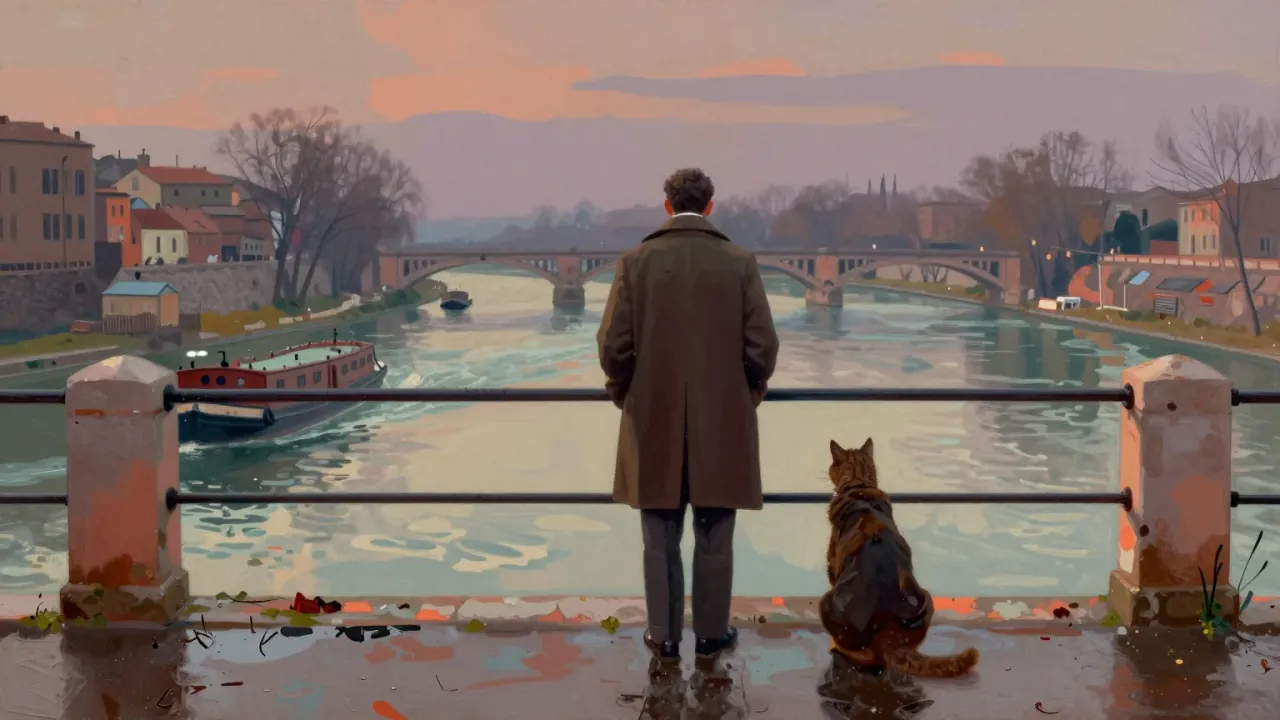
The story unfolds in chronological order, with few digressions and no flashbacks. Carlo Battisti, a non-professional actor and retired university lecturer, plays Umberto with minimal inflection — his face registers fatigue before his voice does, his pauses last just long enough to unsettle. Maria-Pia Casilio, also non-professional, gives Maria the maid a guarded warmth; her confession about her pregnancy is delivered without emphasis, as if rehearsed in private. G.R. Aldo’s cinematography keeps interiors dim and grainy, favouring medium shots that frame bodies within doorways or behind half-drawn curtains. Eraldo Da Roma’s editing avoids rhythm or punctuation: scenes end when action ends, not when emotion peaks. Alessandro Cicognini’s score is sparse — a piano motif recurs, but often drops out entirely for minutes at a time. Virgilio Marchi’s sets are not stylised but lived-in: cracked plaster, mismatched furniture, laundry lines strung across courtyards. There are no establishing shots of Rome; the city appears only through bus windows, hospital corridors, or the iron railings of a footbridge.
What gathers weight
What lands is the cumulative pressure of small failures: the watch sold for too little, the dog slipping through an open door, the train approaching as Umberto stands still. These moments do not build to catharsis but to a kind of recalibration — the final park sequence works because it refuses resolution. Umberto does not find work, win sympathy, or secure housing; he simply resumes play, tentatively, with Flike. The film’s empathy is procedural, not emotional: it earns our attention by refusing to flatter, simplify, or moralise. The hospital scenes avoid pathos by treating illness as bureaucratic procedure — Umberto signs forms, waits, is told to return. Even the eviction threat is delivered without shouting, just a glance at the calendar and a sigh. The dog is never anthropomorphised; his loyalty is shown in movement — tracking Umberto across cobbles, pressing against his leg, retreating then circling back. This restraint makes the few gestures of connection — a shared cigarette, a hand placed briefly on a shoulder — feel earned, not imposed.
Where it lets go
What does not land is the subplot involving Maria’s pregnancy. It is introduced with care but remains underdeveloped, its stakes unclear beyond thematic echo: like Umberto, she is caught between dependence and autonomy, but her arc resolves off-screen, with no visible consequence. The landlady Antonia Belloni is more functional than felt — her motivations stay opaque, her resentment unexamined beyond financial need. A few scenes drift into repetition: Umberto’s visits to potential dog-keepers follow near-identical beats, differing only in setting. The hospital sequence, though grounded, stretches longer than its dramatic weight warrants, its clinical tone occasionally flattening tension rather than deepening it. The film’s commitment to austerity means some emotional textures go unarticulated — we infer Umberto’s shame, but rarely see its physical manifestation beyond posture and silence. That choice is deliberate, but it leaves certain relationships — particularly with the landlady — feeling schematic rather than lived. The film assumes a viewer already attuned to its register; those expecting psychological exposition or moral framing may find it withholding.
What it keeps close
The themes that matter are ageing without infrastructure, dependency without reciprocity, and dignity as a daily practice rather than a status. Umberto’s struggle is not against poverty per se but against erasure — the way institutions, landlords, and even friends stop seeing him as a person with history, preference, or agency. His relationship with Flike is not sentimental but practical: the dog anchors him in routine, provides a reason to walk, to feed, to wait. The film treats care as labour, not virtue — Maria cleans, cooks, and hides Umberto’s distress; Umberto watches her, offers advice, remembers her name. Class is present not as ideology but as habit: the landlady’s new husband wears a suit; Umberto’s coat is frayed at the cuffs; the hospital patients wear slippers with holes. There is no nostalgia for pre-war Italy, no critique of fascism or celebration of resistance — the past is simply absent, replaced by the immediate arithmetic of rent, medicine, and transport fares. The film’s quietest theme is endurance as repetition: getting up, walking, returning, trying again, even when the outcome is known.
Who it meets halfway
This film is for viewers who value precision over propulsion, observation over explanation, and restraint over revelation. It suits those accustomed to slow cinema, to non-professional acting, and to narratives where the central character’s interiority is conveyed through gesture, not monologue. It is not for viewers who require plot momentum, clear antagonists, or emotional payoff — those expecting redemption, justice, or even closure will find none. Some may object to its unrelenting gravity, its refusal to offer irony or relief; others may find its politics too implicit, its critique too diffuse. A viewer who values historical context over psychological depth, or who finds meaning in the unsaid, will respond differently than one who seeks narrative clarity or moral certainty. The film’s value lies in its fidelity to a specific social reality — change that reality, and the film’s force changes too.
What it leaves with you
Yes, it is worth your evening — not as diversion but as calibration. Its ninety-one minutes ask you to adjust your sense of pace, scale, and significance: a dropped coin, a delayed bus, a dog’s whimper become events of weight. It rewards attention not with spectacle but with consistency — every shot, performance, and edit serves the same unembellished register. Those who watch it expecting entertainment may leave restless; those who watch it as study will find it exacting and clarifying. It is not demanding in technique — there are no complex cuts or layered scores — but in patience. Its power accumulates slowly, like debt or fatigue. To dismiss it as ‘depressing’ mistakes its purpose: it is not about despair but about presence — the stubborn, unglamorous act of remaining visible in a world that has stopped looking. That makes it neither easy nor optional, but necessary for anyone who wants to understand how cinema can hold space for lives usually left off-screen.